• About
  • History Writings

Water and Me

Water and Me

Tag Archives: glass plate negatives

The Conduit from Loch Raven (aka my favorite workers GPN)

08 Wednesday Jun 2016

Posted by Ronald Parks in Baltimore, water history

≈ Leave a comment

Tags

Baltimore, engineering, glass plate negatives, Gunpowder Falls, HISTORY, Lake Montebello, photography, Public Works, water history

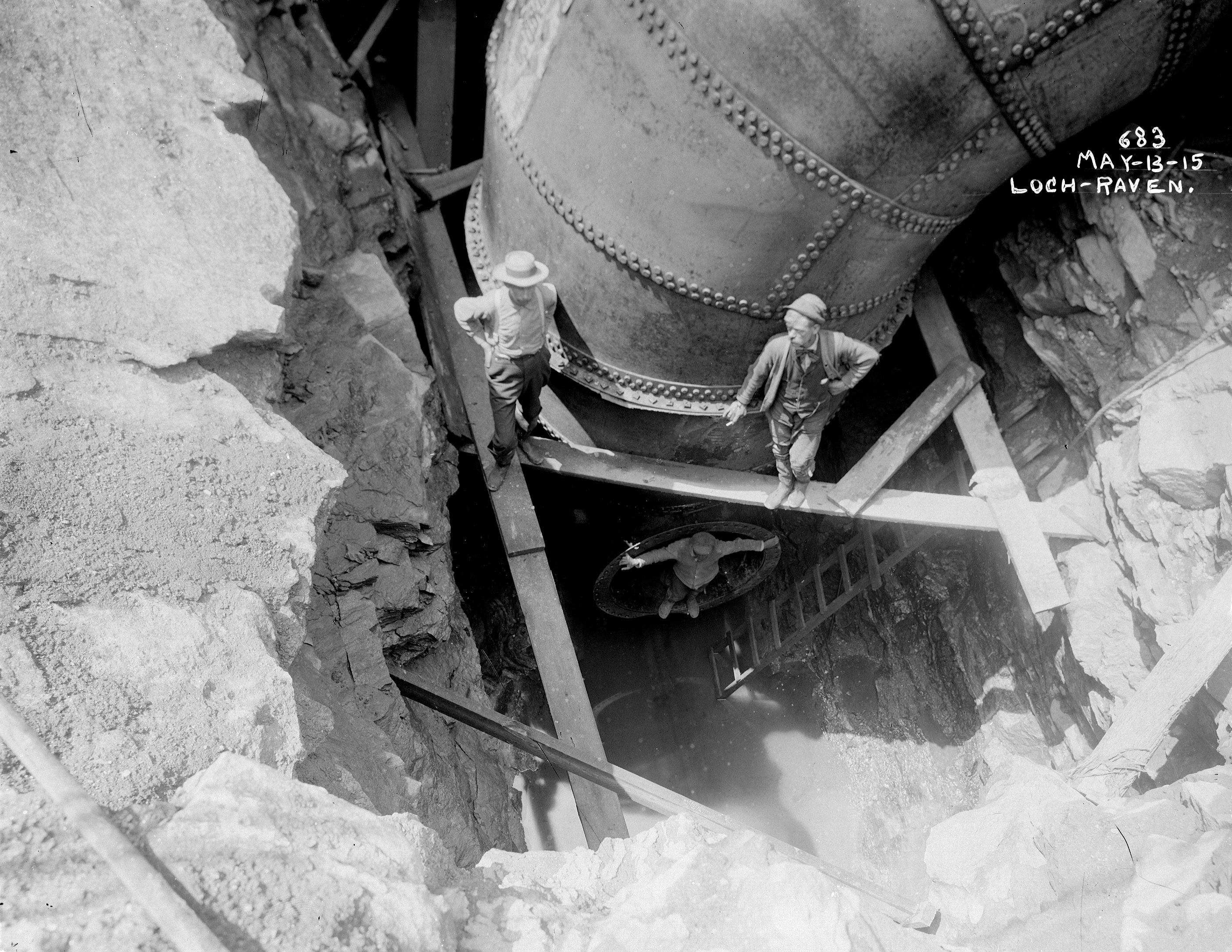
Since I started scanning and documenting the huge collection of Glass Plate Negatives (GPN) at work, there has always been a few that really caught my eye and became my favorites. Such being the one below. I would take the 8″ x 10″ GPN out of its falling apart sleeve, hold it up to the light and see what it was and in which collection it belonged. Most of these negatives were in the original boxes. Some not, just thrown into other boxes. I had to take a second look at this one. Is that a foot I see? I scanned it and blew it up and it sure does look like a foot! And a couple of workers taking a smoke break.

The original 1881 tunnel from the first dam to Lake Montebello was dug through rock. The new dam of 1915, just upstream from the old dam, was connected to the old tunnel by a steel conduit. The second picture below shows the steel conduit dropping down to meet the old one.

LochRaven 5-15 686a copy

I enlarged the center section and superimposed onto the corner.

LochRaven 5-15 683

Workers posing, which makes me wonder how much work would slow down if the cell phone/selfie was around back then?

Dumps and Incinerators

21 Thursday Apr 2016

Posted by Ronald Parks in Baltimore, HISTORY, Sewage History

≈ Leave a comment

Tags

Baltimore, engineering, garbage, glass plate negatives, Health, HISTORY, Jones Falls, POLITICS, Public Works, sewage, Sewage History, water history

In the 1884 Street Cleaning report are listed the following five dumps: Canton, Spring Garden, Back Basin, Eager St. and South Baltimore. By the 1920s, Baltimore was burning its garbage at two incinerators. One at Sisson and 28th street. The other on Philadelphia road. What does this have to do with sewage? Both places are on streams. Sisson street on Jones Falls, which still has a household hazardous waste collection site (original building appears to be gone). And Philadelphia road, as seen in the one photo below dumped right into Herring Run, which empties into Back River then on to the Chesapeake Bay. These photographs come from glass plate negatives that were broken due to improper storage. If you have GPNs, handle them with care.

img008r

The horse drawn cart was replaced by the modern dump truck. Here they are backing into the Sisson Street Incinerator, also known as #1 incinerator.

img002r

Instead of just piling the refuse into a dump, hoping somehow it would disappear, the garbage was sorted and then burned. #2 Incinerator on Pulaski Highway.

img010r

Pulaski Highway #2 Incinerator showing how any liquids and washed down materials were dumped into Herring Run. And yes, there use to be Herring in that stream.

Pumps at Eastern Ave Pumping Station 1906-1960

30 Wednesday Mar 2016

Posted by Ronald Parks in Baltimore, Sewage History

≈ Leave a comment

Tags

Baltimore, engineering, glass plate negatives, HISTORY, Jones Falls, Public Works, sewage, Sewage History

Pumping Station: The land for a pumping station, located at East Falls and Eastern Ave was acquired by arbitration. The contract for the construction of pumps and machinery was awarded to the lowest responsible bidder, on December 10, 1906, to the Bethlehem Steel Co. of Bethlehem, Pa. for $450,000.

Six Years Operation of the Baltimore Sewage Pumping Station by Keefer. 1915-1923 (From Public Works July 1924) At the present time there are only a few sewage pumping stations in this country equipped with vertical triple-expansion pumping engines. One of these is the Eastern Avenue Pumping Station. The design of this station started in 1906; construction work was begun in 1907, and it was put in operation on January 31, 1912. Since then the station has operated continuously and has given excellent service.

br010r

This photograph was taken soon after the original pumps were installed, showing Calvin Hendrick, engineer. The three sewage pumping engines now under contract will weigh 4,000,000 pounds or more. They will develop about 400 H. P. each when running at full normal load, and about 1,000 pounds of coal an hour will be burned under the boilers, on an average, when the plant now under contract is running at the designed capacity. Of the three engines included in this contract it is intended that one shall be always held in reserve, other engines being added as may be necessary to make this possible.

img021

From an undated photo, showing one of the newly installed centrifugal pumps. At the Eastern Ave. PS, since its installation, essentially all the incoming sewage was handled by the new 40mgd centrifugal sewage pump, the old reciprocating steam-driven pumps being used for standby purposes. Photograph found at the DPW Museum, in a box of fire and water damaged albums.

img031

1960 the new pumps.

Discharge Into River

18 Friday Mar 2016

Posted by Ronald Parks in Baltimore, Sewage History

≈ Leave a comment

Tags

Baltimore, boats, engineering, glass plate negatives, Health, HISTORY, photography, Public Works, sewage, Sewage History

The sewage of Baltimore City is pumped to the sewage plant at Back River in Baltimore County, where it is ‘cleaned’ and then discharged into the river. Interesting fact about the below photos from a 1955 report is this – “A number of leaks were repaired in the wood stave discharge pipes by a diver. The pier at the river, which had been damaged by hurricanes was rebuilt.”

As the photographs from the early 1900s show, the discharge pipes are above the water? So were they lowered into the water after assembly? That seems unlikely as there are hundreds of adjusting bolts holding the pipes into the air? Maybe I will find the answer one day in the many reports still to be read…

img013-3172 img014-3190 img016-3753 img162

Low Level Interceptor

17 Thursday Mar 2016

Posted by Ronald Parks in Baltimore, Sewage History

≈ Leave a comment

Tags

Baltimore, engineering, glass plate negatives, Health, HISTORY, Jones Falls, Public Works, sewage, Sewage History

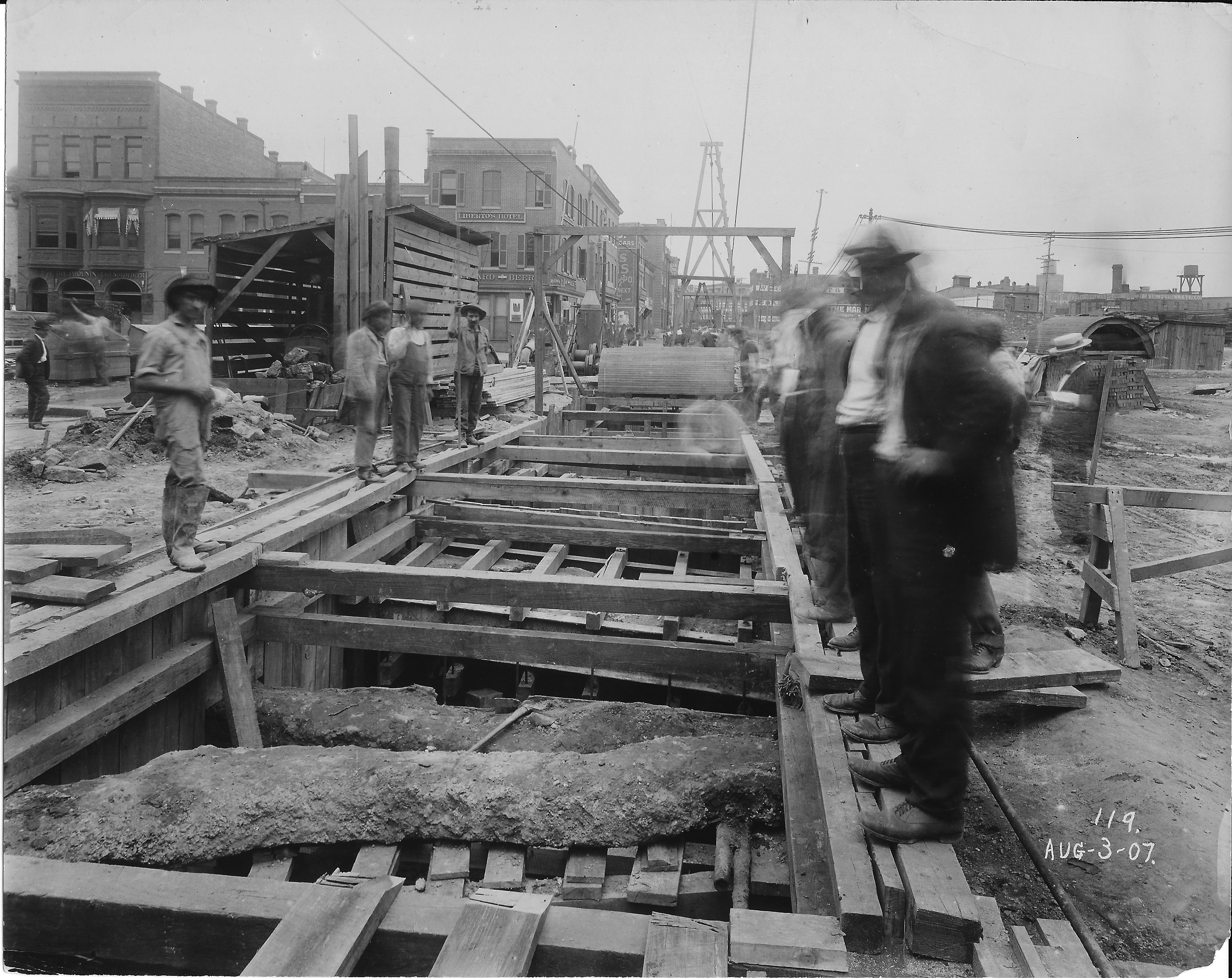
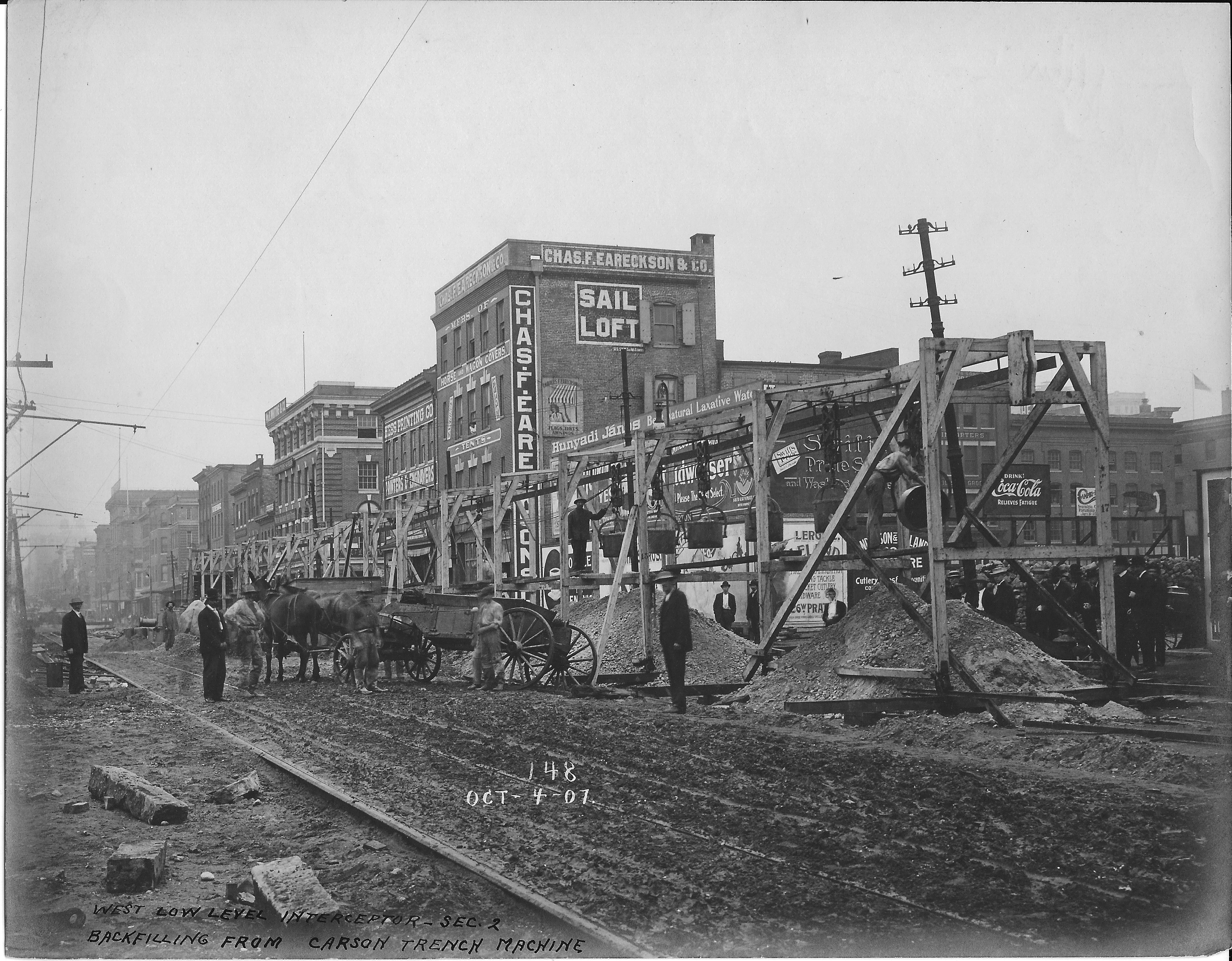
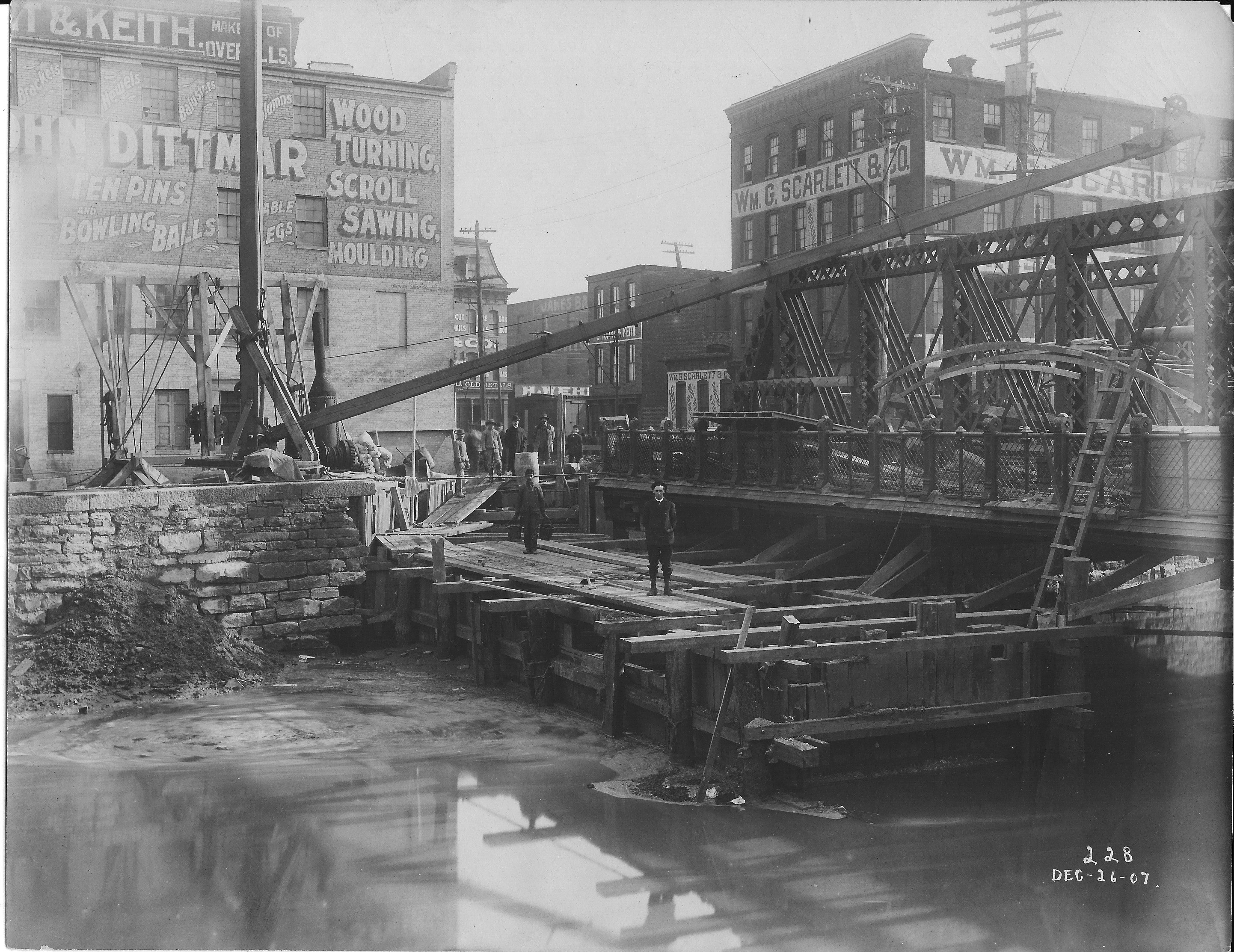
Report of the Low Level Division, Kenneth Allen, Engineer: Section One begins at the Sewerage Pumping Station at President St and Eastern Ave. and extends through President street to Pratt street, and thence westerly to Center Market Space, crossing under Jones Falls on the north side of the Pratt street bridge. General notes on construction. The excavation in general was through a dark material containing particles of sand which appears to be a compacted deposit of mud, with clay, sand, fullers’ earth, gravel and quicksand in places. Gravel was usually found at or near sub-grade, and where this or other firm material was absent the material was excavated and refilled with gravel. Near Pratt street and West Falls avenue, where the depth to sub-grade was some 23 feet, a fine running sand was encountered above sub-grade, which made progress slow and difficult. Previous to excavation, the corner of the four-story brick dwelling on the corner of West Falls avenue was hung by 5 sets of needle beams and twenty 8-ton jacks. Section Two: This section extends from Pratt street and Center Market Space to Pratt and Light streets. The diameter of the sewer is 74 inches throughout the section.

005-119Section #1 Center Market Place showing supports to conduits in foreground and supports to large conduits leading to United (?) & Electric company Power House.

009-148

Section #2 Backfilling from Carson Trench Machine.

016-228

Section #1 Cofferdam for going under the Jones Falls at Pratt Street.

Testing Plant

25 Thursday Feb 2016

Posted by Ronald Parks in HISTORY, Sewage History

≈ 2 Comments

Tags

Baltimore, engineering, FILTRATION, glass plate negatives, HISTORY, Jones Falls, sewage, water history

1906 – Before building a complete, City-wide sewerage system, a Testing Station was built to figure out the best means of treatment.

At Hampden and Walbrook, surveys were made and every house located, and in each place a plan for a comprehensive sewerage system was made. As a result of these studies Walbrook was selected as offering the most advantages.

Establishment of experimental testing station at Walbrook: In accordance with the Chief Engineer’s recommendation, the Commission on June 14th, 1906 authorized the erection of an experimental Testing Station. On October 2nd sufficient land was secured, without charge, from the Walbrook Land Corporation for the site of the Testing Station, for a period of seven years. On October 10th the contract for the erection of this testing station was awarded to the lowest responsible bidder, Malcolm W. Hill Company of Baltimore, Md., at their bid of six thousand, nine hundred and thirty dollars and forty-seven cents ($6,930.47). The contract for the Laboratory Building in connection with the Testing Station was awarded to the lowest responsible bidder, Wm. Kirkpatrick, of Baltimore, Md., on October 18th, at his bid of three thousand, seven hundred and fifty dollars ($3,750.00). The contract for the permanent sanitary sewers which will lead to the Testing Station was awarded to the lowest responsible bidder, M. A. Talbott & Company, of Baltimore, Md., on October 29th, at their bid of thirty-three thousand, two hundred and thirty dollars and ninety-eight cents ($33,230.98).

1907 – “Sir: In obedience to the requirements of Section I, Chapter 349, of the Acts of the General Assembly of Maryland for 1904, this Commission has the honor to make a report of its official transactions for the year 1907.” The first sanitary sewers to be constructed were those in Walbrook for the drainage of houses embraced within a prescribed area, and which were constructed as auxiliary to the experimental testing station, as part of the permanent system. Work on outfall sewer and interceptors was begun. There was criticism as to the size chosen for the sewers, but the Commission stuck to the plans of the advisory engineers: Rudolph Hering, Samuel Gray and Frederick Stearns.

These photos show constructing the Testing Station and Lab. Also the sprinkling filters.

81_6_56 81_6_159 img041

1908 sewage map walbrook

Here is the only reference I could find concerning the exact location of the Testing Plant.It comes from the Johns Hopkins Sheridan Library. I cut it down in size for viewing here. The location is never mentioned in any of the Annual Reports other than “Walbrook”. The testing plant is represented by the two circles at the bottom of the dark lines, just above Patterson Ave.

From Sewage Commissioner’s Report: The sewage testing part of the laboratory has been closed for a number of months, but the testing of all materials for construction work is being carried on, which has proved of great value in getting desired results. The plant is continuing to receive and purify the sewage carried to it from the system of sewers throughout Walbrook. On account of the disposal plant being operated by gravity, the cost of maintenance is reduced to a minimum.

Debate: Gatehouse vs Valvehouse

08 Sunday Mar 2015

Posted by Ronald Parks in Baltimore, HISTORY

≈ Leave a comment

Tags

Baltimore, engineering, FILTRATION, glass plate negatives, Gunpowder Falls, HISTORY, Lake Clifton, Lake Montebello, Montebello, photography, valve house, water history

Since starting my research in a museum archives, I’ve found quite a few discrepancies in the labelling of photographs and negatives. Some archival boxes were marked as Loch Raven Construction – 1909 (Which didn’t start until late 1912. These photos were actually the building of Lake Ashburton). Then there are the glass plate negatives marked as Loch Raven 1875-1881. A few of these are of Lake Montebello and Clifton. This is ok only because I know they are from a group known as the “permanent supply”, they belong together. But my problem is that somewhere along the timeline known as “History” someone decided to call the gatehouses ‘valve houses’ Why?? I do not understand the intent of changing the engineer’s designation of a structure from gatehouse to valve house? The drawings I have along with engineer’s reports all call these structures Gatehouses. Who changed it? Would it be alright to call one of Baltimore’s Little Tavern Restaurants – Small Bar Restaurants? Hell no! Words mean the same but they aren’t. You go to a small bar to get drunk – you go to the Little Tavern for their bags of hamburgers!!

I recently found a photograph of one I already have, that was mislabeled. Below is the photo from a glass plate , the other is from a framed photo that hung in the engineer’s office (Bottom Photo from 1894). The framed one clearly calls the Clifton Gatehouse a gatehouse, not a valve house – Stop the insanity and call it what it is!!!

Plate482

From a mislabeled GPN saying this is Loch Raven


IMG_1254

Framed photograph clearly marked as Gate House at Lake Clifton


Eng 5-94

Engineer Kenley’s office, 1894 with framed photographs hanging on the wall.


Newer posts →

Blogroll

  • Flouride Action Network
  • lulu
  • My Book
  • WordPress.com
  • WordPress.org

Recent Posts

  • Bermuda 2023
  • ICELAND April 2023
  • George Chalmers of Fochabers
  • In Search of The Skipjack Ada Mae
  • Trap Pond Kayak

Blog at WordPress.com.

  • Subscribe Subscribed
    • Water and Me
    • Join 231 other subscribers
    • Already have a WordPress.com account? Log in now.
    • Water and Me
    • Subscribe Subscribed
    • Sign up
    • Log in
    • Report this content
    • View site in Reader
    • Manage subscriptions
    • Collapse this bar
 

Loading Comments...