• About
  • History Writings

Water and Me

Water and Me

Tag Archives: water history

200th Blog

20 Friday Oct 2017

Posted by Ronald Parks in water history, Writing

≈ 8 Comments

Tags

Baltimore, engineering, FILTRATION, fluoride, glass plate negatives, Gunpowder Falls, HISTORY, Loch Raven, Montebello, Public Works, water history, writing

My WordPress Dashboard tells me that this is my 200th blog post. So, since my blog is called Water and Me, maybe I should write something about water? Trying to think of something profound or water history worthy! I know – Don’t Drink The Water!!!

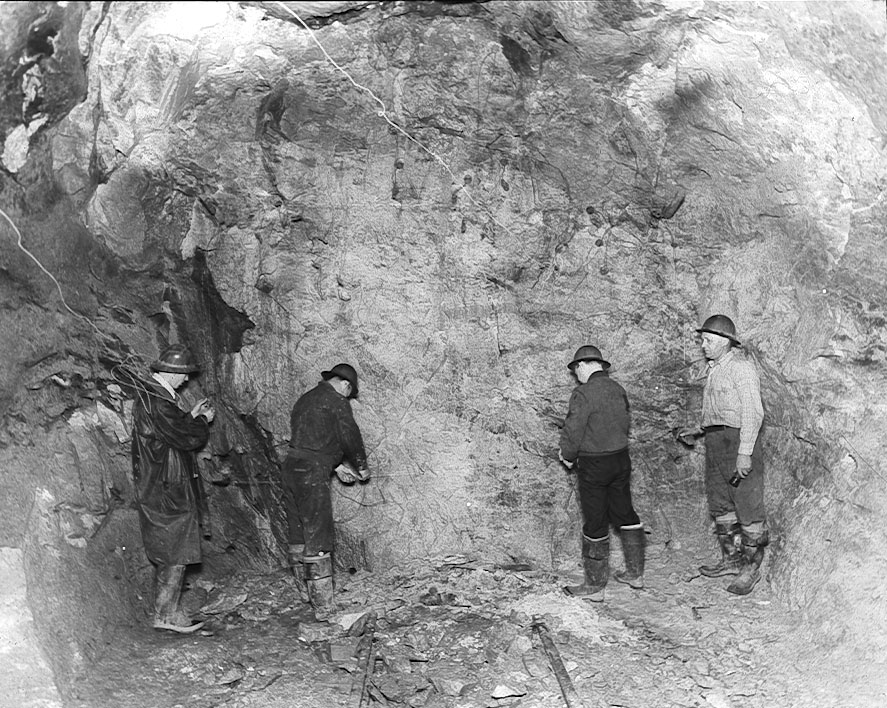
In 2006 I started writing about water history, doing research and then eventually writing a small book, mostly on one of the water tunnels that supplies water to the Montebello Filters. Here is the Lantern Slide I saved from the dumpster, that started it all:

This is what I had to say about it in my book: “While working with one of the lantern slides, I noticed something odd, that in a tunnel, where workers were excavating, there were train tracks that came to a dead end under what looked like a giant boulder. This particular slide came from a box from around 1938, so I asked Richard if he had any information on an event of that year that was of interest. Sure enough, he showed me the Annual Report covering the year 1938 where it was reported that an explosion had occurred in the building of the Gunpowder Falls Montebello Tunnel. This notation in the report was only about a half a paragraph long, nothing more than a blurb, so I decided to investigate it further.” And I have been investigating water history ever since. Ten men were killed in this explosion and it was just a blurb in a report!

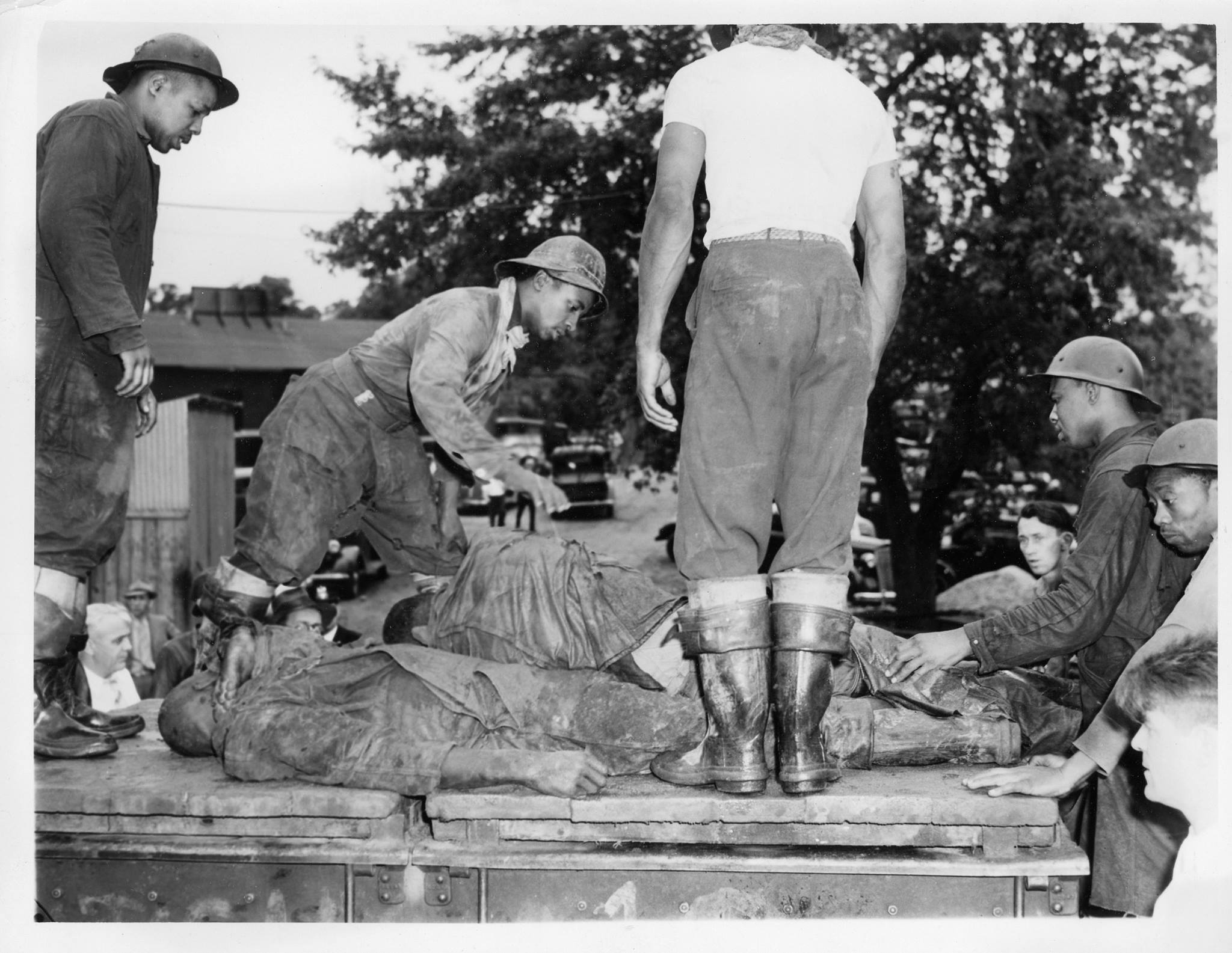
After years of refining my skills at research, I came across so much more information on this explosion. It is amazing what you can find these days on the internet. I found this photo and purchased it from the Baltimore Sun.

It shows the ten dead African American miners being hauled out. My research has taken me to draw the conclusion that this was no accident. That because of the Union troubles going on back then (Fighting between Unions for membership), this was a case of murder.

Sometimes historical research is not pleasant. Just as much as present day research can be unsettling. Like my comment above to not drink the water. I don’t drink it because of the research I have done concerning the fluoridation of the water system. But, I will save that for another post…

Thanks

18 Wednesday Oct 2017

Posted by Ronald Parks in water history, Writing

≈ 2 Comments

Tags

Baltimore, engineering, FILTRATION, Gunpowder Falls, HISTORY, Lake Montebello, Loch Raven, Montebello, photography, Public Works, Research, water history, writing

Just want to thank the person(s) that bought 6 copies of my book yesterday. I receive a sales report, but there are no names attached. Thank You!

Speaking of Loch Raven – Update

12 Thursday Oct 2017

Posted by Ronald Parks in engineering, water history

≈ 2 Comments

Tags

Baltimore, Construction, Dams, engineering, Gunpowder Falls, HISTORY, Loch Raven, Public Works, water history

These aerial photographs were just sent to me from Corey at www.aceservinc.com

Makes me want to go out and buy a drone! As far as I know, the busted ten foot conduit has not been fixed, but these guys are doing an exceptional job on building the new Loch Raven Maintenance Yard and Admin buildings. 

This is a great shot, including the dam in the background.

Another view of the same area.

Up the road a piece is the new admin building. The abandoned Zebra Mussel Station is in the background.

Thanks Corey.

Building Montebello Filters and Loch Raven Dam

12 Thursday Oct 2017

Posted by Ronald Parks in Archives, HISTORY, water history

≈ Leave a comment

Tags

Baltimore, Dams, engineering, FILTRATION, Gunpowder Falls, HISTORY, Lake Montebello, Loch Raven, Montebello, POLITICS, Public Works, Research, water, water history

I am now in the process of documenting Water Board minutes from 1912-1919, Baltimore City. Over the course of blogging water history, some readers had asked information concerning relatives that may have worked on the New Dam at Loch Raven and/or constructing the Filtration Plant at Montebello. These ledgers have list of employees and their addresses and in some cases, their titles and pay rates. If you think this may be you, send me their names and I will try to look up that info. Keep in mind this is for the above dates. Once I am finished documenting, these books are going into the archives…

Lake Ashburton 1908-1910

04 Wednesday Oct 2017

Posted by Ronald Parks in Baltimore, engineering, Photography, water history

≈ 4 Comments

Tags

Baltimore, Dams, engineering, FILTRATION, glass plate negatives, HISTORY, photography, Public Works, water history

More files, more documenting. More work. As stated before, I am trying to get my archive files in some sort of order so that at a later date, it will be easier for people to find things. (Not that I really think anyone will go through this stuff once I’m gone, but I can retire with a clear conscience that yes, I did my job).

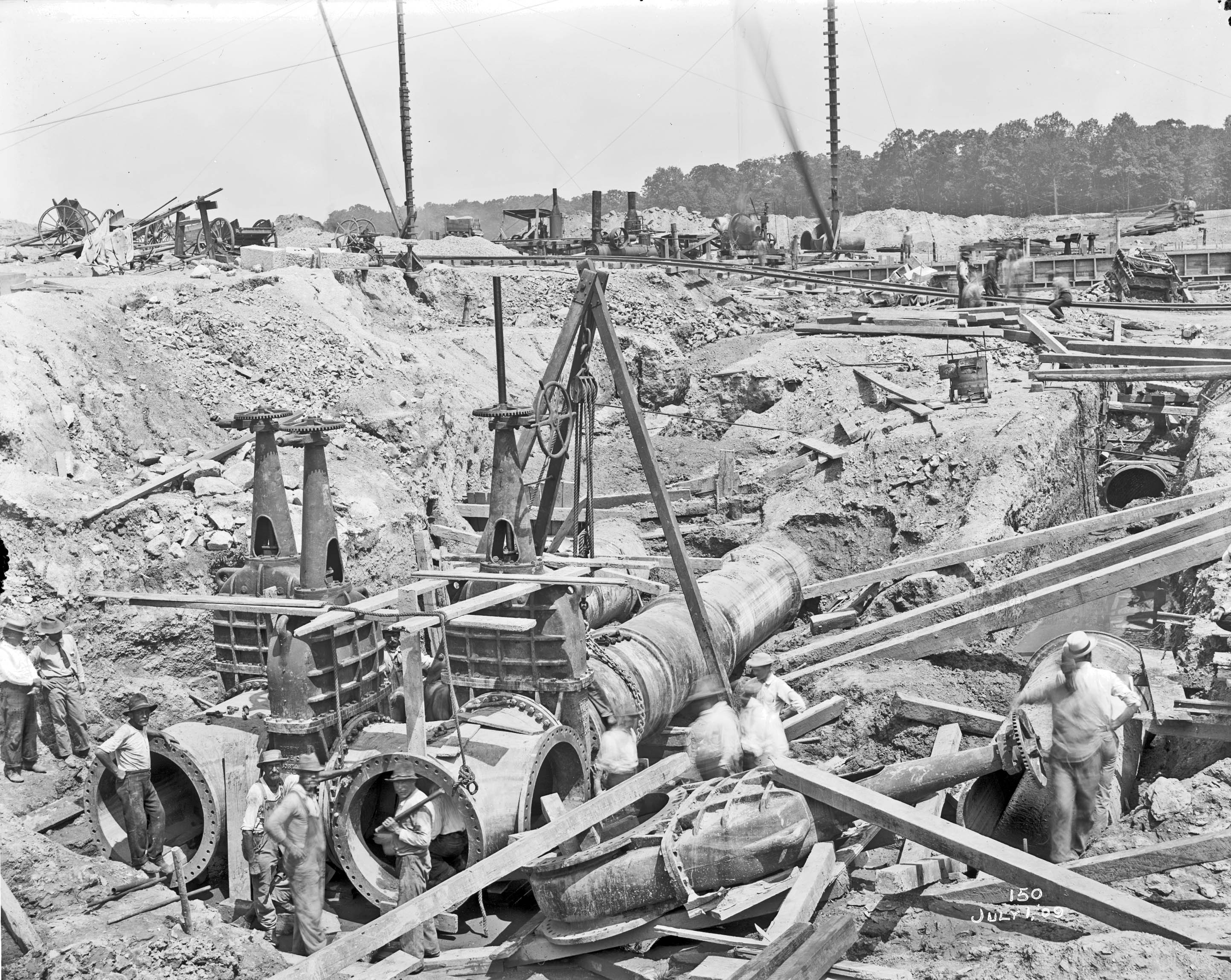
What has made this job difficult, yet interesting, is that various people have had numerous boxes of archives scattered throughout the City. A lot were mislabelled. These photos came from a box of glass plate negatives marked as ‘Loch Raven’ Bringing it all together in some sort of order is challenging. Chaos:

It is hard to believe that out of this construction chaos there will be built a reservoir so that the citizens of Baltimore will be able to enjoy drinking water. These are the pipes from the lake to the gate house (foundation in background).

Many years ago when I started this project, I had no clue about glass plate negatives, positive photos, restoration, etc. When I held the above GPN up to the light I thought it was a bad one – the white shown coming from the pneumatic jack hammers is black on the negative. I thought it was ruined until I processed it. Duh.

This one I have yet had a chance to restore. What I found interesting here is the suitcase in the upper right corner. Not only is this GPN broken, some of the image has peeled off.

Another interesting one from 1908 shows a church in the background. The writing on the sleeve said: Epiphany College in background.

Before building the lake the engineers had to move and raise the sewer/storm water manholes.

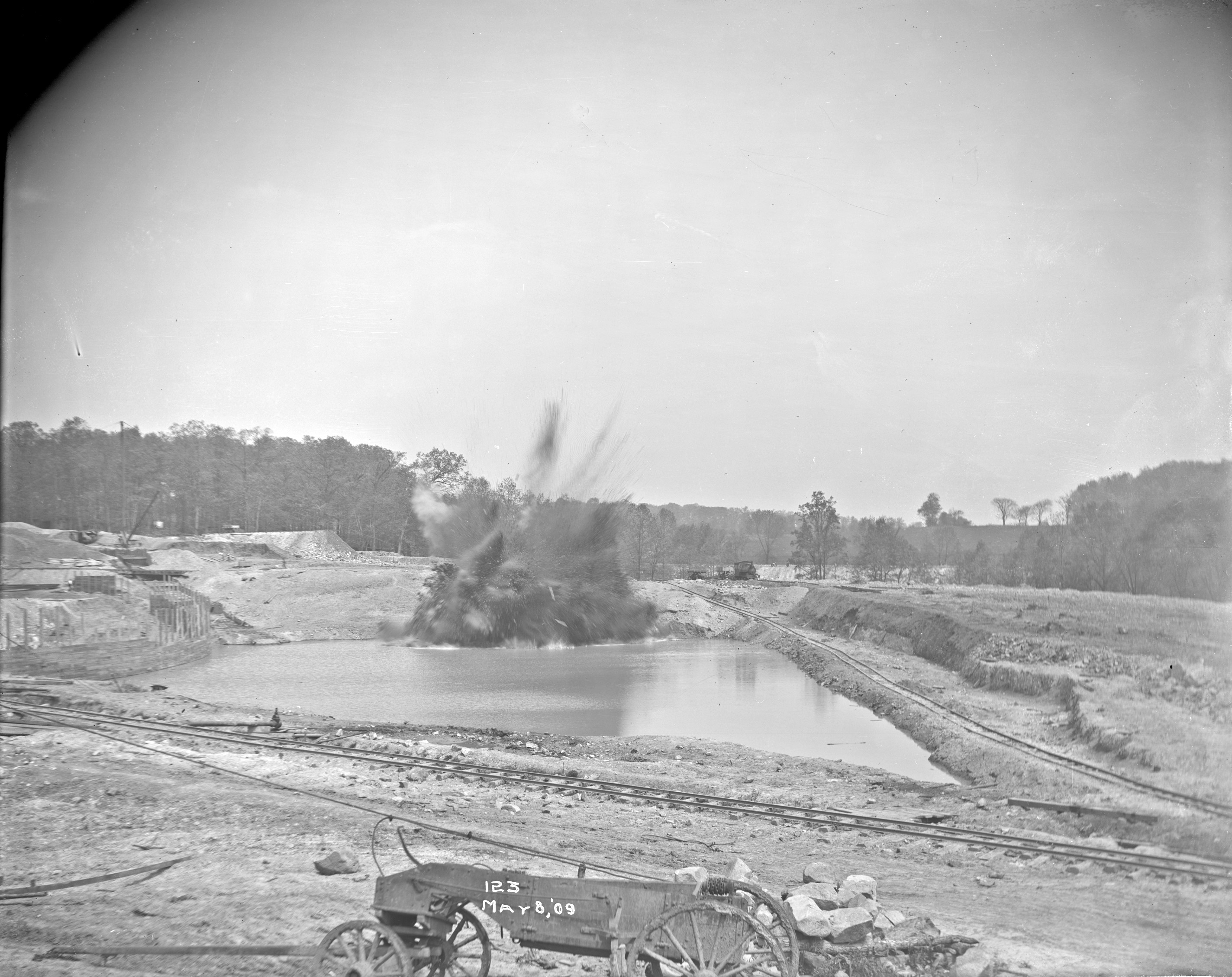
The photographer did a good job catching this dynamite blast at the right time.

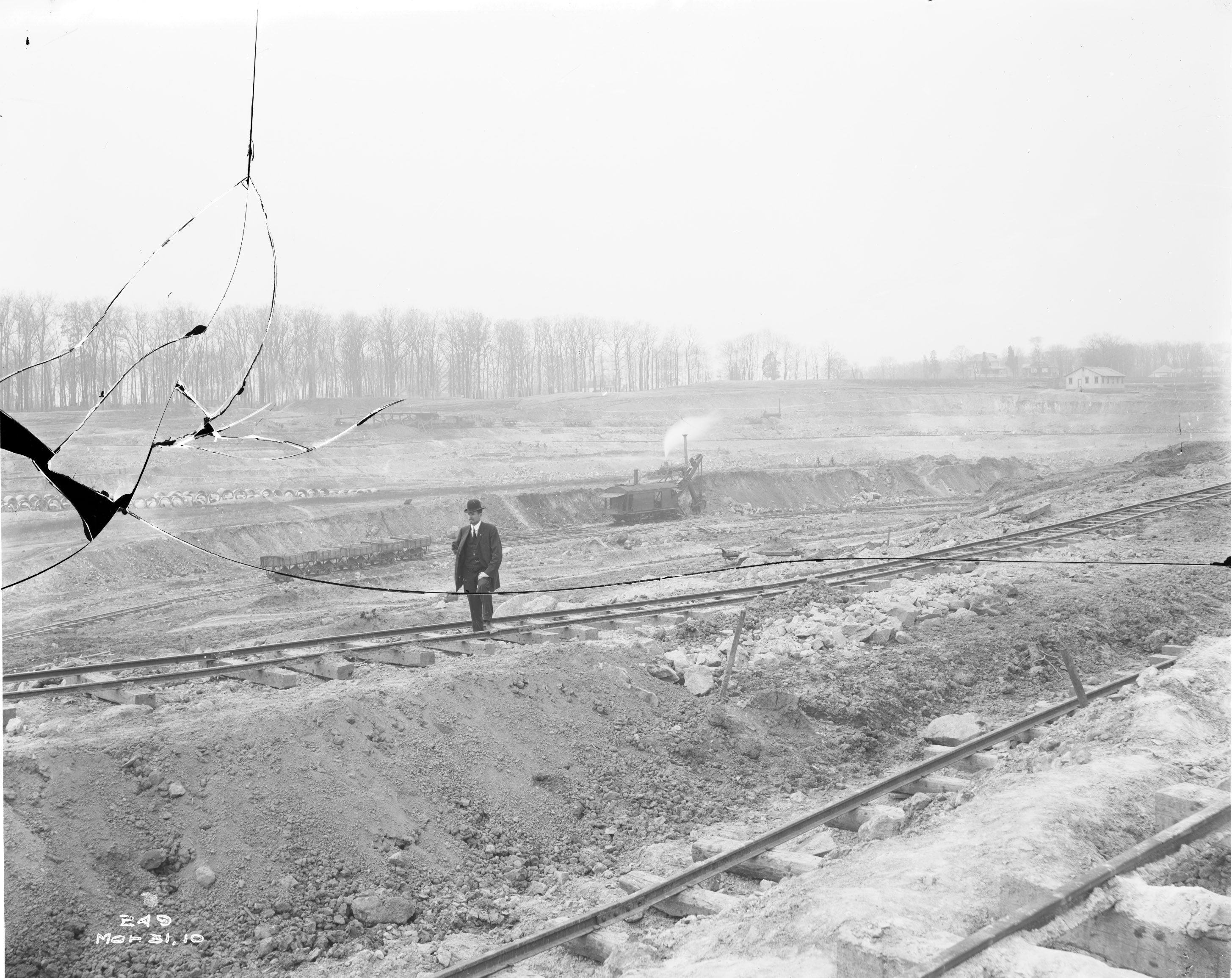
This broken jigsaw puzzle plate I did restore.


Tying Up Loose Ends

21 Thursday Sep 2017

Posted by Ronald Parks in Photography, water history

≈ 2 Comments

Tags

Baltimore, Dams, engineering, FILTRATION, glass plate negatives, Gunpowder Falls, Loch Raven, Museum, photography, Research, water history

Since my retirement is pretty much just around the corner, I need to start working on “Tying up some loose ends”, so to speak. At work, this means getting my files together and putting them in order so others may find important information. As far as my work on the DPW Museum archives, I do not think I will ever get this done. Just so much stuff.

I came back across an old box full of broken glass plate negatives. I guess it must be about 24 8″x10″ plates. Hard to tell because most are broken into a lot of small pieces. Some, like the one below, are in just a couple pieces, making restoration fairly simple. Years ago, before computer scanning and restoration software, the previous archivist either placed the pieces on a Xerox copier and scanned them or took a photograph of the pieces, placed together as best they could. They came out as negatives. I need to find those paper copies to help put the pieces back together.

Here is one of the better broken plates. The slivers from the crack will never be found by me. So I filled it in as best I could with the software. When I first started my water history research, I had no idea that Baltimore City built one dam on top of another. The upper right portion shown was built in steps, at an elevation of 188′. This was to be able to support the newer dam which would be built at elevation 240′. It was thought to be able to support a dam at 270′.

The jigsaw puzzle, restoration process is long and tedious and I don’t believe I will have the time to finish up this box of broken pieces. Let alone finish up documenting what is left to be done.

Drawing Loch Raven Dam

17 Thursday Aug 2017

Posted by Ronald Parks in Baltimore, HISTORY, water history

≈ 1 Comment

Tags

Baltimore, Dams, engineering, FILTRATION, glass plate negatives, Gunpowder Falls, HISTORY, Loch Raven, Public Works, water history

It seems that everytime someone asks me to find something for them, I find a lot more undocumented stuff. While researching information concerning the properties at Ashland, which is Northwest of the Loch Raven Dam, Baltimore, Md., I came upon a full scale drawing of the dam. I had posted a few years ago, one of my favorite photographs:

This is the photographer’s studio showing the artist’s rendition of what the dam would look like when construction is completed in 1922. All the supplies for developing the film/glass plates are on the shelves.

Later I would find a lantern slide of just the drawing.

Yesterday I found a colorized drawing. It is fairly beat up. So glad I was able to scan it.

Swimming Bathing Drowning

06 Thursday Jul 2017

Posted by Ronald Parks in Baltimore, HISTORY, water history

≈ 3 Comments

Tags

Baltimore, engineering, FILTRATION, Health, HISTORY, Jones Falls, Lake Montebello, Loch Raven, Montebello, POLITICS, Public Works, Swimming, water history

For your summer reading pleasure:

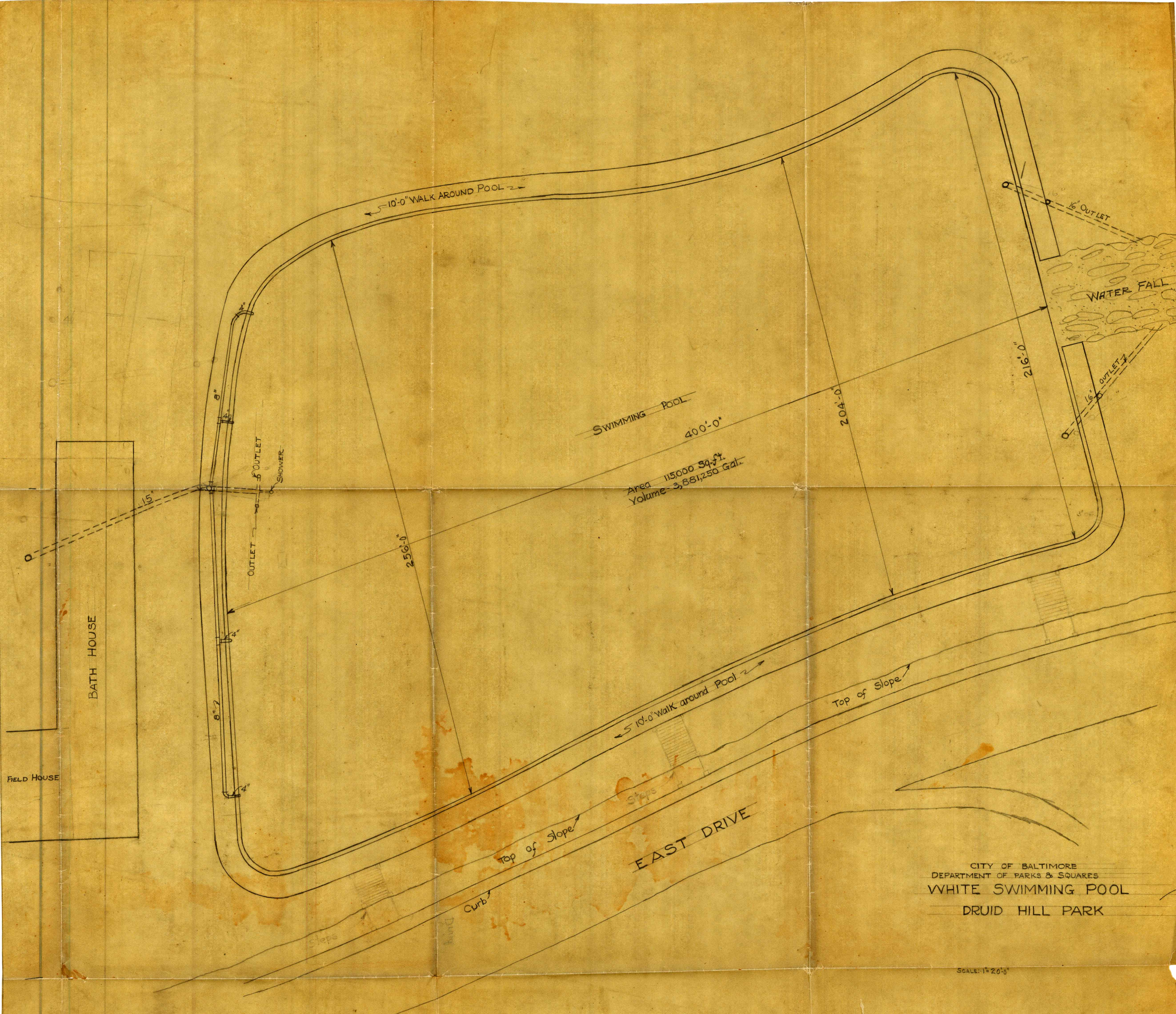
1916: A 16,000 gallon swimming pool was being built next to Lake Roland. July 19, 1917 letter from Water Engineer Walter Lee to the Baltimore County Commissioners asking that they police the area around Lake Roland as it has been reported that 10-15 persons bathe there every day. They reply that the city should get their own men to do it. June 9, 1923 letter requesting permission for the L’Hirondelle Club to be allowed to swim in Lake Roland. March 1924 newspaper clipping on drowning of boy, thirteen, in Lake Roland. The city investigation tried to place blame on the Pennsylvania Rail Road, who they say had some timbers floating about, which the boy fell off of as he used them as a raft. The PRR said it was a contractors fault, who used the timbers for some work they were doing. They also note that the boys were trespassing at the time of the incident. October 10, 1917 letter from Walter Lee to Mayor Preston notifying him of the intent of two ladies from Hampden, asking that a swimming pool be constructed on the property of the Hampden reservoir. They were also soliciting for his honor to pass a city ordinance in which they were to propose. Lee asks that if this happens, would the mayor turn the property over to Park Board? June 20, 1922 letter from Megraw to Christhilf Construction and other contractors, asking that they put in a modest bid (For charities sake) for the construction of a swimming pool at West Park (New name of Hampden Reservoir area) March 22, 1923 memo concerning the creation of a swimming pool between the upper and lower dams complete with toilet, shower facilities and a snack shack. June 20, 1924 letter from Armstrong to Siems concerning the swimming in the waters between the dams. He says it is prohibited. June 20, 1926 letter from the Baltimore Federation of Labor to Bernard Siems concerning the city using non-union workers to build the Druid Park Swimming Pool. On the bottom of this memo is a union logo: Specify UNION LABOR, have the job done Right!
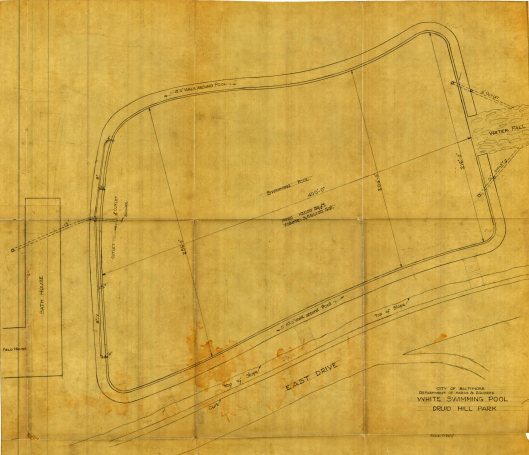
Druid Park Swimming Pool

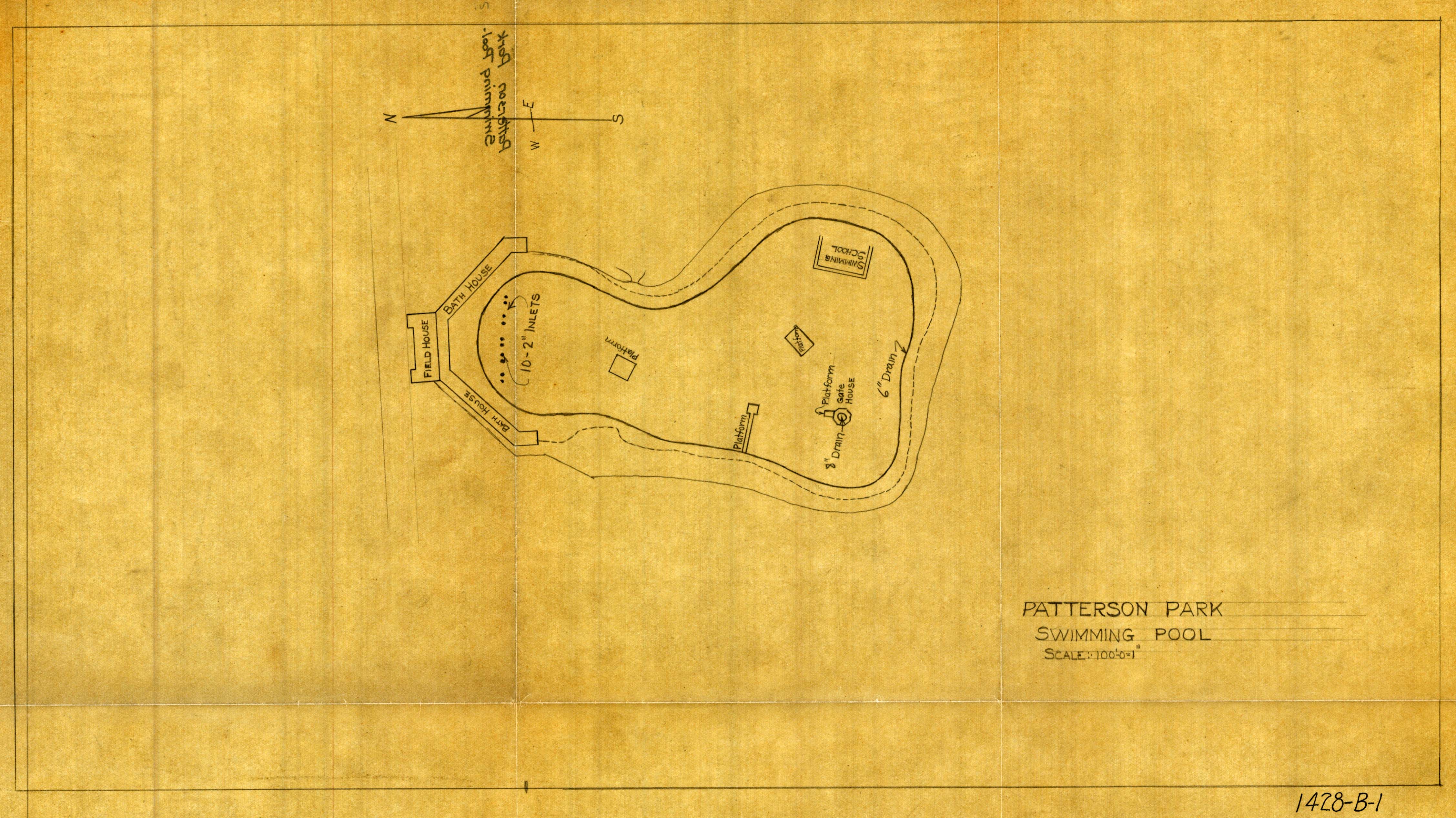
July 11, 1927 letter from Wolman to Wieghardt, “…when the pool was inspected by us a couple years ago we were informed that the Hampden Reservoir contained filtered water…the Hampden reservoir obtains all its water from the Jones Falls. In other words, the pool has been obtaining a completely untreated water from a relatively dangerous source, which has been abandoned for all municipal purposes for over 10 years…” July 14, 1927 letter refers to the Hampden Reservoir area as Roosevelt Park instead of West Park. June 24, 1930 memo from Rost to the Police Commissioner asking that the police stop the boys from climbing over the fence and swimming in the Montebello Plant II filtered water reservoir. 1932 Pools listed are: Druid Hill Colored Pool, Druid Hill White Pool, Gwynns Falls Park Pool, Carroll Park Wading Pool, Riverside Park Pool, Patterson Park Pool, and Clifton Park Pool.
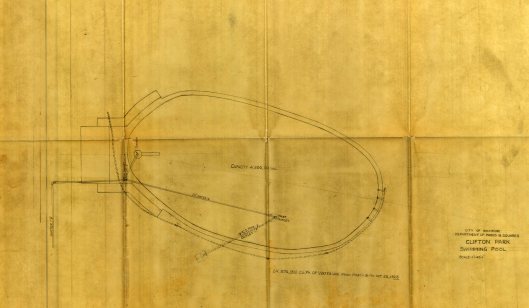
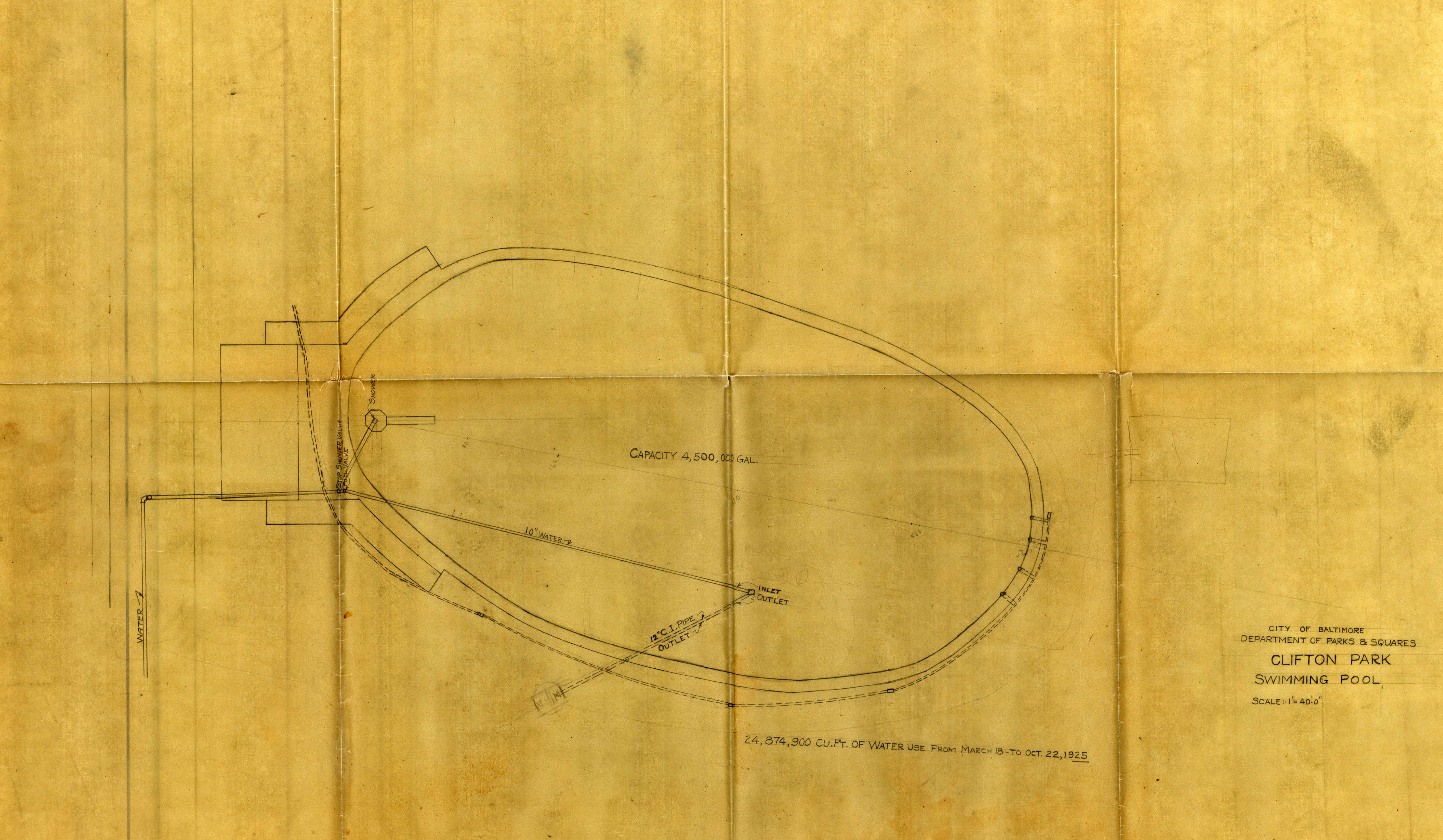
Clifton Park Pool

June 10, 1933 police report on a ten year old who went swimming with three other youths and he drowned. The others left him and told no one. July 18, 1935 request from the National Guard for a shooting range at Loch Raven. Small does not want this. August 15, 1935 Brigadier General Washington Bowie writes Small back stating, “I note what you state in regard to the interference with the recreational purposes. If you had been with me last Sunday…when I saw three negroes in bathing suits swimming back and forth near where I wish to locate the range, or on a previous occasion when I found a half-dozen white boys swimming…I think you would find a rifle range more desirable than such recreational use…the portion outlined on your print is constantly used by both negroes and whites for swimming. The rifle range would at least make this unpopular.”  Bowie then goes over Small’s head to Crozier. Crozier agrees with Small. A few months later, the Mayor agrees with Small and Crozier. June 14, 1938 list of names of swimmers at Loch Raven. Officer Goetz is to arrest these people and take them to Towson jail if they are caught again swimming in the reservoir. June 14, 1945 memo from A. Bailey to L. Small concerning kids swimming in the waste lake, “The boys in the Northwood neighborhood…are using it as a swimming pool…groups up to about thirty…during the daylight and night hours, sometimes as late as 12pm. They have been warned a number of times by various employees of this division only to be cursed for their troubles…radio police have been summoned but made no attempt to stop this practice…I talked with two patrolmen while eight to ten boys were in the lake and asked that they talk to the boys…they promised they would but walked to the opposite side of the lake and blew their whistles instead. Yesterday, June 13, there were even a greater number of swimmers than any time previous, so I contacted these boys personally and told them that it was my orders to have them arrested…they paid little attention to what I said…placed twelve ‘No Trespassing’ signs up. By 9pm all signs but one were removed and destroyed. At 10pm, a great commotion was heard, a group of three boys were in swimming and one had gotten into trouble and was so far gone when they rescued him, that it was necessary to apply artificial respiration…police called and all three were taken to Sydenham Hospital. The police, at least the patrolmen, do not seem to want to cooperate with us and make no attempt to put a stop to the practice of swimming. (We) could drain the lake and keep it drained in the summer months…parents may then be willing to stop their kids, but judging from what I have seen of these people, I do not believe they have enough control over their children to prevent them from doing anything that they wish to do. Child delinquency for this section is bad, if not worse than the average for Baltimore City. August 23, 1945 memo from Bailey to Strohmeyer about unwanted visitors to the plant. Young men swimming in the waste lake, one almost drowned. Two, three year olds, alone, swimming in waste lake. One threw a fit and refused to leave. The police were called. Two teenagers running through Plant II and when told to leave, went and got their father who dared anyone to stop them from coming into the plant. An undated memorandum: “Yesterday afternoon … three young men found swimming in the Balancing Reservoir at Loch Raven in their birthday clothes.”

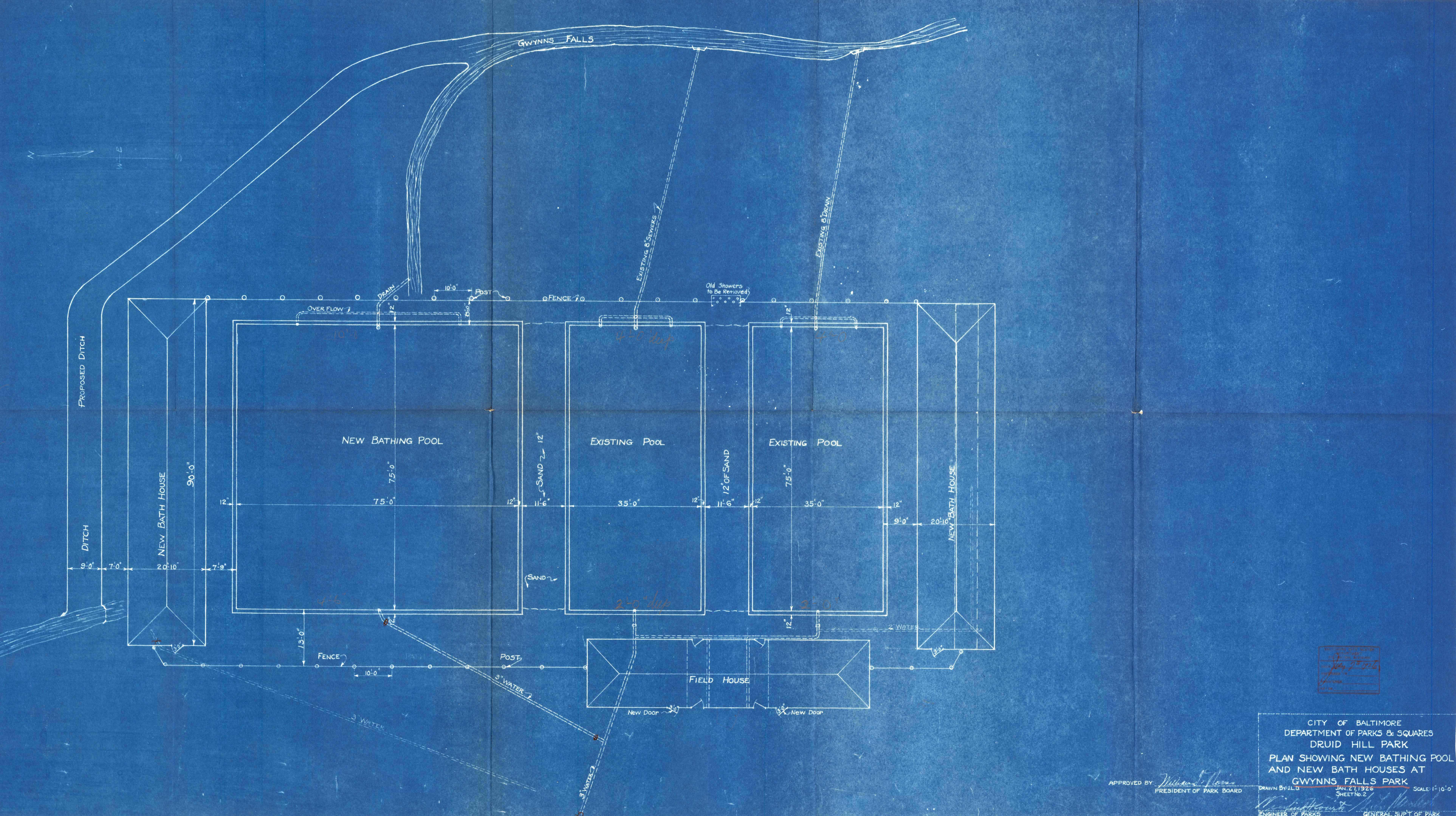
Gwynn’s Falls Pool – the overflow goes right into the stream, adding more pollution.

The largest of the pools back then.

Tunnel Inspection Part 2

30 Friday Jun 2017

Posted by Ronald Parks in Baltimore, engineering, water history

≈ 4 Comments

Tags

Baltimore, bricks, engineering, FILTRATION, Gunpowder Falls, HISTORY, Lake Montebello, Loch Raven, Montebello, nature, Public Works, water, water history

Over a year ago I was asked to be part of an inspection team, to walk/boat through the 12′ tunnel that connects the Loch Raven Reservoir to the Montebello Filters. This tunnel was built between 1875 and 1881. In the early years it was inspected quite often. In the 1960s it was decided, after a parallel tunnel was built in the late 1930s, to reverse the flow in this old tunnel to supply drinking water to Towson via the Cromwell Pumping Station. The old tunnel was last inspected in 1984. For that info you can see my post linked here:  https://rep5355.com/2016/04/06/tunnel-inspection/

In preparation for the inspection, I did all the necessary training – Red Cross/CPR, Confined Space, etc. Then we were told that it was too unsafe to send anyone in the tunnel. Totally bummed!

So now they have finally gotten around to inspecting the tunnel with a remote operated vehicle. It has been a long week starting last Friday. First order of business was to clear the site for the contractor to bring in his equipment.

Area cleared and the phragmites sprayed.

Next, construction mats were placed across the phrag roots – which is very soft. (And the equipment very heavy) These boards did the trick.

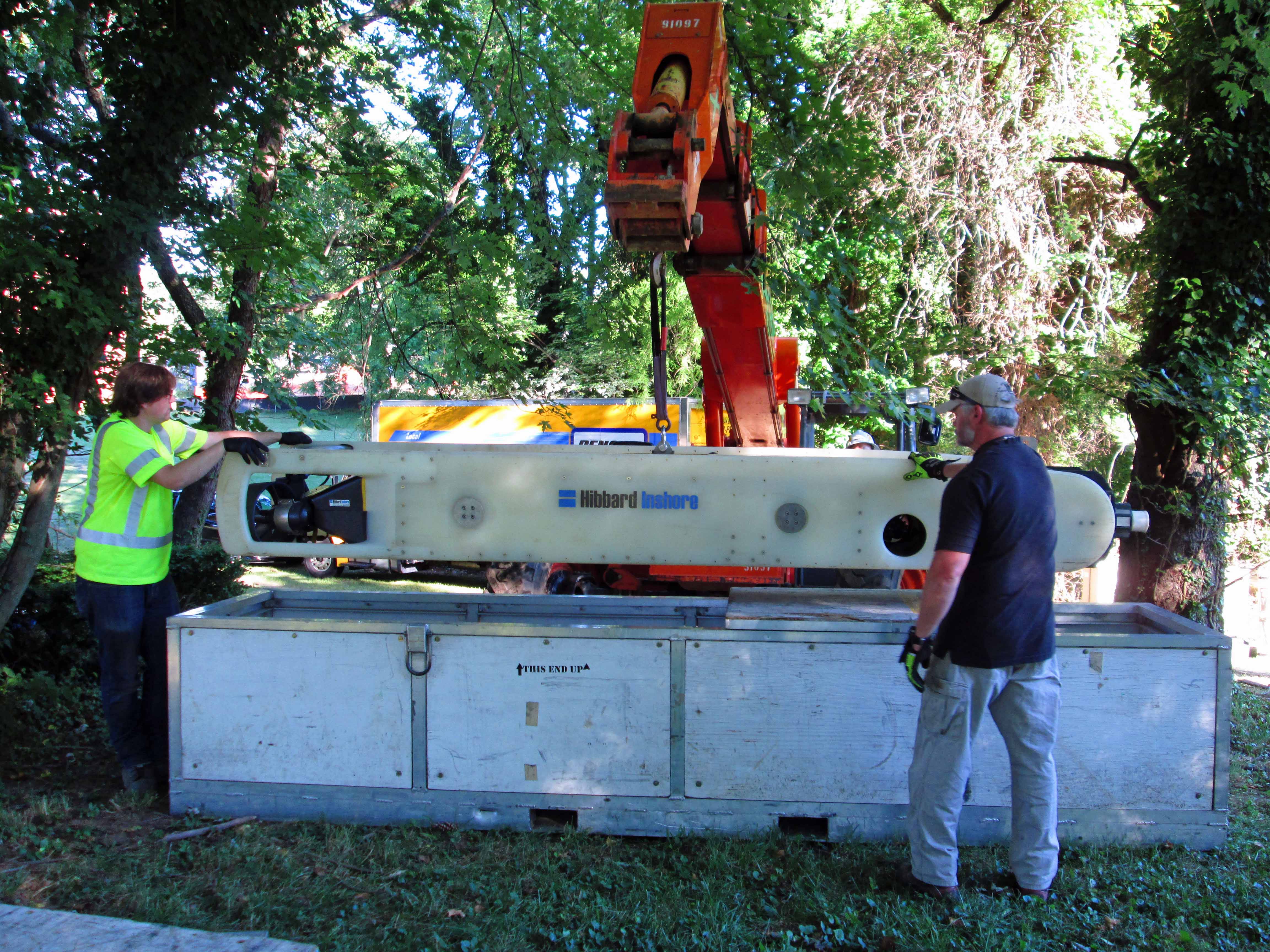
The equipment was unloaded. This is the inspection vehicle. It is about 14′ long and weighs 1500 pounds.

This is the tether. The sub is connected to this. It is 7 miles long, but only needs to go 5-1/2 miles.

The sub will enter at the top right. This is looking down the shaft towards the tunnel.

Here she goes.

Because this is a pipe that is in use, with drinking water, everything that enters the water was sprayed with a chlorine solution.

The control center. All this information on all these screens will be made into a report for the City to decide if the tunnel is still usable. The interesting one is bottom center. If you watch that and there is a change in the circle, say a rise in the bottom, that means the sub is going over a rock fall. You then look at the camera display and you can actually see it.

In my previous tunnel inspection post is a photo where the balancing shaft enters the tunnel at Cromwell. It is mostly smooth. Unlike this entry point – it looks like someone busted thru the top of the tunnel with a sledge hammer.

The sub was moving at a nice pace – looked like the Enterprise going at warp speed! Not sure what those particulates are just yet. Probably just some stirred up lime deposits.

And when I got bored, I went looking for nature. There are 3 young bucks…

A couple babies.

An Eastern-eyed Click Beetle

Bunches of other bugs.

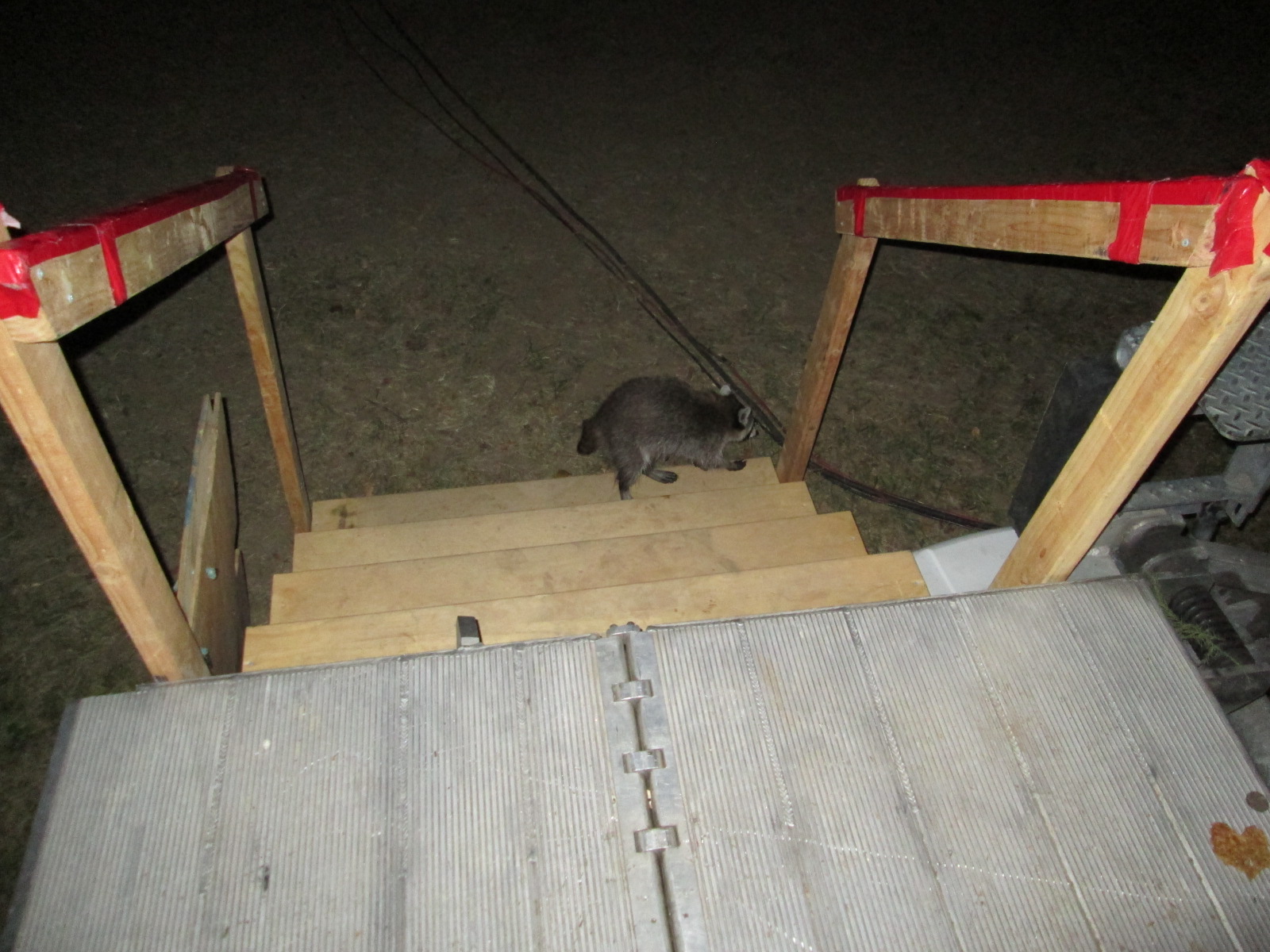
And our night time visitor looking for food.

Saving History, One Piece at a Time

16 Friday Jun 2017

Posted by Ronald Parks in Baltimore, HISTORY, water history

≈ 3 Comments

Tags

Baltimore, Clifton Gate House, Dams, engineering, FILTRATION, Gunpowder Falls, HISTORY, Lake Montebello, Loch Raven, Montebello, POLITICS, Public Works, water history

Anyone that has been following my blog will remember my writing about a few construction projects that are water related. Such as the new buildings at Loch Raven, the contractor busting a hole in the ten foot conduit that supplies water to Baltimore, another contractor digging up the foundation to an old pumping station, the attempts to save the Clifton Gate House, the Roland Tower, the residence at Montebello, etc.

When I first wrote about the work along Loch Raven, I wrote about the house and buildings they were tearing down. After being notified of this project, I went to investigate and saw a bunch of metal signs. Not necessarily ultra historic, but a part of Baltimore’s Water Supply History nonetheless. I was able to retrieve from the contractor, 2 of the 8 that were there. The other six were taken by a company the reuses old building materials.

Here is one of the eight signs. This all happened a few months ago. The other day I received an email. One of those courtesy type ones from the big bosses downtown, trying to keep me in the history loop. Well, I was dumbfounded when I read the email. It just said FYI and had the attached photo along with two other attachments.

I couldn’t believe what I was seeing! This photo is of the marble plaque that was in the original 1881 gate house to the first Loch Raven Dam!!! i always wondered what happened to this thing.

The third attachment is a quote, only partially shown to protect the parties involved. Two marble plaques? The quote went on to say that the other one was dated 1887!! Holy crap! Only one water works related to Loch Raven was built at that time and that was the Clifton Gate House!! My eyes were playing tricks on me!! This couldn’t be!

But wait! How did this company get these things and were they really trying to sell them back to the City? City property??!! I don’t think I ever cussed in an email to one of the bosses downtown but I just couldn’t contain myself “What the hell! This is City property. How can they charge us for something that is ours?!” I suggested he gets the Environmental Police involved to check this out. If not, tell them I will give them $500 and we won’t press charges. He said he turned it over to the EP. And he did. Today I received a copy of the investigative report stating that these items were picked up by accident and would be returned to the City. And they were this afternoon!!

More on this later so stay tuned! (I want to go into a lengthy bit of comment on what we should learn from this…)

← Older posts
Newer posts →

Blogroll

  • Flouride Action Network
  • lulu
  • My Book
  • WordPress.com
  • WordPress.org

Recent Posts

  • Bermuda 2023
  • ICELAND April 2023
  • George Chalmers of Fochabers
  • In Search of The Skipjack Ada Mae
  • Trap Pond Kayak

Blog at WordPress.com.

  • Subscribe Subscribed
    • Water and Me
    • Join 231 other subscribers
    • Already have a WordPress.com account? Log in now.
    • Water and Me
    • Subscribe Subscribed
    • Sign up
    • Log in
    • Report this content
    • View site in Reader
    • Manage subscriptions
    • Collapse this bar
 

Loading Comments...