https://www.createspace.com/4511014
I am doing another companion to this one – more technical. And I have already started on my Sewer History book.

10 Wednesday Feb 2016
Posted in Baltimore, filtration, HISTORY, water history, Writing
https://www.createspace.com/4511014
I am doing another companion to this one – more technical. And I have already started on my Sewer History book.
08 Monday Feb 2016
Posted in Baltimore, HISTORY, water history
Tags
Baltimore, engineering, HISTORY, sewage, water, water history
From Calvin Hendricks, Engineer, to the Mayor:
“It all comes down to the fact that we are getting nearer to the laws of God than ever before, which laws man cannot improve on, but can only strive to follow. For instance: The pumps lifting the sewage from the low level to the Outfall Sewer, is the sun drawing the salt water from the sea to the cloud; the flow of the sewage through the Outfall Sewer to the Disposal Plant, is the cloud drifting through the air; the spraying of the sewage over the stone beds, is the rain falling from the cloud to the earth; the trickling of the sewage down through the stones is the rain sinking into the earth; the purified sewage coming out into the settling basins, is the spring water bubbling out of the ground, and the electric light produced by the flow of the sewage is the sunshine after the clouds have passed.”
The sewers completed and under contract, about 160 miles, if placed end to end, would almost reach from Baltimore to New York, and a portion of them are large enough to drive through in automobiles. I feel safe in stating that the entire built-up portion of the City will be completely sewered and in operation in 1914, the time originally stated, provided we are allowed to continue in the rapid manner in which we have so far prosecuted the work.

04 Thursday Feb 2016
Posted in HISTORY, water, water history
Tags
Baltimore, engineering, HISTORY, Jones Falls, POLITICS, water, water history
Baltimore starts construction for a system of sewerage, officially, on October 22, 1906, with a groundbreaking by Mayor Clay Timanus at Ensor and Lanvale streets. Behind Greenmount Cemetery.

As was typical for the times, a plaque was created and placed on the cemetery wall

In the 1906 Annual Report of the Sewerage Commission are listed some interesting facts about Baltimore:
The population, according to a police census was 555,000. The city being 31-1/2 square miles consists of, approximately, the following buildings:
Asylums, Homes and Hospitals; Jail, Penitentiary and House of Refuge 77. Apartment Houses 26. Banks and Libraries 47. Breweries and Distilleries 21. Car Barns and Railroad Stations 45. Churches and Missions 364. Coal, Wood, Stone and Lumber Yards (Sheds) 130. Clubs and Office Buildings 57. Department Stores 10. Engine Houses and Police Stations 46. Hotels 32. Livery Stables 55. Industrial Plants 266. Manufacturing Plants 367. Markets 10. Residences 108,340 (of which, 15,000 dumped household waste directly into the Jones Falls/harbor). Schools, public and private; Colleges, Convents 169. Stables, small 1461. Theatres and Halls 38.
Total 111,561
02 Tuesday Feb 2016
Posted in HISTORY, water, water history
Tags
Baltimore, engineering, HISTORY, Jones Falls, water, water history
The Jones Falls flooded on many occasions, bringing with it all the sewage, manure, street sweepings, etc. and dumping it into the Inner Harbor. The flood of July 24, 1868 was another wake up call to the City, that something needed to be done.

Many engineers were asked to come up with a game plan on what to do. Benjamin Latrobe and two others suggested to channel the Falls away from downtown, diverting it to Herring Run, at the mouth of Back River.

Throughout the years, other plans were also devised.
01 Monday Feb 2016
Posted in Baltimore, filtration, HISTORY, water


So the Montebello 100th anniversary has come and gone. It was a pretty nice affair. I will start doing some more Water History on here, but it will probably be more Baltimore Sewage history. I have been doing some extensive research on the subject and will share some of it here. I will most likely put it in book form, to go with my water history book.
The first photo is inside the gate house, of which I talked earlier about. The second is a State Historical marker that was placed outside the gate house.
08 Sunday Mar 2015
Tags
Baltimore, engineering, FILTRATION, glass plate negatives, Gunpowder Falls, HISTORY, Lake Clifton, Lake Montebello, Montebello, photography, valve house, water history
Since starting my research in a museum archives, I’ve found quite a few discrepancies in the labelling of photographs and negatives. Some archival boxes were marked as Loch Raven Construction – 1909 (Which didn’t start until late 1912. These photos were actually the building of Lake Ashburton). Then there are the glass plate negatives marked as Loch Raven 1875-1881. A few of these are of Lake Montebello and Clifton. This is ok only because I know they are from a group known as the “permanent supply”, they belong together. But my problem is that somewhere along the timeline known as “History” someone decided to call the gatehouses ‘valve houses’ Why?? I do not understand the intent of changing the engineer’s designation of a structure from gatehouse to valve house? The drawings I have along with engineer’s reports all call these structures Gatehouses. Who changed it? Would it be alright to call one of Baltimore’s Little Tavern Restaurants – Small Bar Restaurants? Hell no! Words mean the same but they aren’t. You go to a small bar to get drunk – you go to the Little Tavern for their bags of hamburgers!!
I recently found a photograph of one I already have, that was mislabeled. Below is the photo from a glass plate , the other is from a framed photo that hung in the engineer’s office (Bottom Photo from 1894). The framed one clearly calls the Clifton Gatehouse a gatehouse, not a valve house – Stop the insanity and call it what it is!!!

From a mislabeled GPN saying this is Loch Raven

Framed photograph clearly marked as Gate House at Lake Clifton

Engineer Kenley’s office, 1894 with framed photographs hanging on the wall.
01 Sunday Mar 2015
Posted in HISTORY
Tags
Baltimore, engineering, FILTRATION, Gunpowder Falls, HISTORY, Jones Falls, Lake Clifton, Lake Montebello, Montebello, photography, water, water history
In 1881 the Permanent Supply started delivering water to Baltimore City, to help supplement the failing Jones Falls. Over the next few years, the Jones Falls would become so bad that larger reservoirs would be needed. Especially after the annexation of 1888. Plans started to take shape in 1904, after the Big Fire, to increase Loch Raven. And because of pollution, Baltimore started testing various forms of filtration.
These photos epitomize the sanitation conditions of our rivers and streams, and why water sources were failing:


Testing forms of filtration at both Montebello and Loch Raven gatehouses:

New pumping stations and reservoirs were built and/or their water redirected. Mt Royal no longer was receiving water from the Jones Falls, but from the Gunpowder Falls, via pumping stations. Below is the Mount Royal Reservoir, followed by the High Service Reservoir at Pimlico and below that the Eastern Pumping Station, which pumped water from Clifton to Guilford.


15 Sunday Feb 2015
Tags
Baltimore, engineering, FILTRATION, Gunpowder Falls, HISTORY, Lake Clifton, Lake Montebello, Montebello, photography, water, water history
The Gunpowder Temporary Supply was in use between 1873 and 1881, as the City required it. Work on the Permanent Supply started in 1875. This new supply would consist of a dam at Loch Raven, a 6-1/2 mile tunnel to Montebello, where a lake would be built with a gatehouse, to connect to another lake at Clifton. The properties at Montebello and Clifton belonged to Garrett and Hopkins.


On September 29, 1881, Lake Montebello reached its full height elevation of 163′. Lake Clifton would not be completed until late 1887. The water from Montebello flowed thru pipes, to the site of the lake and connected to pipes, to supply the City. Until the lake and gatehouse were completed at Clifton, a temporary shed was built over the pits that housed the gate valves. There was a house built on the property for the Gatekeeper. There was recent talk of leasing the Clifton Gatehouse for a Farmers Market, if the person would restore the building.
12 Thursday Feb 2015
Tags
Baltimore, engineering, FILTRATION, Gunpowder Falls, HISTORY, Jones Falls, Lake Roland, Montebello, water, water history
Before the Montebello Filtration Plant came to be in 1915, Baltimore received its water from various sources. Mostly at the direction of the City Commissioners to form a water company, for fire protection. Wells were sunk and springs directed to fountains. But like every other growing city, Baltimore had its fair share of problems – drought, pollution, pestilence, etc.
In 1854 the Bureau of Water Supply became a Municipal Utility Corporation. 1861 saw Swann Lake (Lake Roland), Hampden Reservoir and the new Mt Royal Reservoir put into service. These received water from the Jones Falls. In 1864 the City started construction of Lake Chapman (Druid Lake). By 1866, Mayor Chapman realized the inadequacy of the Jones Falls, so authorization for the purchase of lands along the Gunpowder Falls began. 1869-70 saw one of the worst droughts in Baltimore history. In 1871 a reservoir at Pimlico was built, but this was still receiving water from the Jones Falls, which was failing. 1873 saw an urgent need for a supplementary water supply. A temporary pump, pumping station and a 36-inch cast iron discharge water main were constructed for the delivery of the Gunpowder Falls water from Meredith’s Ford Bridge to Roland Run, a tributary of the Jones Falls, above Lake Roland. The water flow would be forced at a rate of 10 million gallons a day into Roland Run, a distance of 3-1/2 miles. To the dismay of the property owners. This was known as the Temporary Supply.
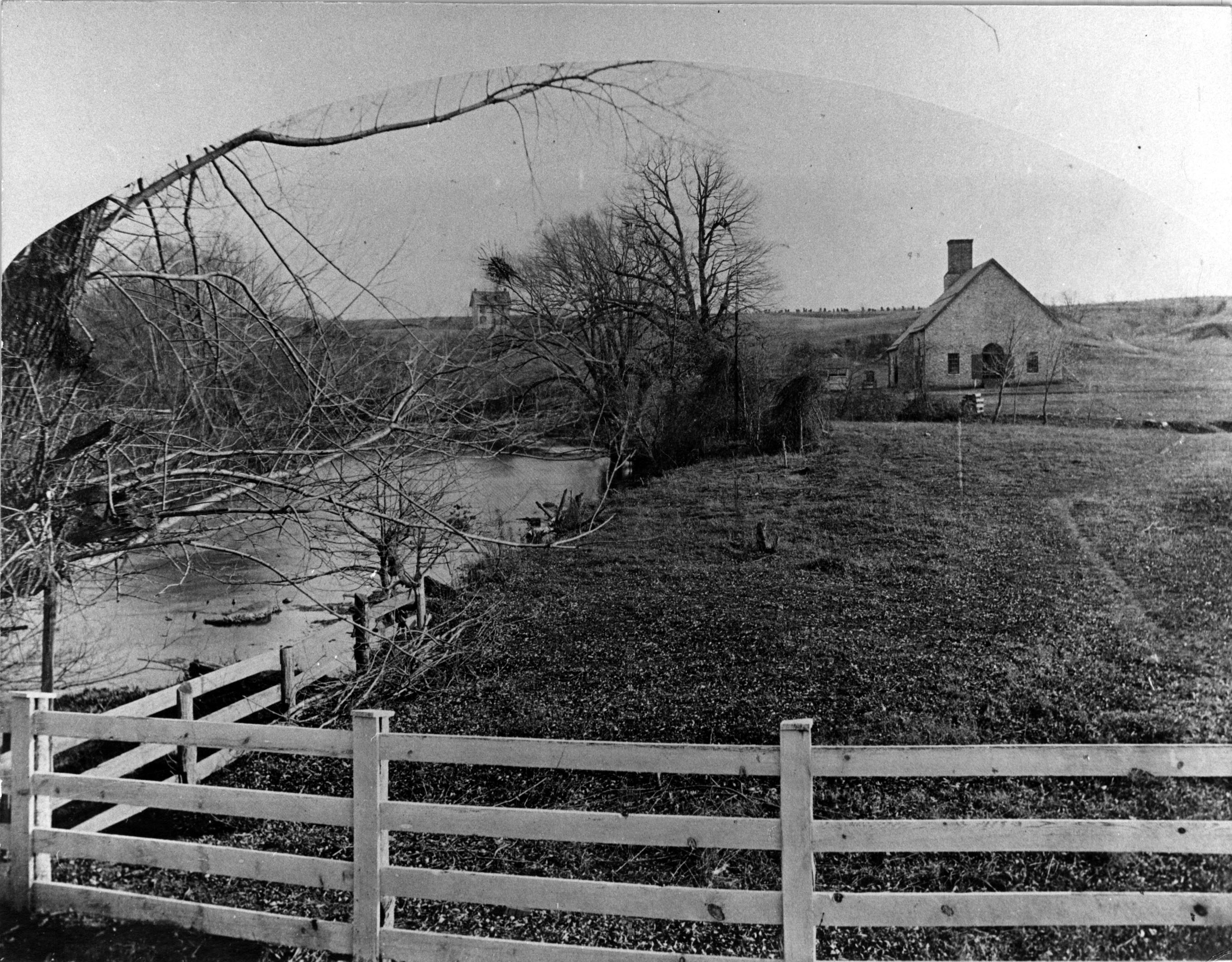
Original photo

A. Hoen litho from original photo 1875
05 Thursday Feb 2015
Tags
Baltimore, boats, engineering, FILTRATION, HISTORY, models, Montebello, war, water history
Met to discuss the plans for the anniversary – a lot of events are being lined up. Two have to do with boats and water. Rec and Parks wants to have “Boating on the Lake” where attendees can get in a kayak or canoe and go out onto the lake. The lake is pretty big. The road around it is 1.3 miles.
Another event is for the Model Yacht Club to hold some demonstrations. When the water plant opened, all the way to the beginning of WWII the water engineer and the politicians battled it out over allowing model boat sailing on one of our lakes. We have two. The engineer had no qualms about letting people know how much he did not want the boats on either lake. Finally, the boat people won. When WWII broke out and security tightened around the water plant – no more boaters (I think the engineer started that war, just to have a reason to stop them!) On a few occasions, the engineer purposely sent the lake to drain – oops! sorry, forgot you guys were coming this weekend!


The below photograph is where the party will be. The small lake to the right is where the model yachts use to sail…

 Water and Me