• About
  • History Writings

Water and Me

Water and Me

Category Archives: engineering

Swann Lake – Not the Ballet

23 Friday Feb 2018

Posted by Ronald Parks in Baltimore, engineering, HISTORY, water history

≈ Leave a comment

Tags

Baltimore, Dams, engineering, HISTORY, Jones Falls, Lake Roland, maps, Monuments, POLITICS, Public Works, Research, water history

When I first started researching the water history of Baltimore, and I came across a map of Swann Lake, I just assumed that it was called Swann Lake because the Mayor at that time was Thomas Swann, who later went on to be the Governor of Maryland. 
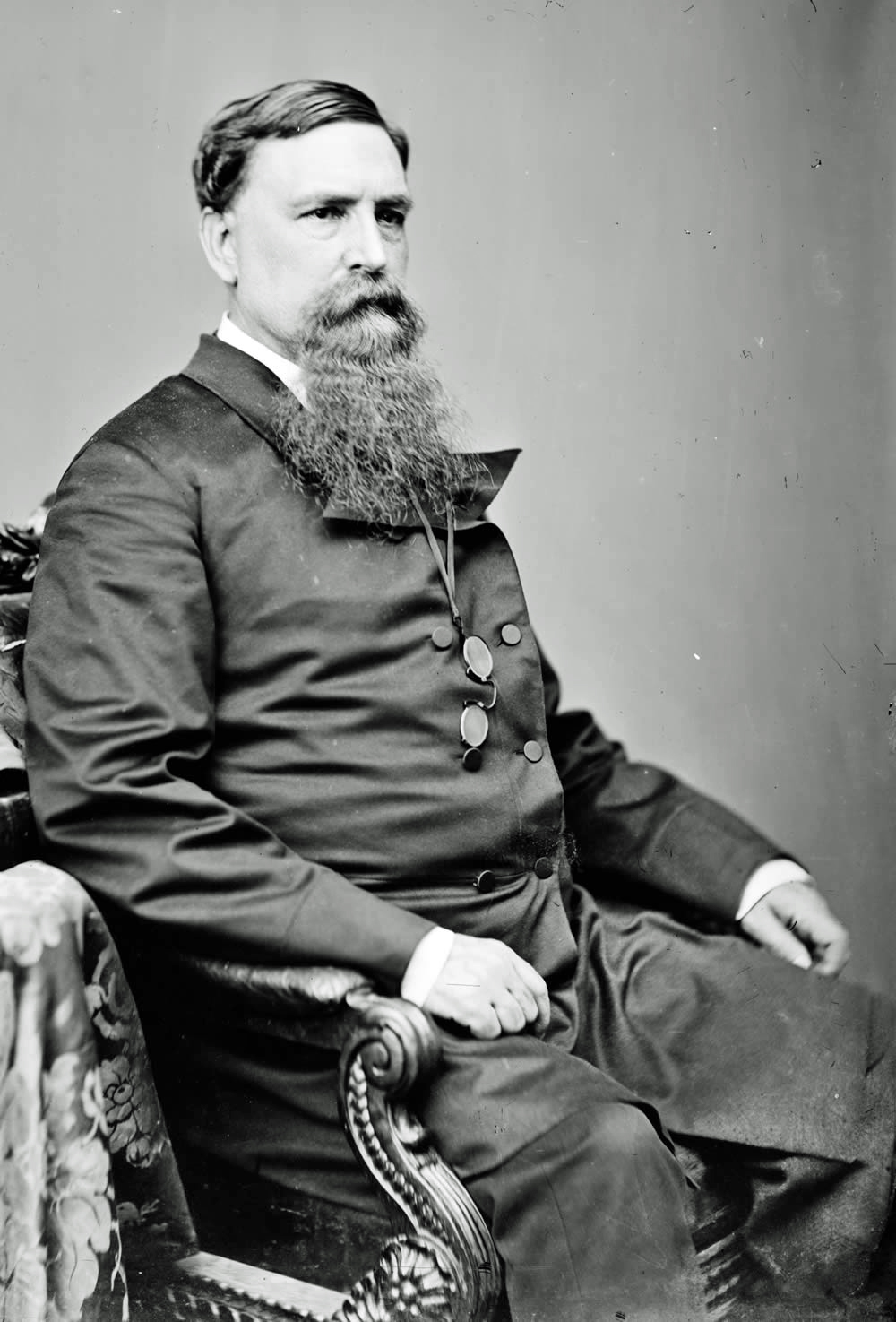
Here is the man himself. In the journal I am presently transcribing, I came across this entry:

October 4, 1869: The Committee on Swann Lake submitted the following report: Having examined the minutes of the Board and the records of the office, with the view of ascertaining in what way and by what authority the Lake, so long called Lake Roland received the name of Swann Lake, would respectfully call the attention to the Board the following – That Mr. Charles Manning, Chief Engineer was asked to name the principal stream that supplies the Lake, by which with great propriety the Lake could be known. Under his direction the name of Lake Roland was placed over the door of the stop house and a map of Lake Roland was presented to the Water Board with the general and final report of the Chief Engineer on the completion of the Works. In this manner the lake became known to all our citizens, by a familiar and more appropriate local name. The Board of Water Commissioners, by resolution, posed at a regular meeting on December 26, 1861, approved and adopted what had been done in the premises…to be called Lake Roland. At some subsequent period the name on the door (Roland) was erased and Swann Lake inserted and a patch was made and placed on the map stating the same. In the opinion of the Committee, these changes and defacement were entirely unauthorized and would have been improper even if ordered by the Water Board. The Board has heretofore declared its opinion as to the impropriety of designating any of the public works by the name of an individual citizen, because of his connection with the City Government and your committee sees no reason why this Lake should be made an exception of. These views have long been entertained but have thought it best to defer presenting them until the present time, when by no possibility can it be supposed that you are in any way influenced by personal or political feeling. Ask that the Lake be referenced from this point forward as Lake Roland. Unanimously resolved.

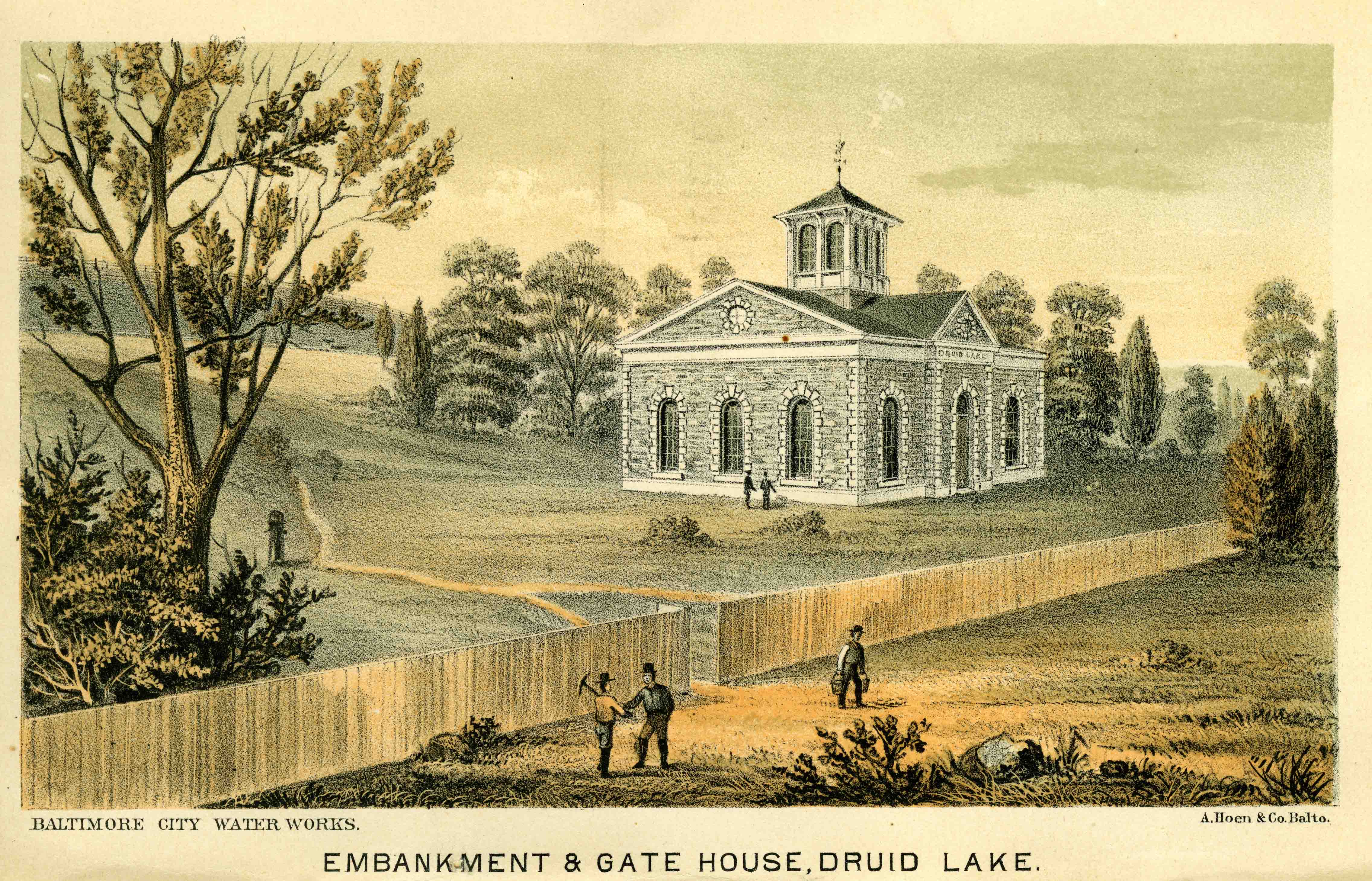
So, one has to wonder – did a political adversary go and change the name from Roland to Swann over the door? And why would the Water Engineers continuously refer to the lake as Swann Lake? Every entry that I have summarized from the 1862-1869 journal notes “The work at Swann Lake…” or as such. Here is what the work at Swann Lake looked like. Even A. Hoen and Co. called it Swann.
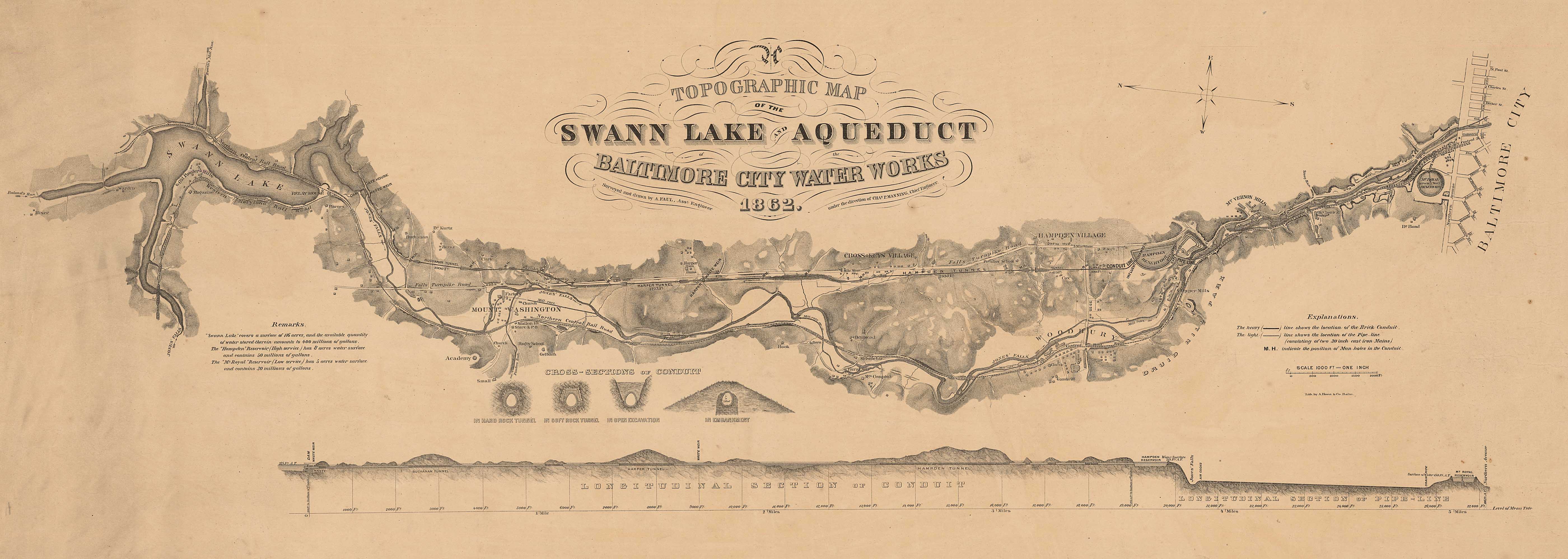
Wikipedia has this to say about Thomas Swann – not too good a commentary!

Many believed once slavery was abolished in Maryland, African Americans would begin a mass emigration to a new state. As white soldiers returned from southern battlefields they came home to find that not only were their slaves gone but soil exhaustion was causing tobacco crops in southern Maryland to fail. With a growing number of disaffected white men, Thomas Swann embarked on a campaign of “Redemption” and “restoring to Maryland a white man’s government”. His strategy was built on the platform of entrenching white power and displacing independent African Americans. During this same time an oyster crisis in New England caused the oyster industry in Maryland’s Chesapeake Bay to surge. Swann’s problem was that the Bay oyster trade was heavily African American. His solution; use government policy to push African Americans in the bay and replace them with, “White Labor, at reasonable rates wherever needed.” Even more egregious he enacted a law that encouraged white fisherman to harass black fisherman when he signed into law the states first ever “Oyster Code.” “And be it acted, that all owners and masters of canoes, boats, or vessels licensed under this article, being White Men, are hereby constituted officers of this state for the purpose of arresting and taking before any judge or Justice of the Peace, any persons who may be engaged in violating any provisions of this article. Furthermore, all such owners and masters are hereby vested with the power to summon pose comitatus to aid in such arrest.” Even more egregious, any property seized during an “Oyster Code” violation was auctioned off, with one quarter of the proceeds going to the white man who initiated the arrest.

Wow and as Confederate Monuments have been removed in Baltimore, I guess no one thought to remove the entrance of Druid Lake at Swan Drive that has his name emblazoned across the top of the arch!

Lake Chapman

22 Thursday Feb 2018

Posted by Ronald Parks in engineering, water history

≈ 2 Comments

Tags

Baltimore, engineering, POLITICS, Public Works, Research, water history

From the 1867 Journal of the Water Board minutes comes the following: December 30, 1867: The Committee on Lake Chapman having recommended a change of name for said lake, it was on motion resolved that the said lake be called “Druid Lake”. And that the Engineer be directed to erase the name Lake Chapman from any and all buildings, structures, charts or drawings, on or in which name now appears and to substitute therefore the same as above, “Druid Lake”.
I wonder who ex. Mayor Chapman pissed off? I could not find anything in the Maryland State Archives blog that would warrant such drastic actions. As a side note – transcribing script gives me a headache. I’m only at page 279 of 462!
Jackson C Gott – Architect

28 Tuesday Nov 2017

Posted by Ronald Parks in engineering, water history

≈ 4 Comments

Tags

Architects, Baltimore, engineering, glass plate negatives, HISTORY, Lake Clifton, Public Works, Research, water, water history

I was asked the other day if I knew who the architect of the Clifton Gate House was? I could not find any information after a couple hours of research. Of course, an internet search took me to the Maryland Historical Trust, where it is noted the architect is unknown, so I decided to look through all the Engineers Annual Reports here in my office. I also looked through a lot of drawings.

I found this. Not for the gate house itself, but for the keepers cottage. In very faded print it names the architect for the cottage as Jackson C Gott.

More research revealed a couple interesting photos and prints concerning Gott. He designed two local buildings. The Maryland Penitentiary.

And the Eastern Pumping Station, which I talked about a few weeks ago. Here is a beautiful print I found at the St Croix website.

Below is the Keepers Cottage next to the Clifton Gate House. I do not have time to fix this glass plate negative, unfortunately.

There were two other ramshackle buildings near the gate house, put up by the water engineer to protect the valves, in a pit.

Two drawings of the water mains at the gate house.

Below shows the location of the venturi meter, added later.

Here is the plans for the building. No architect and it comes from the water engineers office. Curran, Martin and Kenly.

With all that said, looking at the three structures: Gate House, Pumping Station and Penitentiary, I would take a long shot guess and say that Jackson C. Gott designed the gate house. Most prints and photos are from the DPW collection except for the recent Pen photo and the EPS print, which is mine.

Guilford Reservoir

22 Wednesday Nov 2017

Posted by Ronald Parks in Baltimore, engineering, water history

≈ Leave a comment

Tags

Baltimore, engineering, FILTRATION, Guilford, HISTORY, POLITICS, Public Works, water history

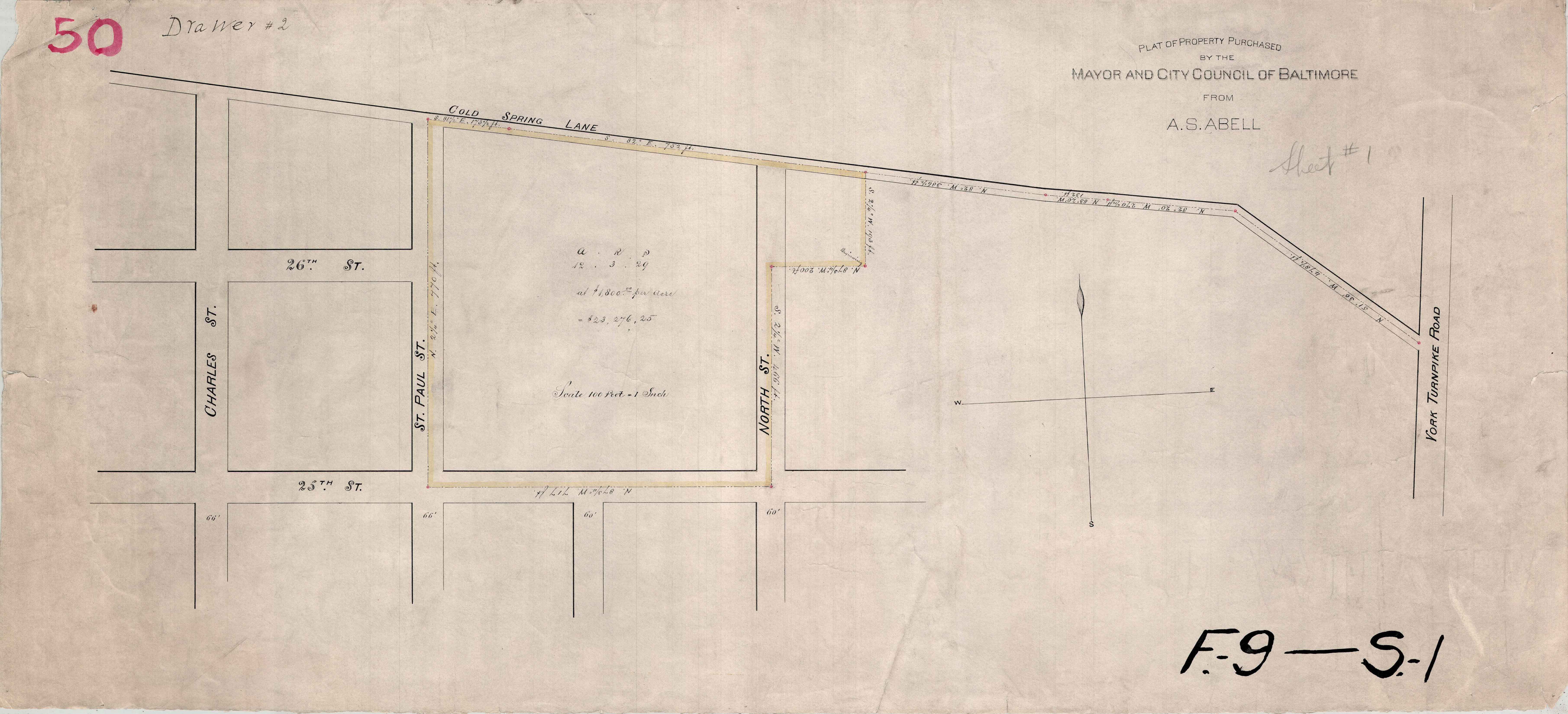
1888 – Eastern High Service Reservoir at Guilford: On June 5th, 12 acres, 3 roods and 29 perches of land was purchased on Cold Spring Lane, west of York Road, for an Eastern High Service Reservoir at Guilford. The Guilford estate was purchased from the heirs of the late A. S. Abell. A contract was awarded on July 30th to Messrs. Jones & Thorne for the construction of the Guilford Reservoir. The reservoir will have an elevation of 350 feet and a capacity of 40 million gallons of water. The water will be supplied to this reservoir from Lake Clifton via the Eastern Pumping Station. All the area between Huntingdon Avenue and Cold Spring Lane will be supplied with water from this reservoir. The 36-inch pipes temporarily used to supply Gunpowder water to Roland’s Run will be re-laid under York Road, forming a line through which water will be forced from Lake Clifton to Guilford Reservoir. The construction of the Guilford Reservoir commenced on August 1, 1888.

Property purchased by the City.

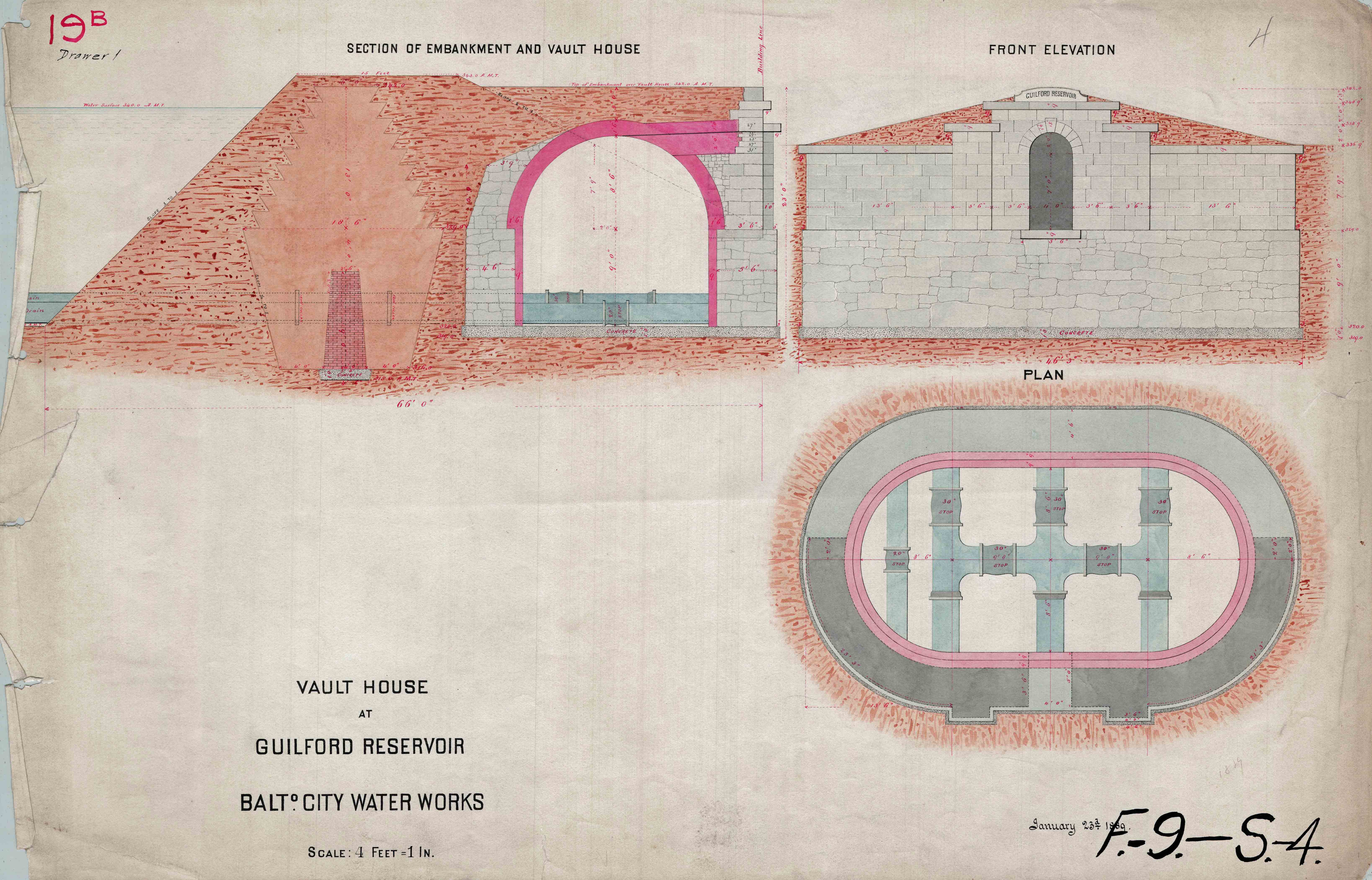
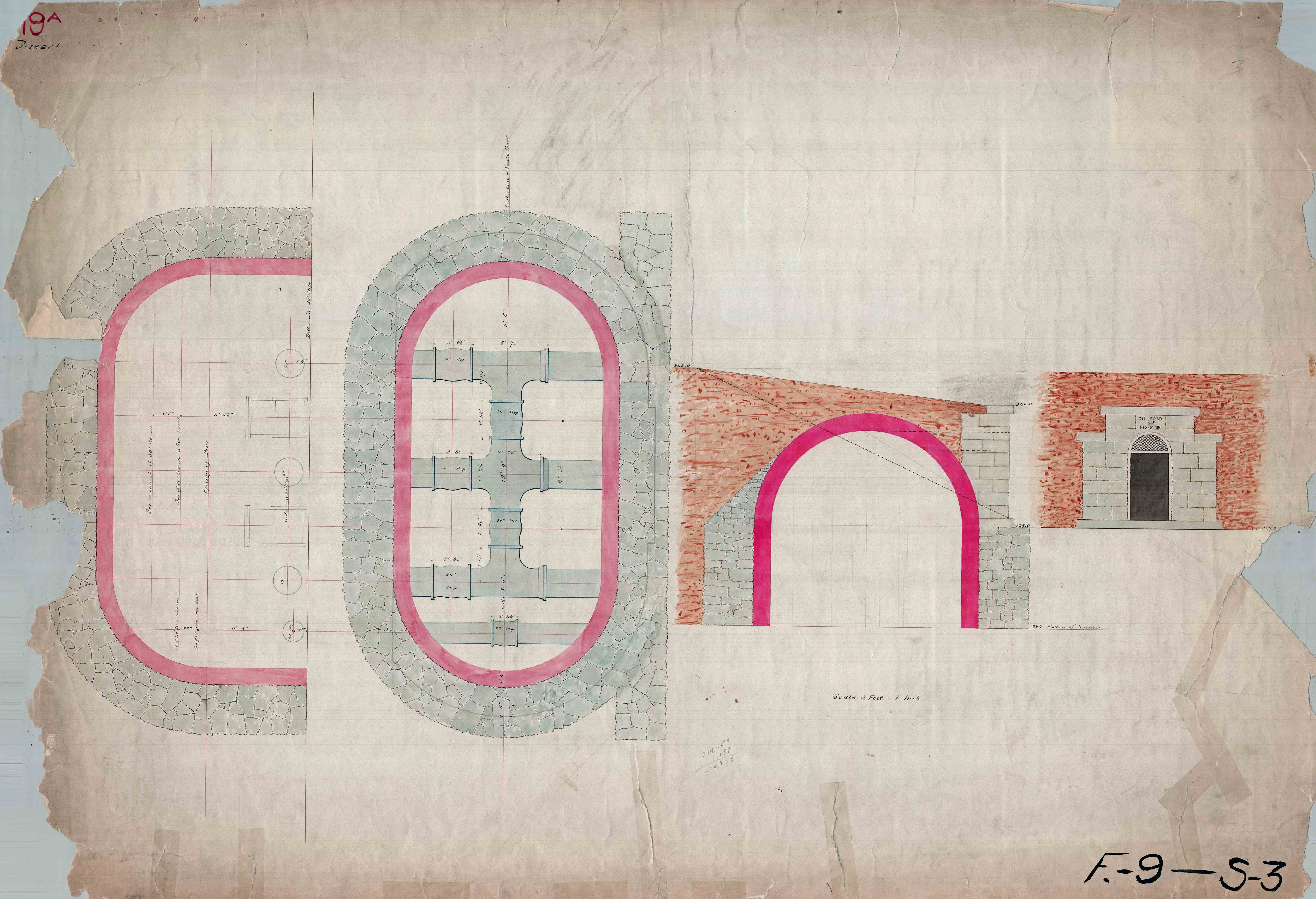
An earlier drawing without the date on top stone of vault.

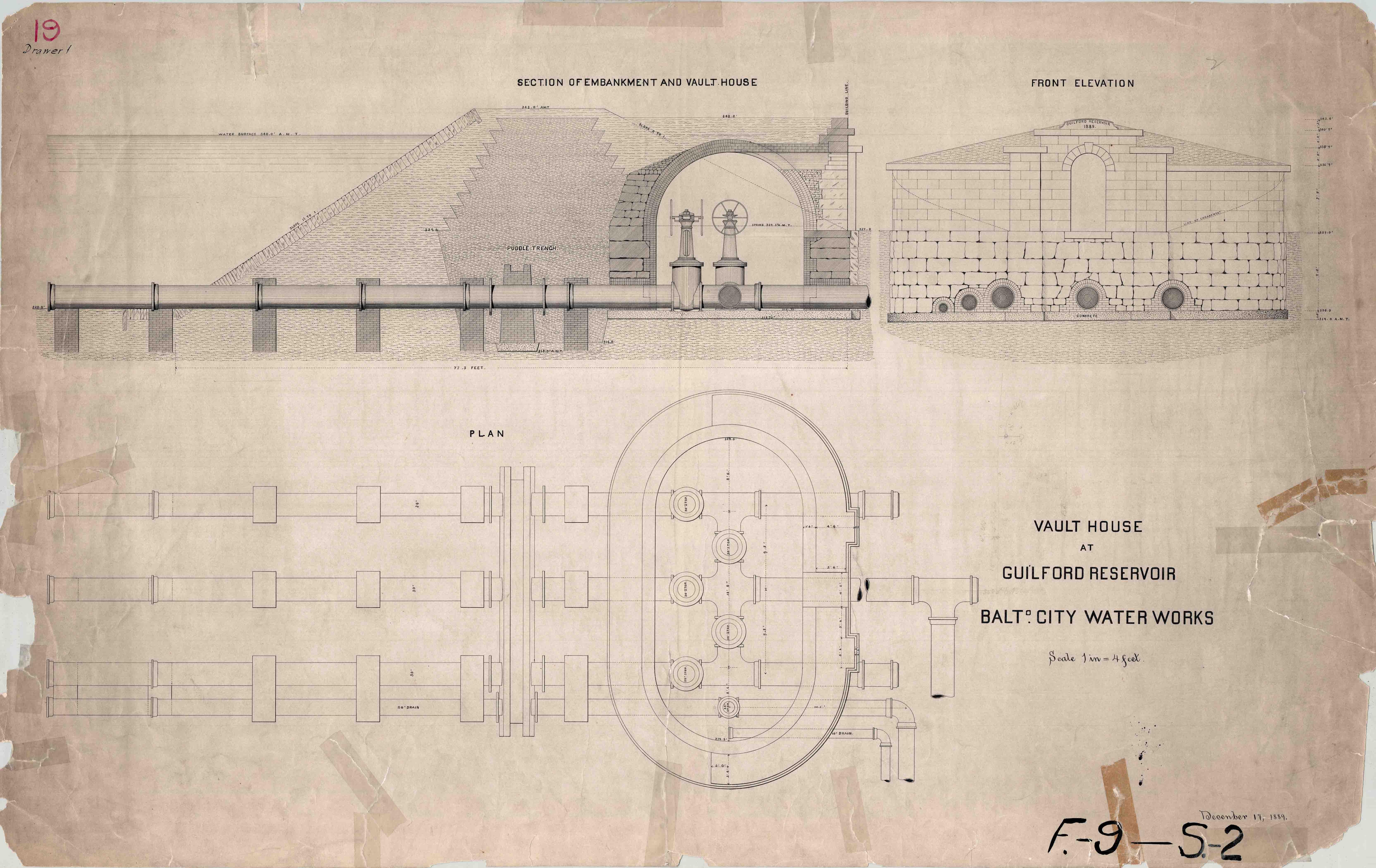
A later drawing for construction purposes, showing the date. The connection of this reservoir to the water system is documented in the Early Water History: 1889 – Eastern High Service Pumping Station: A contract was awarded to Henry R. Worthington Company for the erection of the Eastern High Service Pumping Station at the corner of Oliver and Ann streets. The pumping station will have a heavy duty pump with a capacity of 5 million gallons per day for the Guilford Reservoir and ultimately for increasing the water supply in Druid Lake. Supplying Druid Lake is a result of decreasing flows of the tributaries supplying Lake Roland; and of the increase in water demand to the higher elevations. The pipeline installation connecting the Eastern Pumping Station to the Guilford Reservoir was nearly completed during the year. The construction of the Guilford Reservoir was proceeding at a good pace. The excavation was completed, the vault chamber was constructed, the puddle trenches in the embankment surrounding the reservoir were sunk to the requisite depths, and the mains to the reservoir were installed.

Another drawing by years end. Interestingly the date on the vault house is 1889, but a recent search shows the date as 1893:

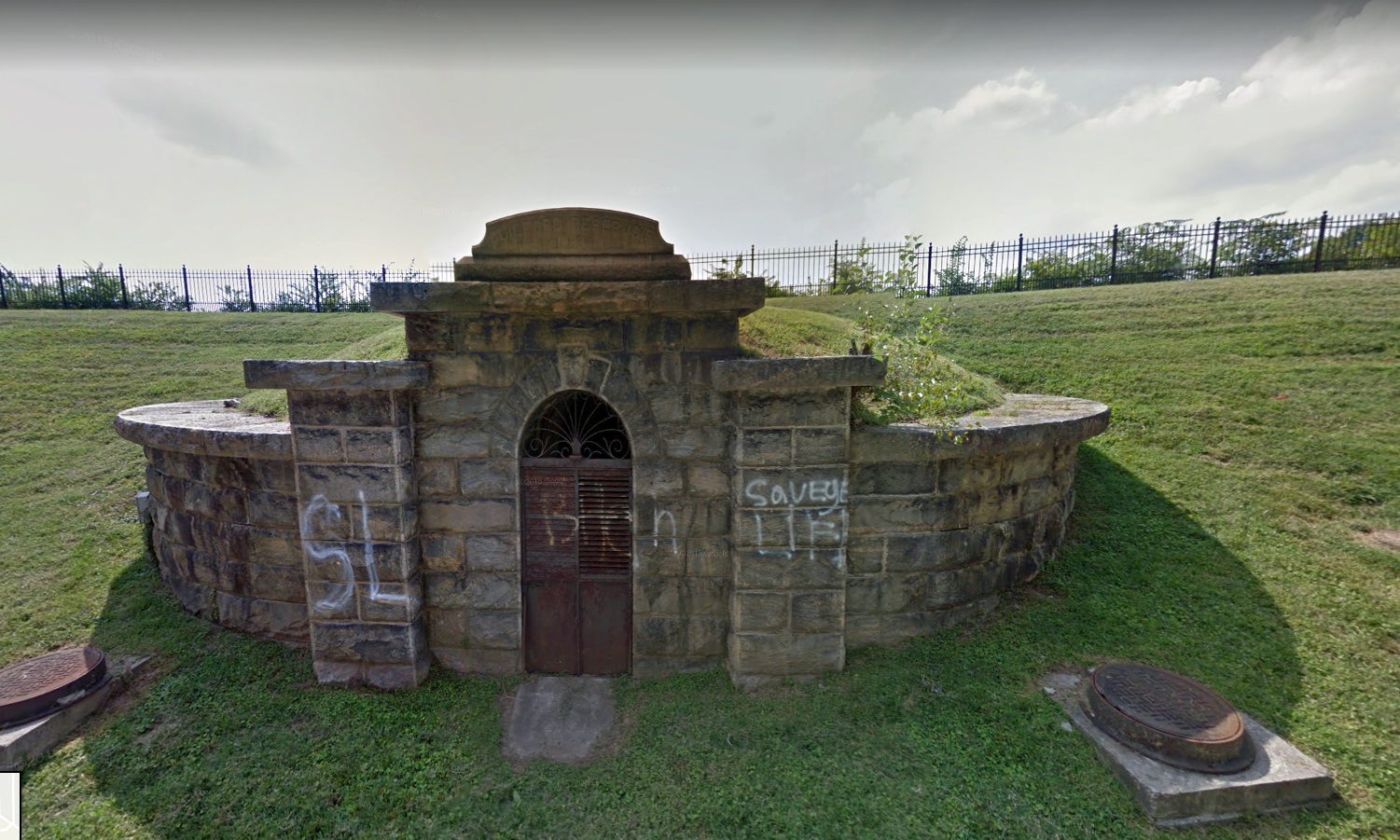
Hard to see the date on the top stone in this street view. From the history: 1893 – The Guilford Reservoir was completed on June 29, 1893 and placed into service supplying finished water to the public. By 1895, the water consumption from the Guilford Reservoir averaged 400,000 gallons per day.

This drawing is from 1894. I did not know there even was a fountain in here. The two times I went to the reservoir for work was a few years ago for a CL2 leak and just recently to see the work going on there.

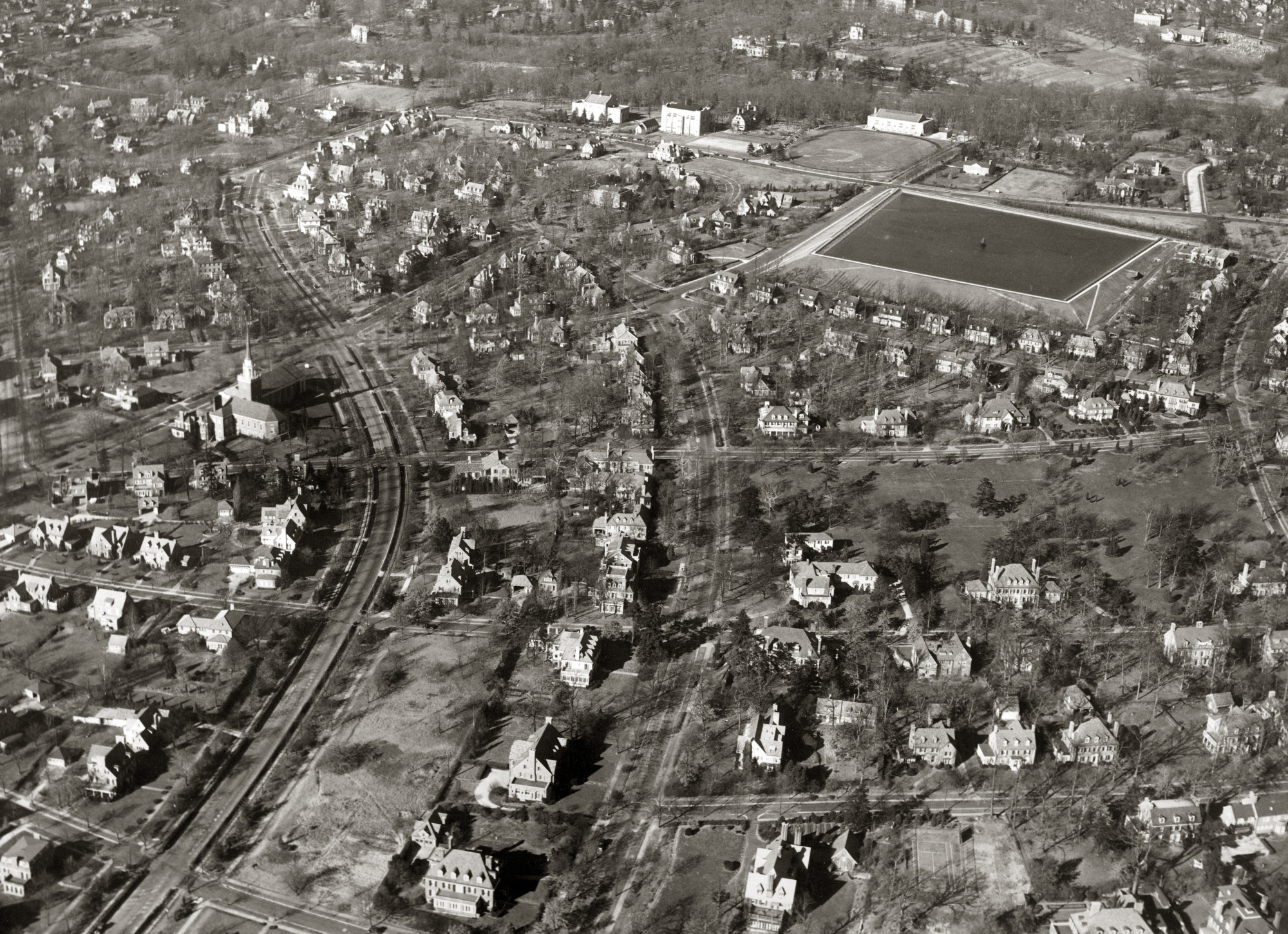
In this 1938 aerial view, from the Baltimore Sun, Dark Room series, you can see the fountain in the center of the reservoir and the valve vault on the right hillside.

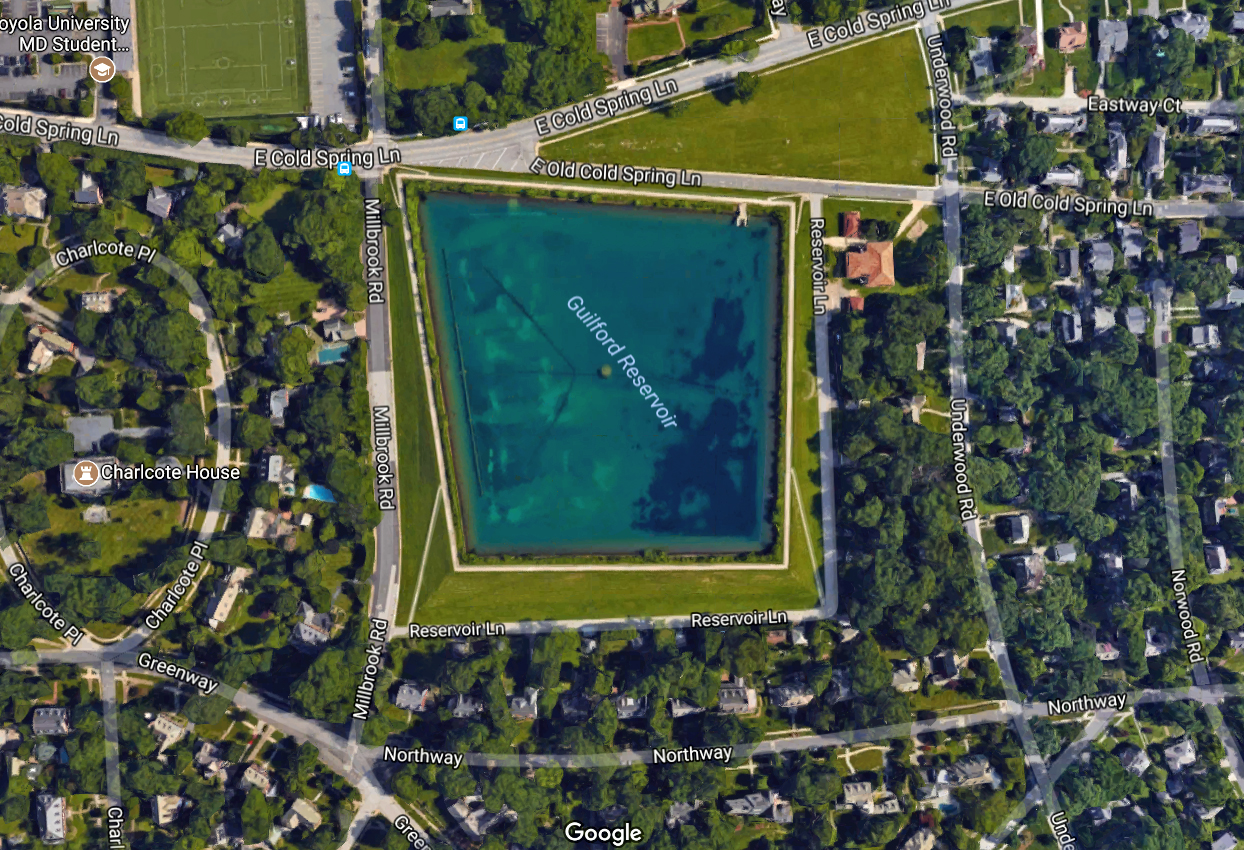
Here is an overhead shot a couple years ago.

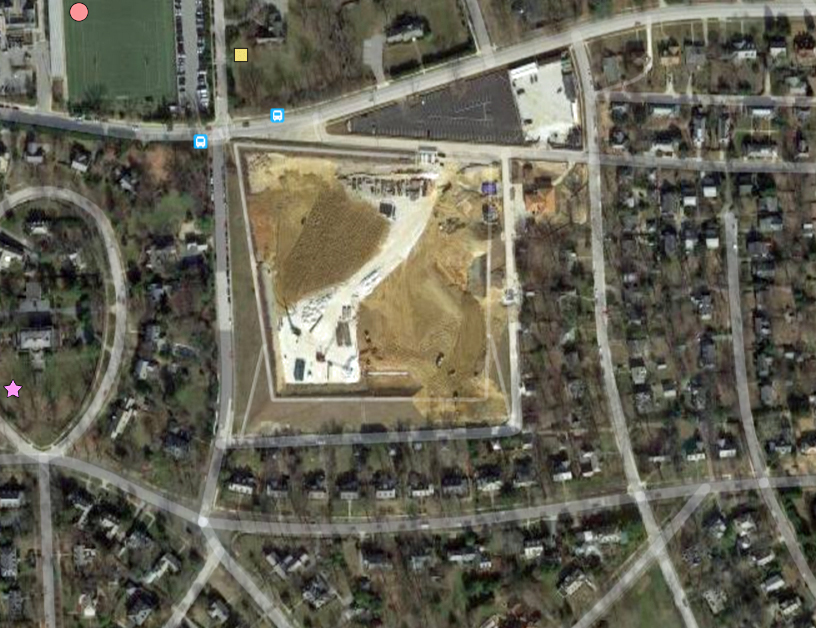
And here is another, showing the construction to cover the reservoir (actually installing new tanks).

Druid Lake a.k.a Lake Chapman

17 Friday Nov 2017

Posted by Ronald Parks in engineering, HISTORY, water history

≈ Leave a comment

Tags

Baltimore, Dams, Druid Lake, engineering, HISTORY, Jones Falls, Lake Roland, Public Works, water history

From the Water Engineer’s office – drawings and history of Druid Lake. A Google search will give various histories of the lake. This history comes from the actual Water Engineer’s reports to the Mayor at that time:

1863 Druid Lake (Lake Chapman): City authorized construction of lake and reservoirs in Druid Hill Park and the land adjoining. Also authorized to lay pipe from Hampden Reservoir or from the conduit to a reservoir or reservoirs within the park. Heavy rains had caused the Jones Falls water to be muddy, hence the need to construct Druid Lake. Work started on March 7, 1864

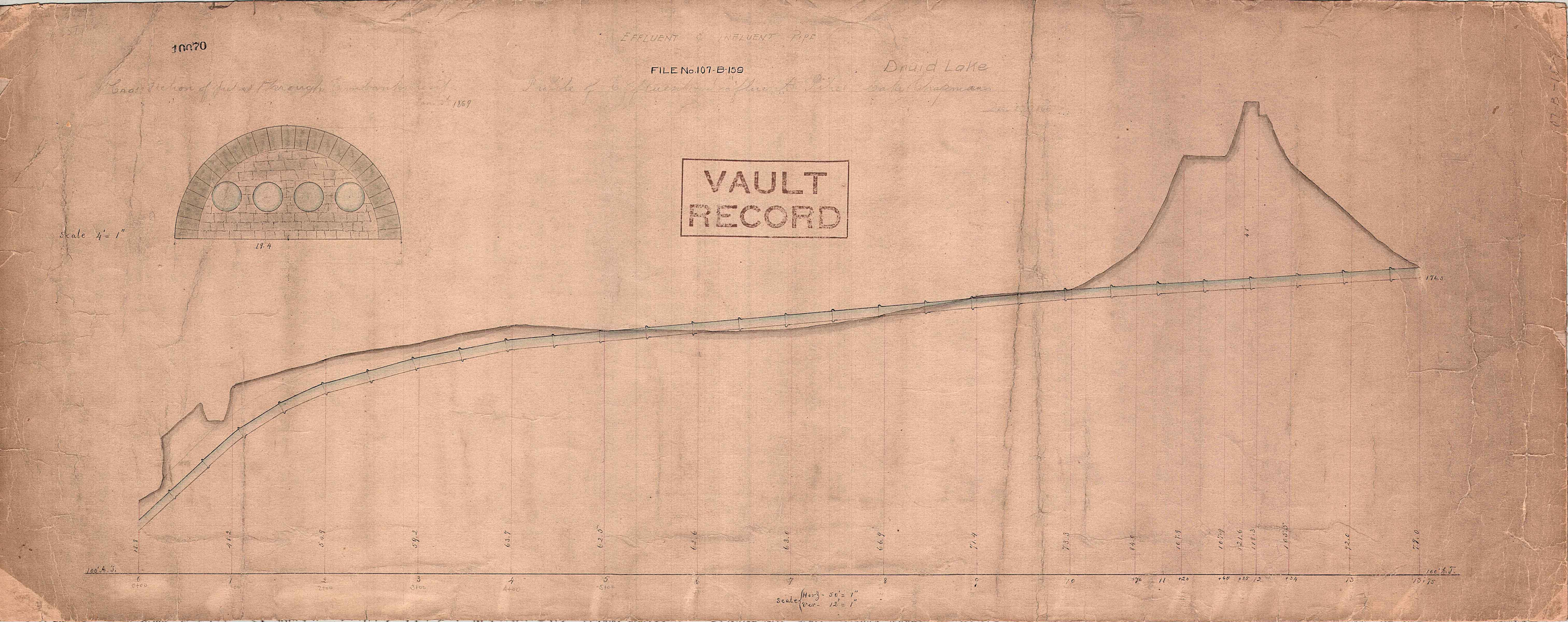
Although the writing on this drawing is hard to read, from what I could read it states: 1869, Cross section through [pipes?]. Effluent and Influent [?] Lake Chapman ^ Druid Lake December 2[?] 1869[?] What I like about this is that it is the first drawing that I have seen where Druid Lake was called Lake Chapman.

1867 Druid Lake (Lake Chapman): Completed Lake Chapman, 429,000,000 gallons, capable of holding a supply of water equal to 40 days of consumption. Lake has nominally the same elevation as Hampden Reservoir, but is usually about 5 feet lower.

1868 Druid Lake (Lake Chapman): March 30, Res. No. 111, changed name of Lake Chapman to Druid Lake.

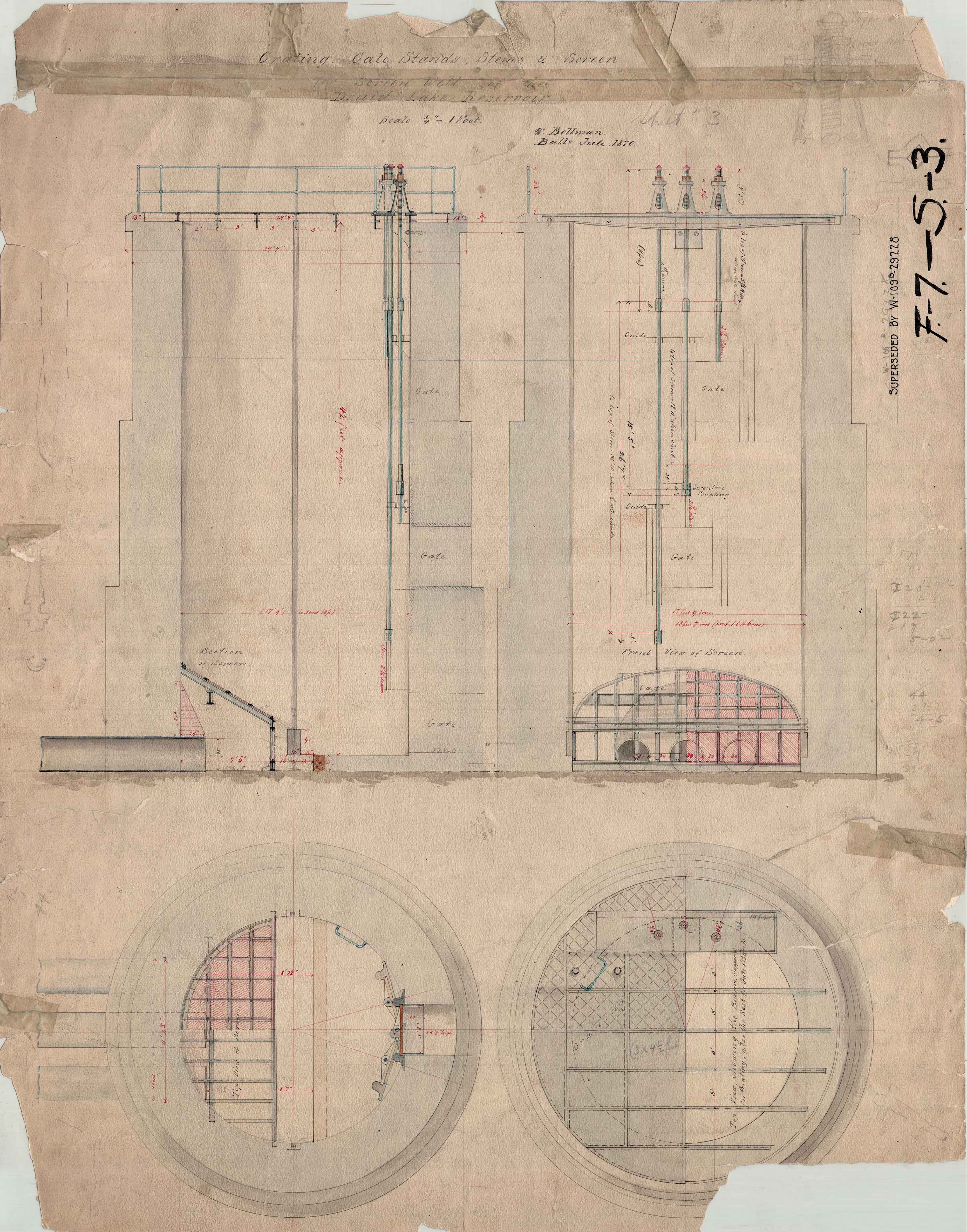
Another hard to decipher drawing: W. Bollman(?). Balto. Jule(?) 1870. Grating, Gate Stands, Stems and Screen for screen well at Druid Lake Reservoir.

1870 Druid Lake: The inside portion of the Druid Lake dam was completed in 1868 except for the remaining top 30 feet of the required elevation, and had remained unfinished during the year 1869. Work on Druid Lake resumed on May 2, 1870. The Druid Lake Park Reservoir is completed and water is first let. Druid Lake has a storage capacity of 493 million gallons, but only 429 million gallons to be available for City use. This equates to 40 days of water consumption which would allow ample time for Lake Roland to settle after the heaviest rains. The extreme water depth at the foot of the dam is to be 65 feet. The extreme water depth at the upper end of the dam is to be 20 feet.

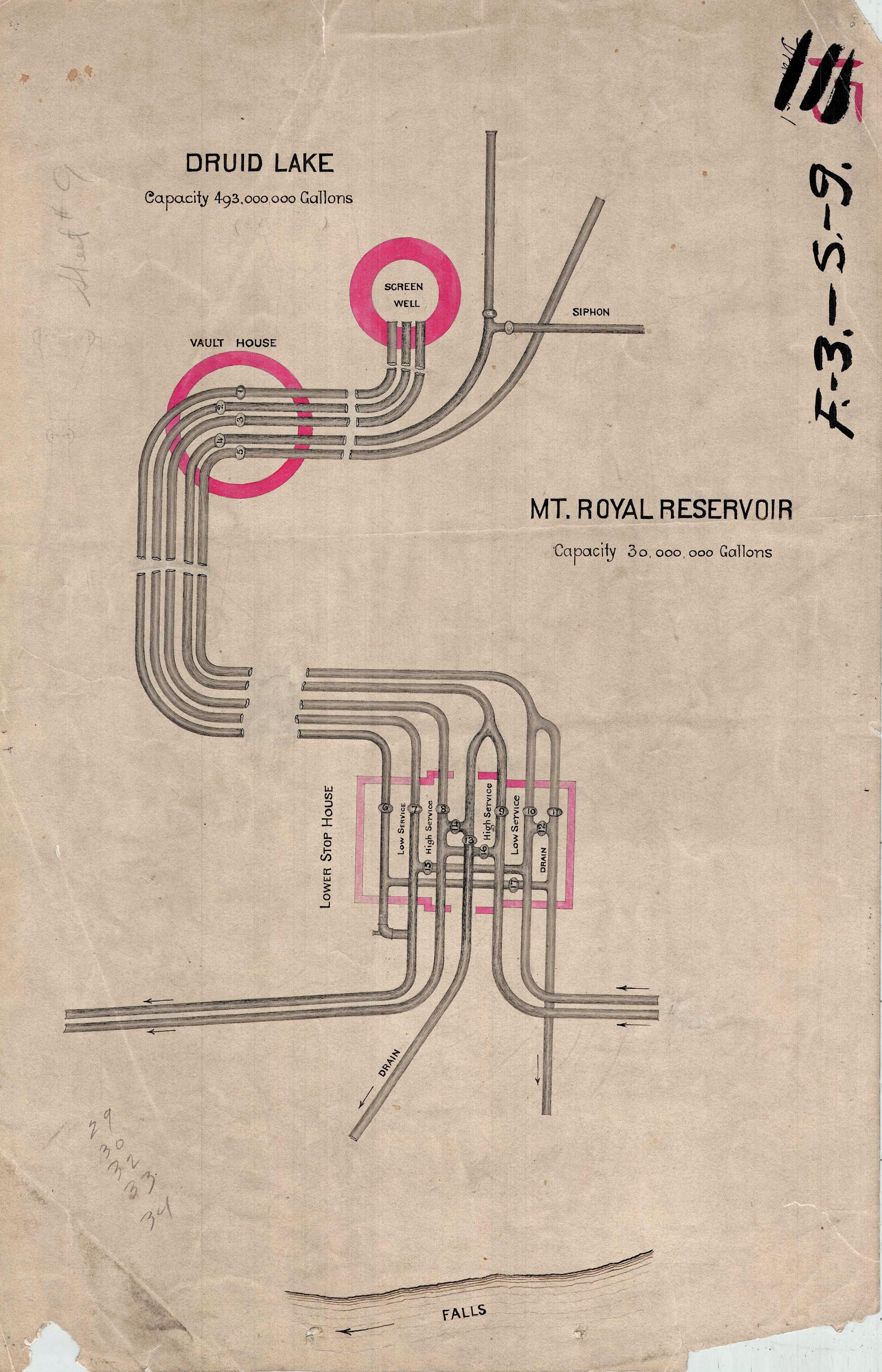
Druid, Mt. royal and Hampden Reservoir were all connected through various series of pipes. In 1898 (for year ending 1897) it is reported that the water conduit from Lake Roland to Hampden Reservoir is a brick conduit, and the water is then delivered from Hampden Reservoir to Druid Lake by means of four 30-inch cast-iron pipes.

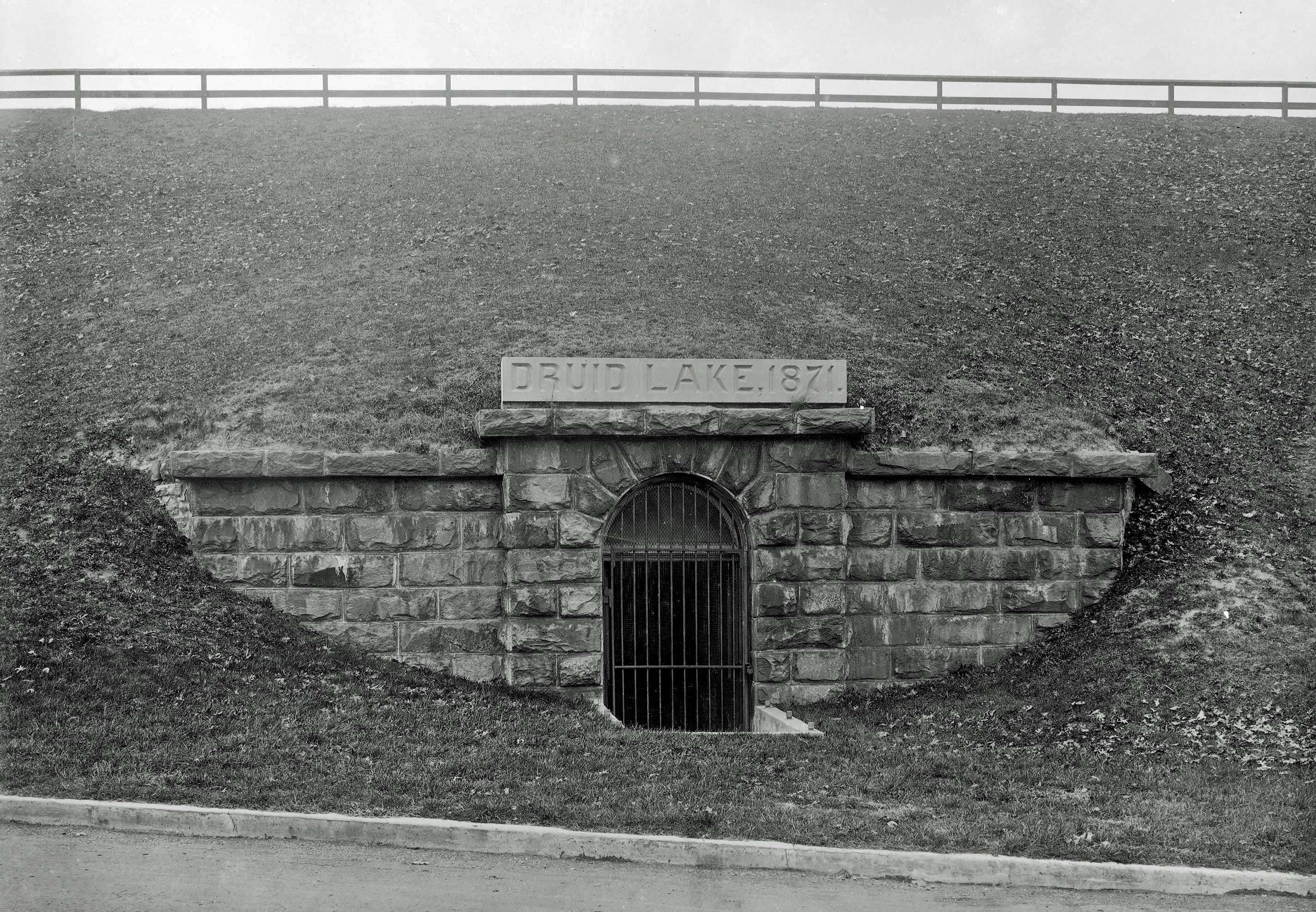
Photo of valve vault at embankment.

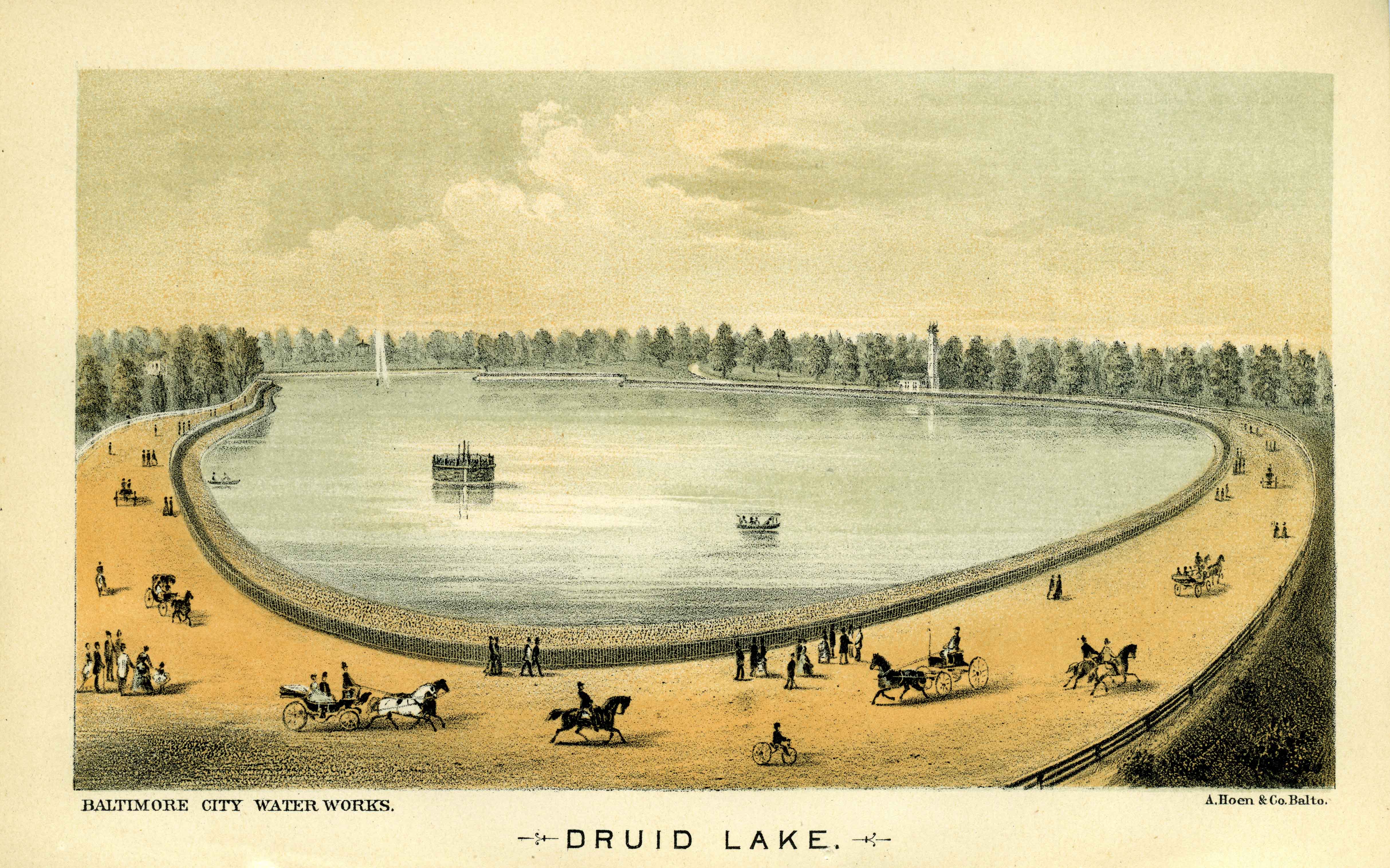
From the Water Engineer’s report to the Mayor – Hoen lithograph.

Another drawing of the lake. Looking close to the upper left I believe that was the keeper’s cottage. To the right is the High Service Reservoir Pump Station.

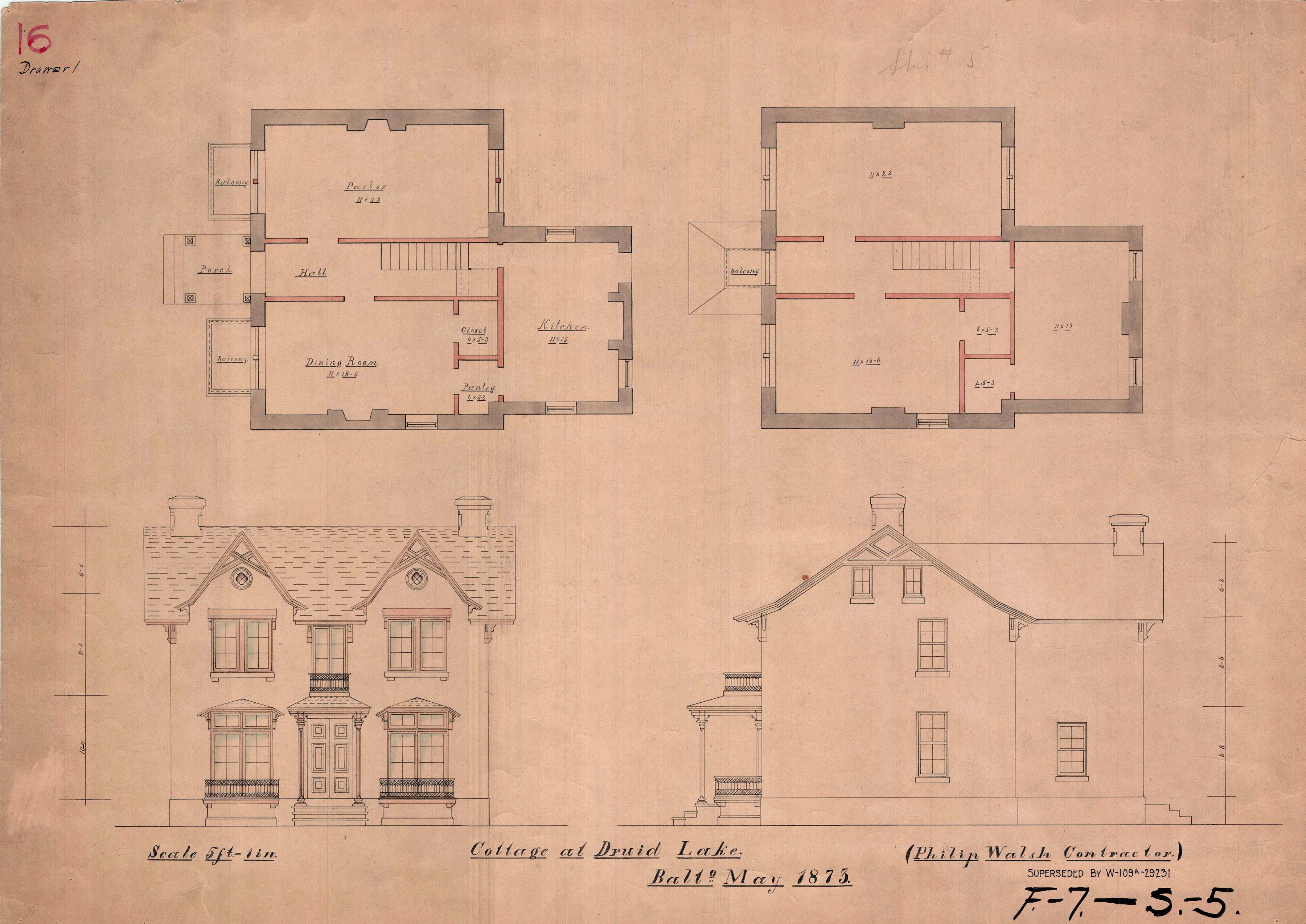
The cottage at Druid. 1873. Philip Walsh, contractor.

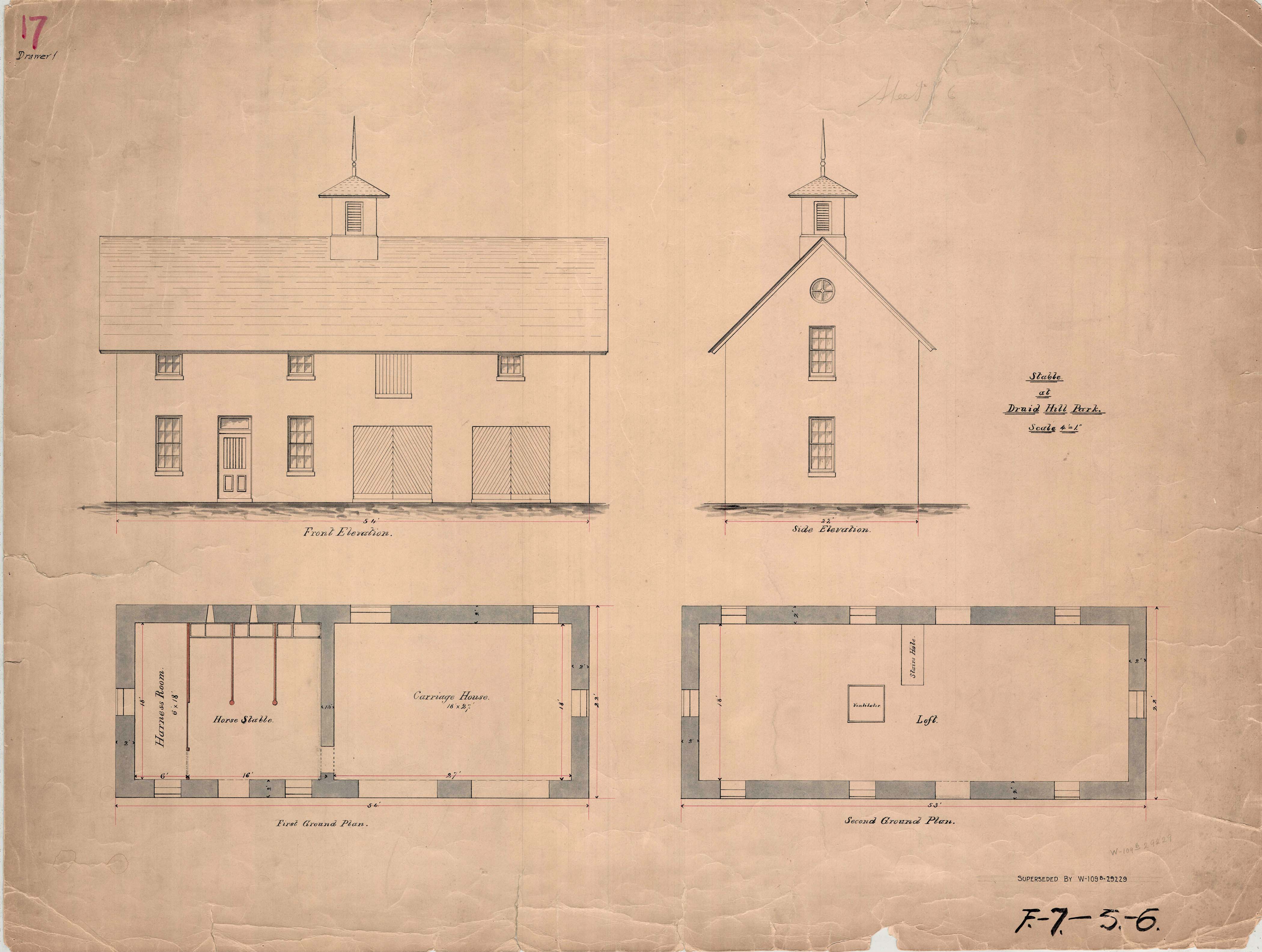
The stable for the cottage.

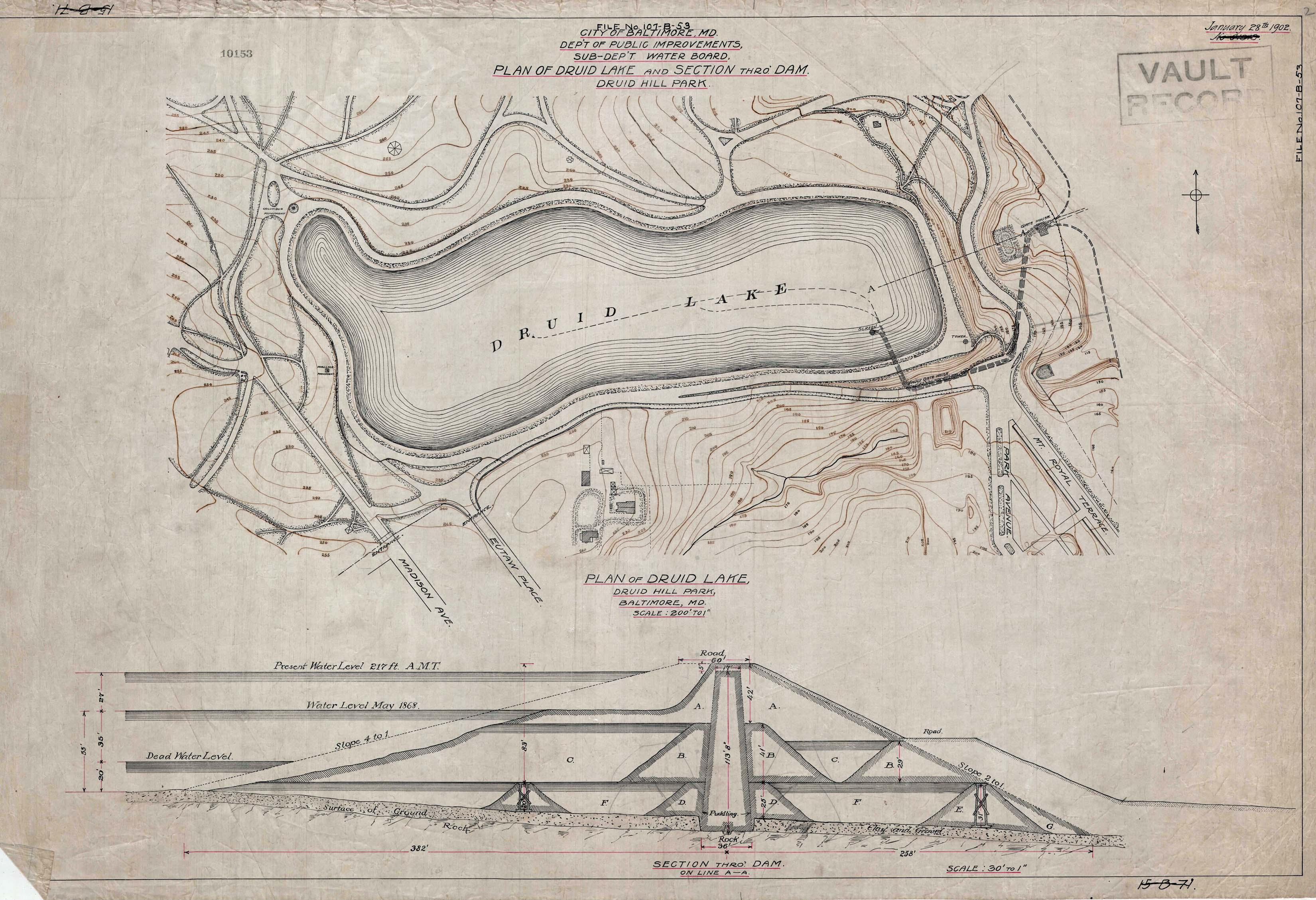
Not sure of this drawing from 1902. It is saying that the lake is 118′ deep?? An earlier report puts it at 65′.

Another 1902 drawing.

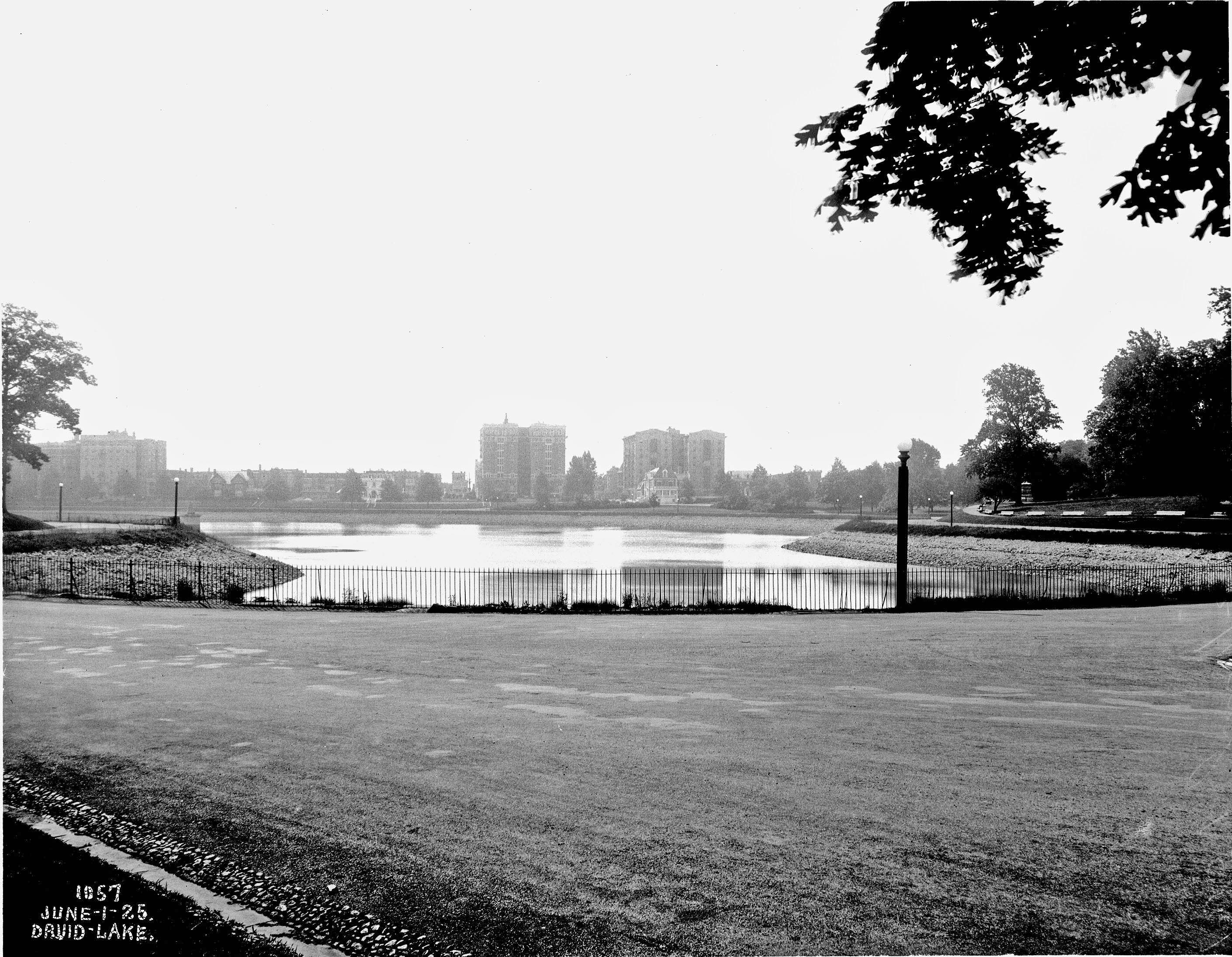
Looking across Druid Lake in 1925.

High Service Reservoir

08 Wednesday Nov 2017

Posted by Ronald Parks in Baltimore, engineering, water history

≈ Leave a comment

Tags

Baltimore, Druid Lake, HISTORY, maps, Public Works, Research, water history

I know this is not a very good drawing but I appreciate it nonetheless. I love the detail that went into this.

This is the pump house for the High Service Reservoir (HSR) in Druid Park. A lot of times when talking to people, when I mention the HSR, they assume I am talking about Lake Ashburton. Because the City was constantly growing the HSR steadily moved north.

110-A-98

Here is another cut away view.

WesternHighService1b

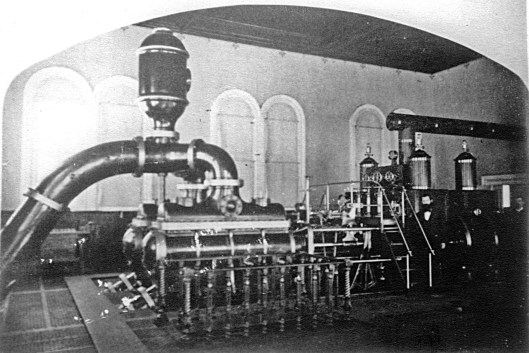
This early photograph shows the pump room.

WesternHighService1a

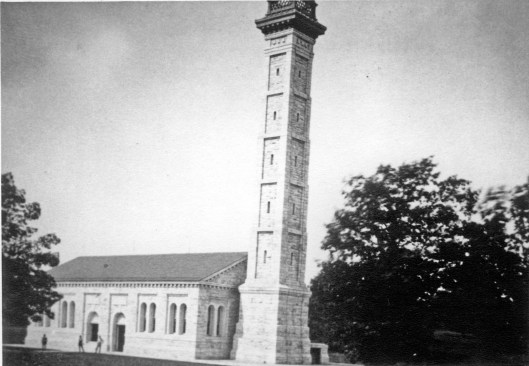
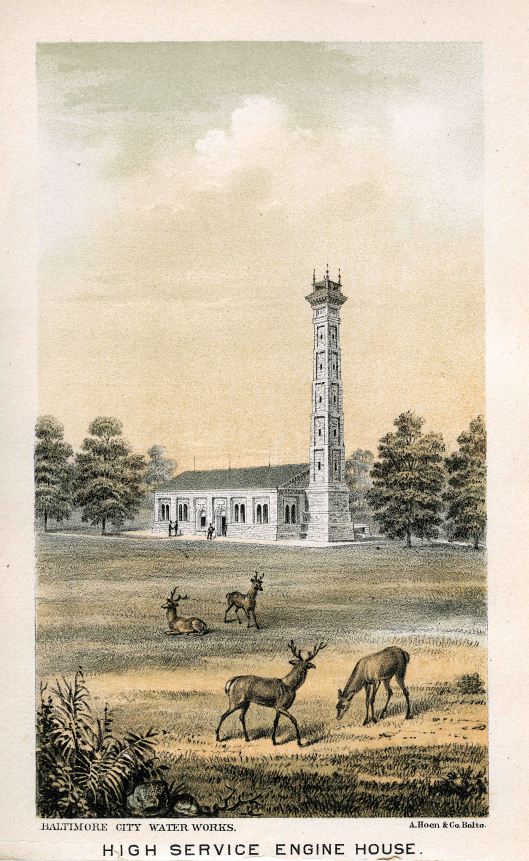
Here we have a photo of the exterior of the building. This photo was used by A. Hoen and Company to create the drawing used by the Water Engineer in his Annual Report for 1875. As shown below.

hsr005

This particular report had many Hoen drawings. (Lithographs).

007

Some things don’t change – today the deer were hanging out at the Dewatering Pumping Station at Montebello.

Druid Park

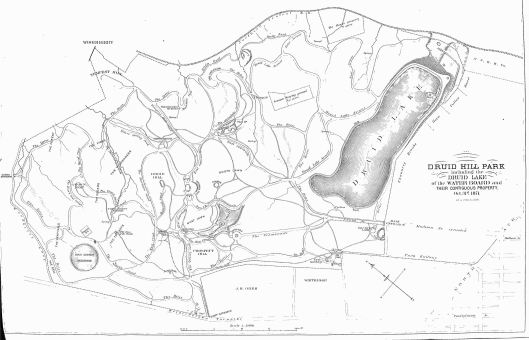
This is a drawing of Druid Hill Park in 1871. The HSR is lower left. In 1861 the Hampden Reservoir supplied the High Service Zones in the City. In 1873 the HSR above, was called the Pimlico Reservoir and it held 26 million gallons. In 1874 the City used water from the HSR to supply the fountain in Druid Lake (They are supposed to fix the fountain under the new contract going on now). In 1891 the Guilford Reservoir supplied the High Service and then in 1909 Lake Ashburton was the HSR.

Water History Drawings

03 Friday Nov 2017

Posted by Ronald Parks in Baltimore, engineering, water history

≈ Leave a comment

Tags

Baltimore, bricks, engineering, Gunpowder Falls, HISTORY, Lake Montebello, Montebello, Public Works, Tunneling, water history

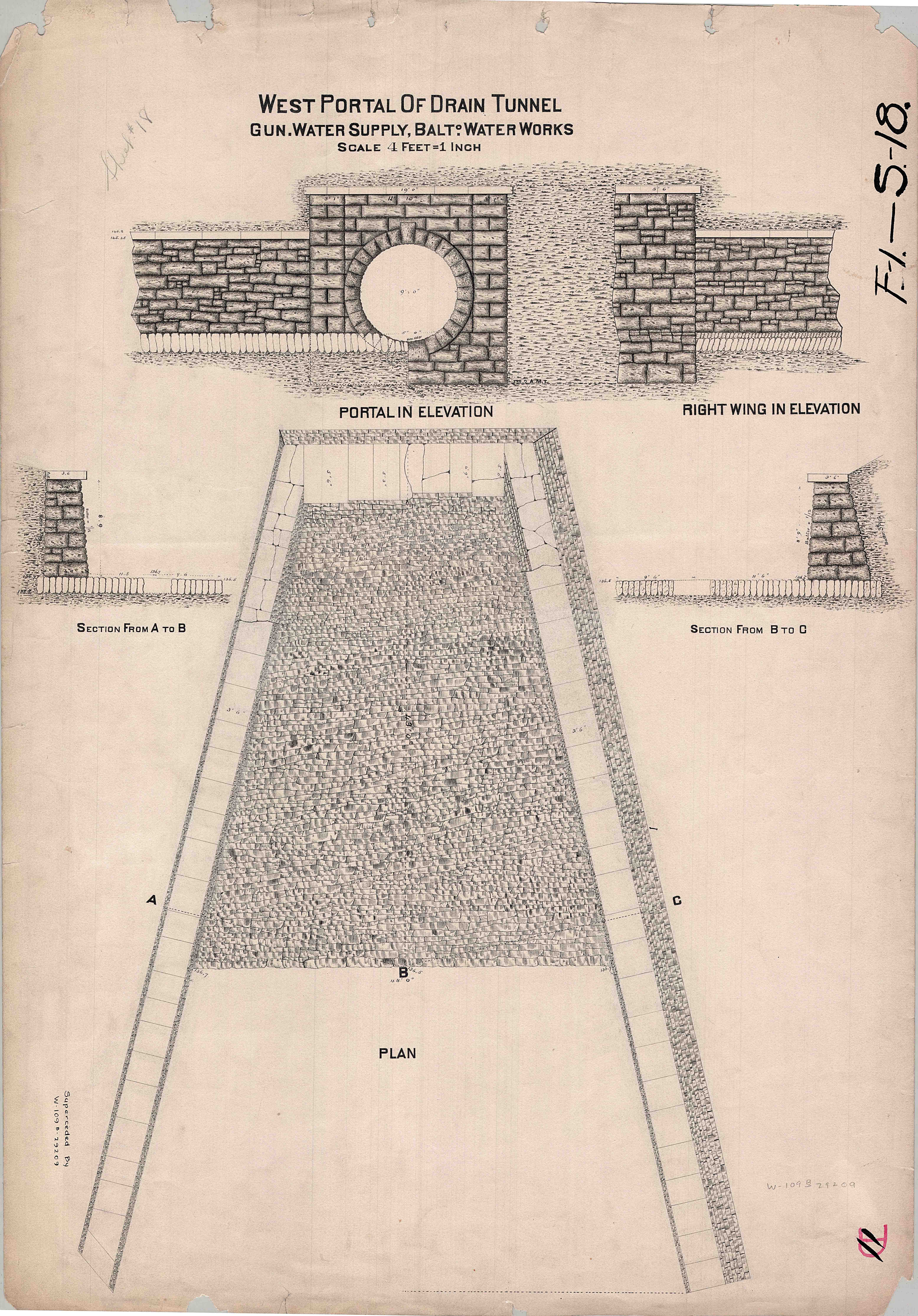
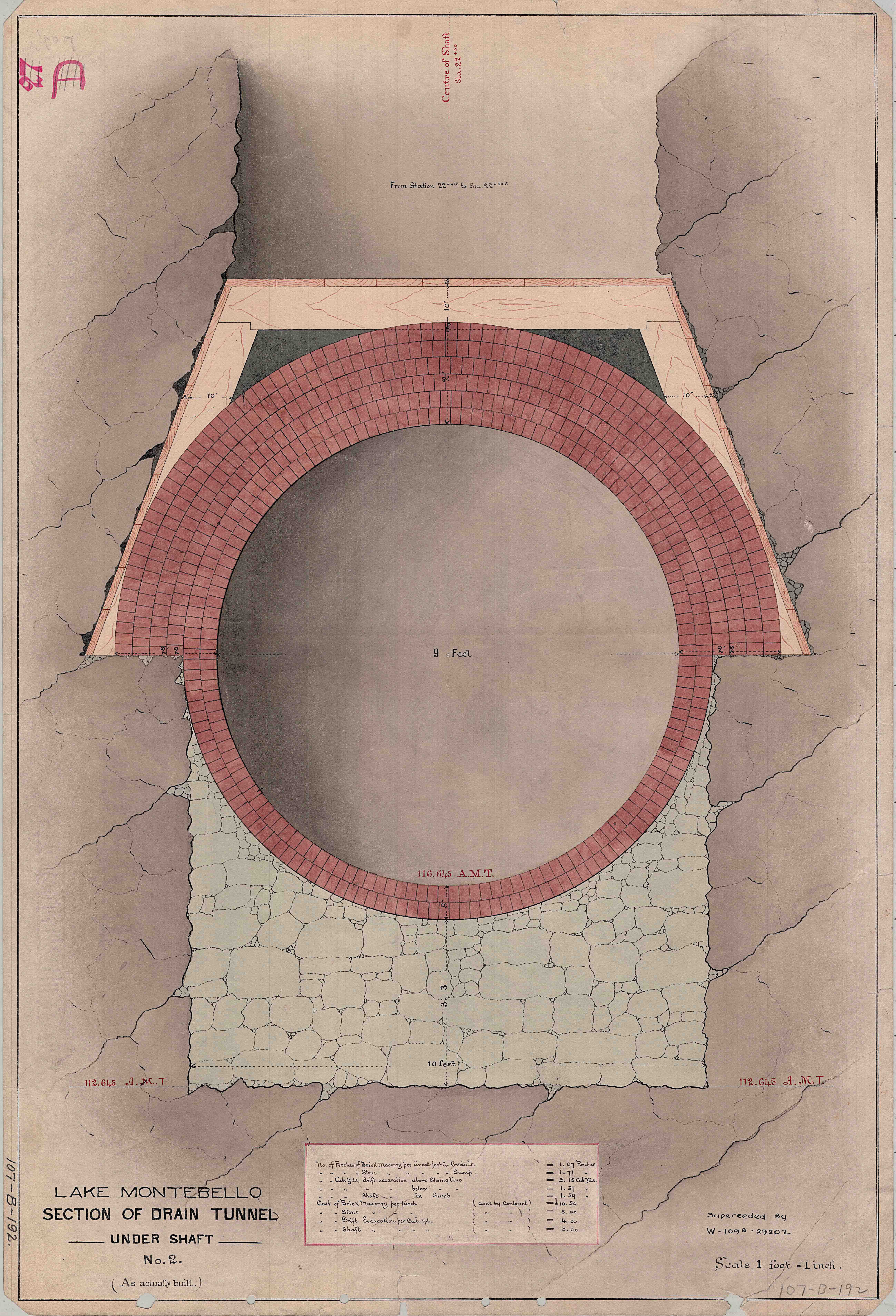
I love it when engineers, from the real world outside of Montebello, send me historic drawings. Not only did he send me some really nice ones, he gave me a link to thousands of others. I’m glad someone else in the Water Department, besides me, is saving our history. Here is one that threw me off at first glance.

I know where the drain tunnel is off of Lake Montebello, but looking close at this drawing and at a recent photo I had taken of the drain where it enters Herring Run, something just didn’t look right.

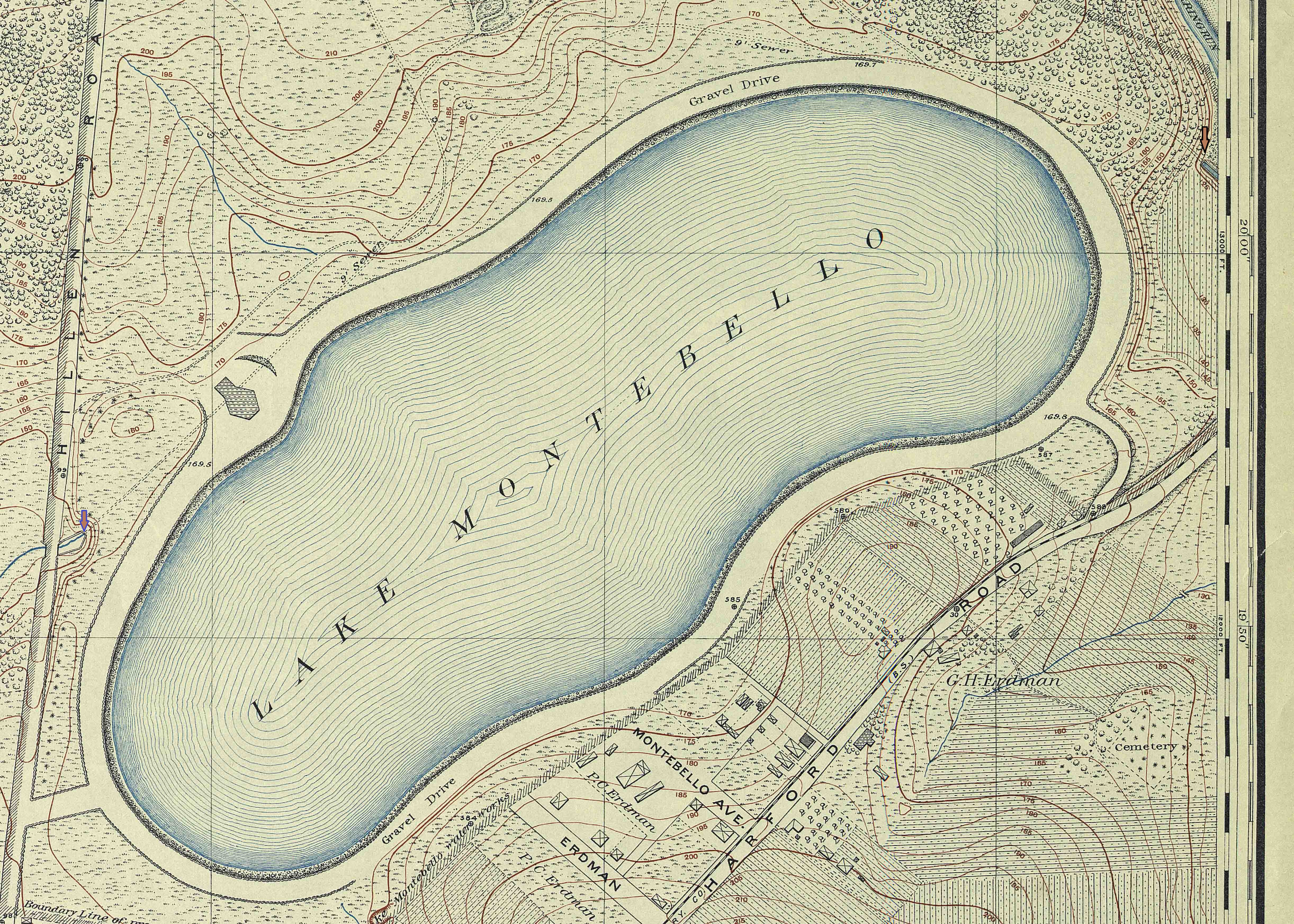
Here is the photo from my inspection down there. Looks about right, but, the drawing says it is of the West Portal? West? This is east of the lake as shown in the 1894 topography below.

To the right of this kidney bean shaped lake is a small arrow pointing to the drain. Then looking close to the left, near Hillen Road is another portal. This is west. Also, the top elevation of 146′ matches the drawing. The east portal top elevation is about 120′. I wish I had photos of when this structure existed. It is all built over now. Under Hillen Road is a large storm drain – 9-12′ that goes into the gate house (Structure with unknown quarter moon shaped object next to it).

Here is another drawing, unknown location because all the shafts were filled in. (Unknown, even though it gives the station as 22+50. Without the overall view, I’m not sure where the engineer started his stations? 2,250 feet from where?

It shows how they built these tunnels, by hand, through solid rock. Bottom legend shows cost and materials. Thanks Engineering!

Eastern Pumping Station aka Food Hub

25 Wednesday Oct 2017

Posted by Ronald Parks in Baltimore, engineering, water history

≈ 7 Comments

Tags

Baltimore, engineering, FILTRATION, glass plate negatives, HISTORY, Lake Clifton, photography, Public Works, Research, Sewage History, water history

Went to check on the status of the work being done at the old EPS down on Wolf St. (Not to be confused with the Eastern Avenue Pumping Station). The first thing I see is a new roof on the old Gay St. Yard, which later became City S/R 06 then part of the Transit and Traffic storage yard. 

Below is what the building looked like when it was first built.

This was about 1902. 

Sign on the gate showing what is going on. The gate was opened so I invited myself in. Something I’m not sure of, because I thought the Pumping Station was a Historic Place, why does this banner show it as a flat roof (green)?

The building to the right is what it originally looked like. 

This building was just recently put up. It is called the Food Incubator (Best to go to the Foodhub website for more info on this) I went inside here to find the general contractor to ask permission to roam around. Granted. He told me the City no longer owns these 3-1/2 acres. They were bought. And soon to be rented out. The new roof, as shown in the first photo is only to help protect the property. It will be up to others to fix the buildings.

The pumping station ready to be rented out. Someone actually went thru and cleaned the inside of these buildings. I was here in 2014 and it was a mess.

Hallway up to the 2nd floor.

A room with a view.

Heading towards the next building…

Last time I was here, I was able to go up and down this spiral staircase.

Last night’s rain splattering on the floor.

These shots are all of the old maintenance shop. They made valves and hydrants here.

The maintenance shop, in middle, and the storage yard. P.S. to left. 

I think this sign should have been at the front gate?!

I believe this was the workmen’s bath house. It is completely gutted now.

This is the rear of the first building with the new roof. Steps inside are shot, so I took the scaffold up.

Nice new roof. 

Headed across the yard to one of the shops/carriage houses. The blacksmith shop had burnt down a few times.

Here is what the above building use to look like.

Hard hat area.

Looking from stables back towards main buildings.

Random engineering craziness!

This was from the Food Hub’s brochure. When I was in front of the building, this was all grown over. Although the date says 1890 my notes tell me that this Pumping Station was completed in 1891.

If you send me your email, I will send you a brief word document covering the history of these buildings.

Speaking of Loch Raven – Update

12 Thursday Oct 2017

Posted by Ronald Parks in engineering, water history

≈ 2 Comments

Tags

Baltimore, Construction, Dams, engineering, Gunpowder Falls, HISTORY, Loch Raven, Public Works, water history

These aerial photographs were just sent to me from Corey at www.aceservinc.com

Makes me want to go out and buy a drone! As far as I know, the busted ten foot conduit has not been fixed, but these guys are doing an exceptional job on building the new Loch Raven Maintenance Yard and Admin buildings. 

This is a great shot, including the dam in the background.

Another view of the same area.

Up the road a piece is the new admin building. The abandoned Zebra Mussel Station is in the background.

Thanks Corey.

Lake Ashburton 1908-1910

04 Wednesday Oct 2017

Posted by Ronald Parks in Baltimore, engineering, Photography, water history

≈ 4 Comments

Tags

Baltimore, Dams, engineering, FILTRATION, glass plate negatives, HISTORY, photography, Public Works, water history

More files, more documenting. More work. As stated before, I am trying to get my archive files in some sort of order so that at a later date, it will be easier for people to find things. (Not that I really think anyone will go through this stuff once I’m gone, but I can retire with a clear conscience that yes, I did my job).

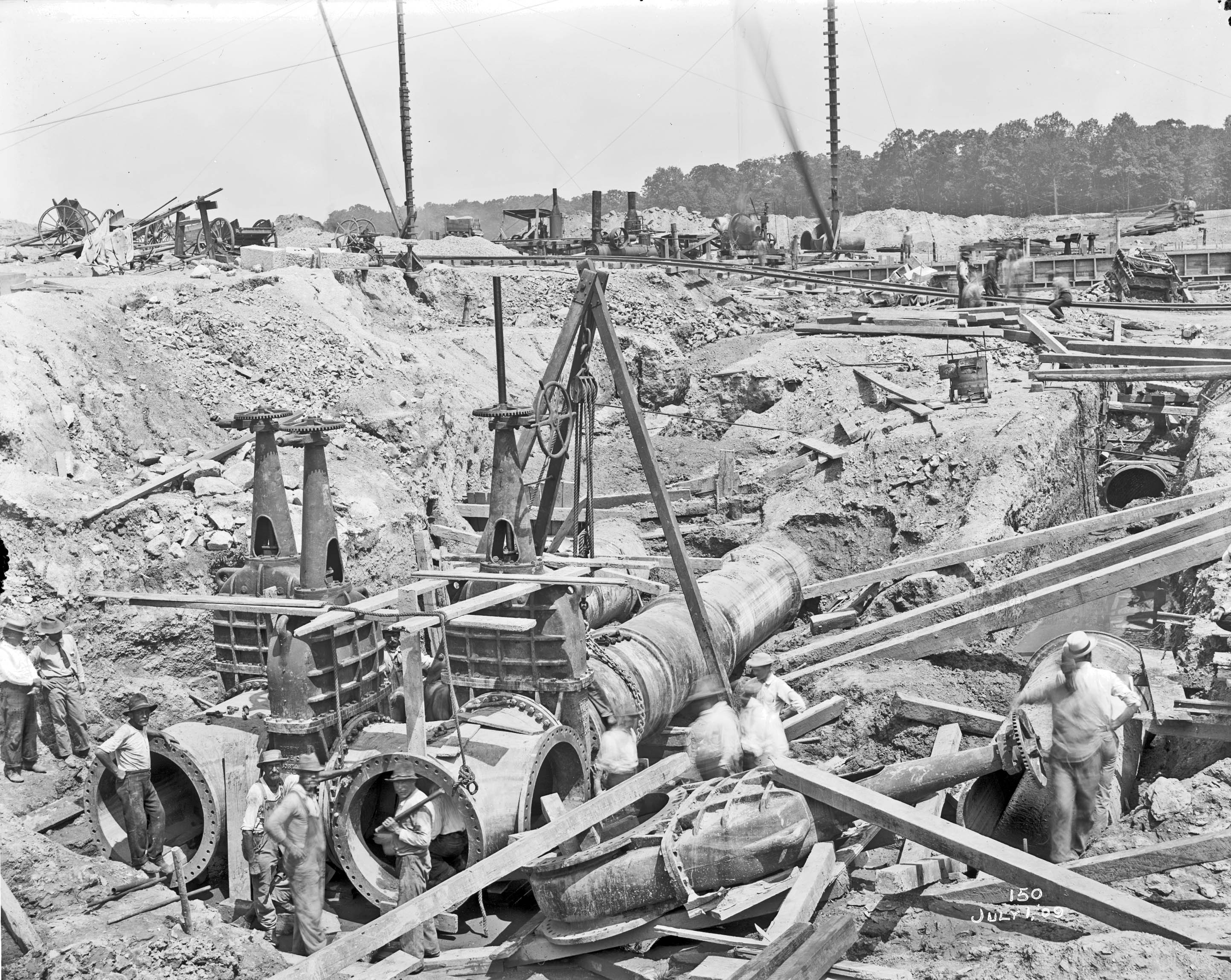
What has made this job difficult, yet interesting, is that various people have had numerous boxes of archives scattered throughout the City. A lot were mislabelled. These photos came from a box of glass plate negatives marked as ‘Loch Raven’ Bringing it all together in some sort of order is challenging. Chaos:

It is hard to believe that out of this construction chaos there will be built a reservoir so that the citizens of Baltimore will be able to enjoy drinking water. These are the pipes from the lake to the gate house (foundation in background).

Many years ago when I started this project, I had no clue about glass plate negatives, positive photos, restoration, etc. When I held the above GPN up to the light I thought it was a bad one – the white shown coming from the pneumatic jack hammers is black on the negative. I thought it was ruined until I processed it. Duh.

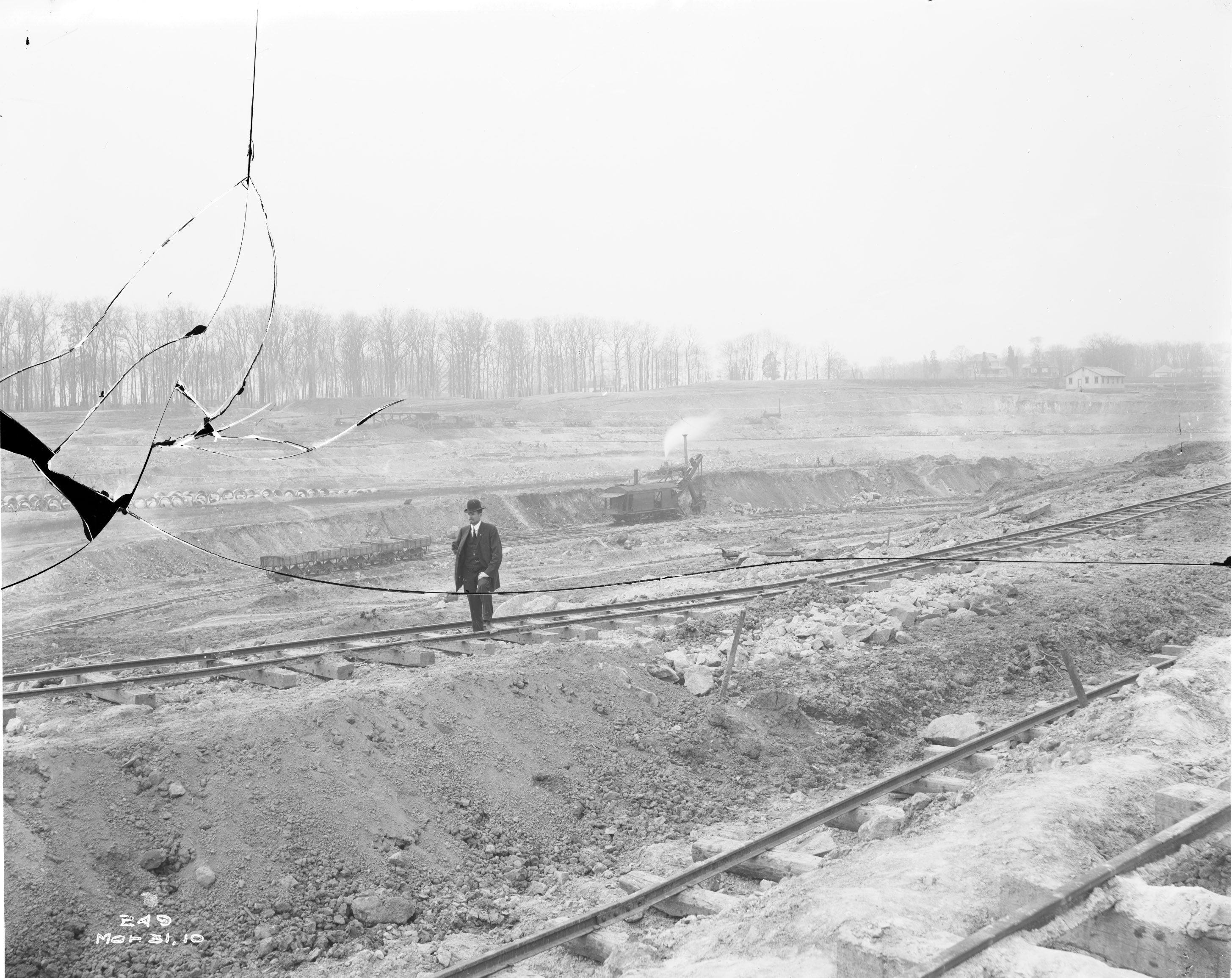
This one I have yet had a chance to restore. What I found interesting here is the suitcase in the upper right corner. Not only is this GPN broken, some of the image has peeled off.

Another interesting one from 1908 shows a church in the background. The writing on the sleeve said: Epiphany College in background.

Before building the lake the engineers had to move and raise the sewer/storm water manholes.

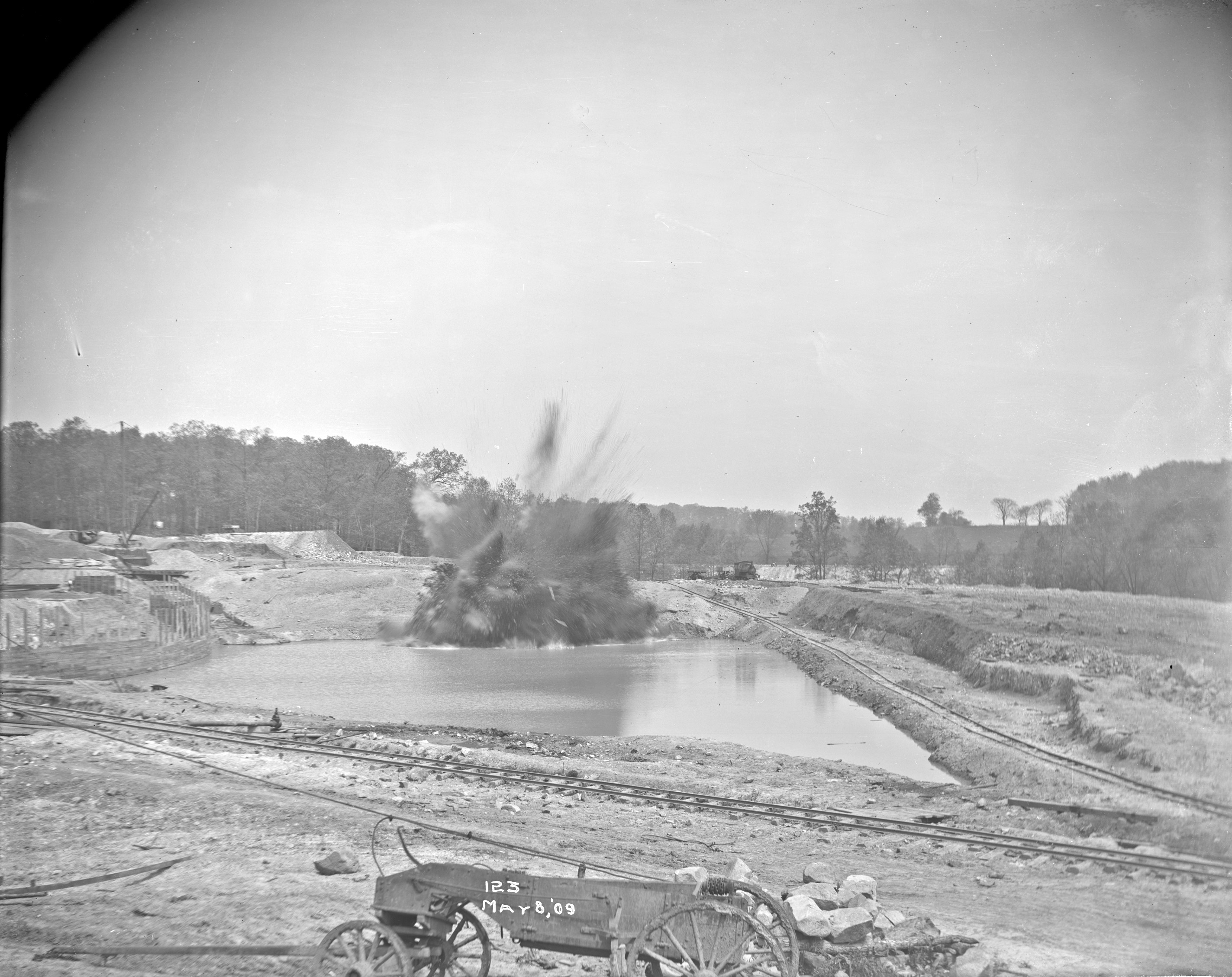
The photographer did a good job catching this dynamite blast at the right time.

This broken jigsaw puzzle plate I did restore.


← Older posts
Newer posts →

Blogroll

  • Flouride Action Network
  • lulu
  • My Book
  • WordPress.com
  • WordPress.org

Recent Posts

  • Bermuda 2023
  • ICELAND April 2023
  • George Chalmers of Fochabers
  • In Search of The Skipjack Ada Mae
  • Trap Pond Kayak

Blog at WordPress.com.

  • Subscribe Subscribed
    • Water and Me
    • Join 231 other subscribers
    • Already have a WordPress.com account? Log in now.
    • Water and Me
    • Subscribe Subscribed
    • Sign up
    • Log in
    • Report this content
    • View site in Reader
    • Manage subscriptions
    • Collapse this bar
 

Loading Comments...