• About
  • History Writings

Water and Me

Water and Me

Tag Archives: Jones Falls

Jones Falls Flooding and Proposed Improvements

14 Thursday Apr 2016

Posted by Ronald Parks in Baltimore, HISTORY, Sewage History

≈ Leave a comment

Tags

Baltimore, engineering, Health, HISTORY, Jones Falls, maps, Public Works, sewage, Sewage History, water history

First map – July 1868. Showing Plat and Sections of Streets Submerged by Flood Exhibiting Proposed Changes Projected to Relieve the City Against Future Overflow by Latrobe, Trimble and Tegmeyer, Commissioners.

The area between the green lines is the flooded zone. The blue is the proposed changes. The grey being the actual Jones Falls. The smaller diagrams show the various streets and how high the water was when they flooded. It appears that the Falls rose about 20 feet in spots. The lower left diagram shows the proposed changes to streets.

A few things I find interesting is; the drawing of the skating pond as being the former City Reservoir (Possibly the second Mt. Royal?), The number of small dams, and all the businesses along the Falls that contributed to the pollution – gas, coal and oil factories, tannery, brewery, sugar refinery, lime kilns, oyster packing and taverns. Not to mention all the residences along the Falls. The City Dock and Block St. drawbridge I will write about later.

Plat and Sections of Streets Submerged

Second map – April 8, 1869. Revised Design for the Improvement of the Channel of Jones Falls and Drainage to Adjacent Portions of the City by H. Tyson. Note in upper left – The original design for this improvement will be found in the report made at the request of the Committee of Property holders of the Flooded District on the 31st of July, 1868.

This map shows the flooded area in a darker tan with numbers indicating the depth of water in feet, i.e. 15’ at Saratoga and Holliday. The proposed Falls is in pink with proposed sewers in red. The Falls is green.

Interesting with this map are the cut-away views showing sewers of Brooklyn, NY and of London. Also the cut-away views of the new retaining walls with sewers running along the Falls. I especially like the Baltimore St Bridge drawing with boat. (They dredged the Falls a lot for the passage of ships to merchants. More on that later) Note the wooden pavements above the sewers in the lower diagrams to the left. Houses and businesses were also built over the sewers. If you are from Baltimore, note that Alice Ann St. was 2 words. Now it is Aliceanna. Canton Ave. is now Fleet St. The note/drawing on bottom shows bridges, then and proposed over the Falls.

Revised Design for the Improvement of the Channel

Tunnel Inspection

06 Wednesday Apr 2016

Posted by Ronald Parks in Baltimore, water history

≈ 1 Comment

Tags

Baltimore, engineering, FILTRATION, Gunpowder Falls, HISTORY, Jones Falls, Lake Montebello, Montebello, Public Works, tunnel, water, water history

Between the years 1875 and 1881 a tunnel, 12′ in diameter 7 miles long was constructed between a dam on the Gunpowder River and a man-made lake at Montebello. This was all part of the new, permanent water supply for Baltimore. It would eventually replace the supply from the Jones Falls. As needed, this tunnel was inspected and found to be in very good condition over the years. The majority of the tunnel is through solid rock with only a few sections having a brick lining. As the City grew, a new dam was built upstream in 1914, with a connection to the 1881 conduit.

In 1933 the City was contemplating a new source of water. The decision was made to build  a parallel tunnel from Loch Raven (on the Gunpowder Falls). An inspection by the consultants was made of the old tunnel first. The below photographs show what they found – rock falls and leakage.

The old tunnel was taken out of service and the new tunnel was used. In the 50s and 60s it was decided to re-use the old tunnel, which carried raw water, to start sending processed water to Baltimore County. An inspection of the tunnel, which at this point being only 5-1/2 miles long (Bulkheads built on each end of the tunnel that were no longer needed) was done in 1968. These consultants, pictured below, found more of the same. Rock falls and leaks. Three of these men I eventually worked with in 1981.

Another inspection was done in 1984. Unfortunately I can not find any photographs. I do have the reports from this inspection and it is not good. More rock falls and leakage. I was asked last year to be a part of a new inspection group to enter this tunnel. I immediately said yes! BUT, over the course of a couple months preparing for this and all the safety people you can imagine being involved, it was decided to send in a remote operated vehicle. Not sure when they will do this, I just know the sub isn’t big enough for me to fit into!

Two quotes came to mind when i was asked “Why do you want to go in there? It is dangerous!”

Valeria to Conan the Barbarian – “Do you want to live forever?” And Lenny and Ziggy singing “Death by Misadventure!”

Pumps at Eastern Ave Pumping Station 1906-1960

30 Wednesday Mar 2016

Posted by Ronald Parks in Baltimore, Sewage History

≈ Leave a comment

Tags

Baltimore, engineering, glass plate negatives, HISTORY, Jones Falls, Public Works, sewage, Sewage History

Pumping Station: The land for a pumping station, located at East Falls and Eastern Ave was acquired by arbitration. The contract for the construction of pumps and machinery was awarded to the lowest responsible bidder, on December 10, 1906, to the Bethlehem Steel Co. of Bethlehem, Pa. for $450,000.

Six Years Operation of the Baltimore Sewage Pumping Station by Keefer. 1915-1923 (From Public Works July 1924) At the present time there are only a few sewage pumping stations in this country equipped with vertical triple-expansion pumping engines. One of these is the Eastern Avenue Pumping Station. The design of this station started in 1906; construction work was begun in 1907, and it was put in operation on January 31, 1912. Since then the station has operated continuously and has given excellent service.

br010r

This photograph was taken soon after the original pumps were installed, showing Calvin Hendrick, engineer. The three sewage pumping engines now under contract will weigh 4,000,000 pounds or more. They will develop about 400 H. P. each when running at full normal load, and about 1,000 pounds of coal an hour will be burned under the boilers, on an average, when the plant now under contract is running at the designed capacity. Of the three engines included in this contract it is intended that one shall be always held in reserve, other engines being added as may be necessary to make this possible.

img021

From an undated photo, showing one of the newly installed centrifugal pumps. At the Eastern Ave. PS, since its installation, essentially all the incoming sewage was handled by the new 40mgd centrifugal sewage pump, the old reciprocating steam-driven pumps being used for standby purposes. Photograph found at the DPW Museum, in a box of fire and water damaged albums.

img031

1960 the new pumps.

The trapping of inlets to sewers

21 Monday Mar 2016

Posted by Ronald Parks in Baltimore, Sewage History

≈ Leave a comment

Tags

Baltimore, engineering, Health, HISTORY, Jones Falls, POLITICS, Public Works, sewage, Sewage History

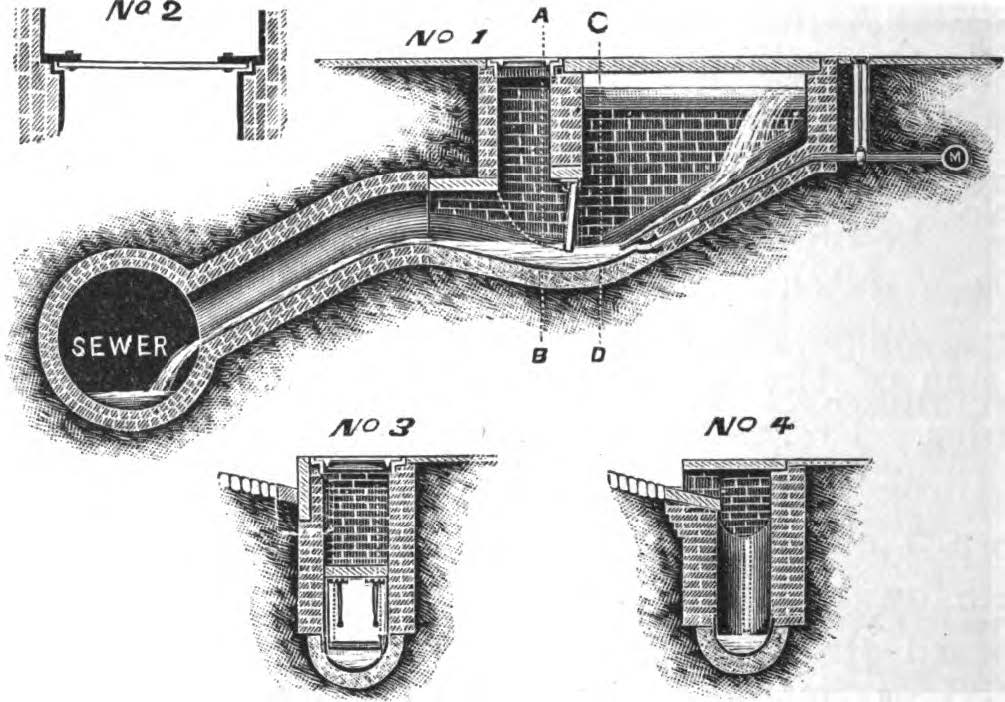
From the 1887 Annual Report of the City Commissioners – This, perhaps, has, as much as any other subject connected with the sewerage of cities, occupied the attention of inventors. Many plans have been devised, from time to time, and for which patents have been granted, for the construction of a perfectly sealed trap. Now, the bad features of all inlets I have yet seen, or know of, are done away with by the simple and comparatively inexpensive contrivance patented by one of the attaches of this office, Mr. Charles P. Kahler. By resolutions of your honorable body, two of these traps have been placed in the inlets to Howard street sewer, at the intersection of Conway and Howard Streets, and at the corner of Camden and Howard streets, which are working clearly up to the degree of efficiency claimed for them by the inventor. I have no hesitation in recommending this invention for adoption. Mr. Kahler can explain the principle involved in his trap more fully to those who may call on him than could be done in this report. A cut representing the improved inlet is annexed.

THE KAHLER PATENT INLET.

CityCommissioner 1872-1887

No. 1–Longitudinal section of Inlet.

No. 2–Section of valve or door with gum packing.

No. 3–Section through A. B.

No. 4–Section through C D.

M—Water mains.

Low Level Interceptor

17 Thursday Mar 2016

Posted by Ronald Parks in Baltimore, Sewage History

≈ Leave a comment

Tags

Baltimore, engineering, glass plate negatives, Health, HISTORY, Jones Falls, Public Works, sewage, Sewage History

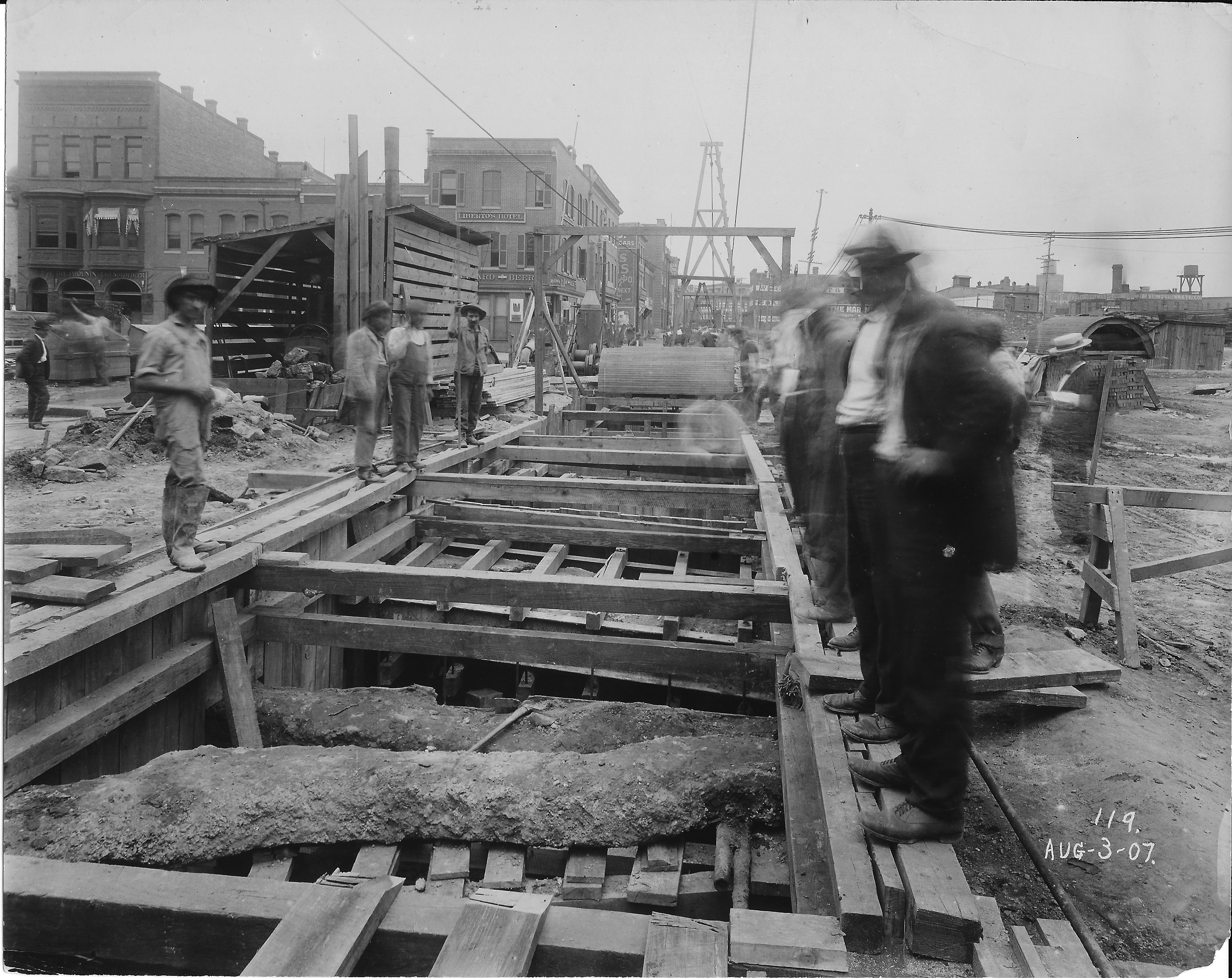
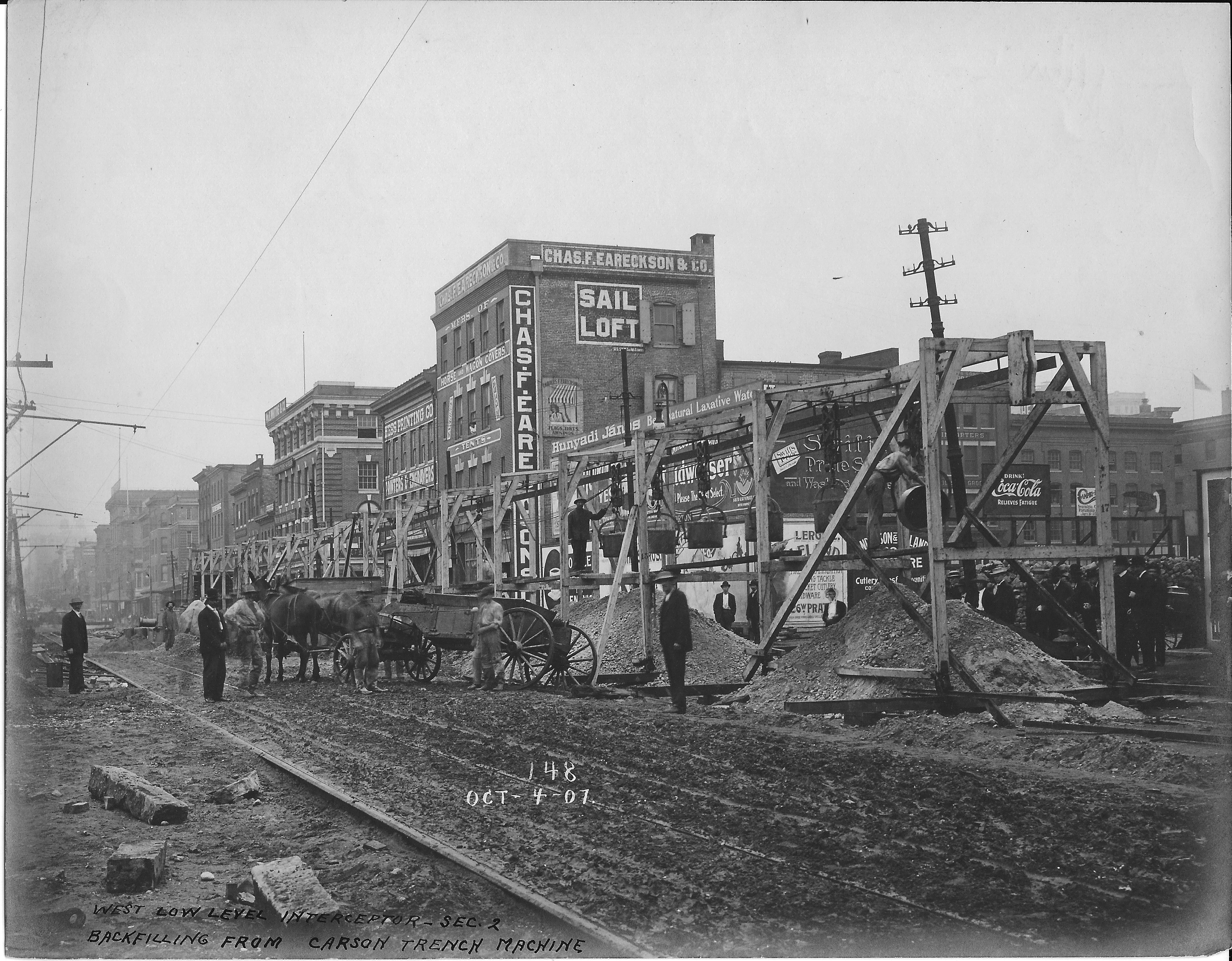
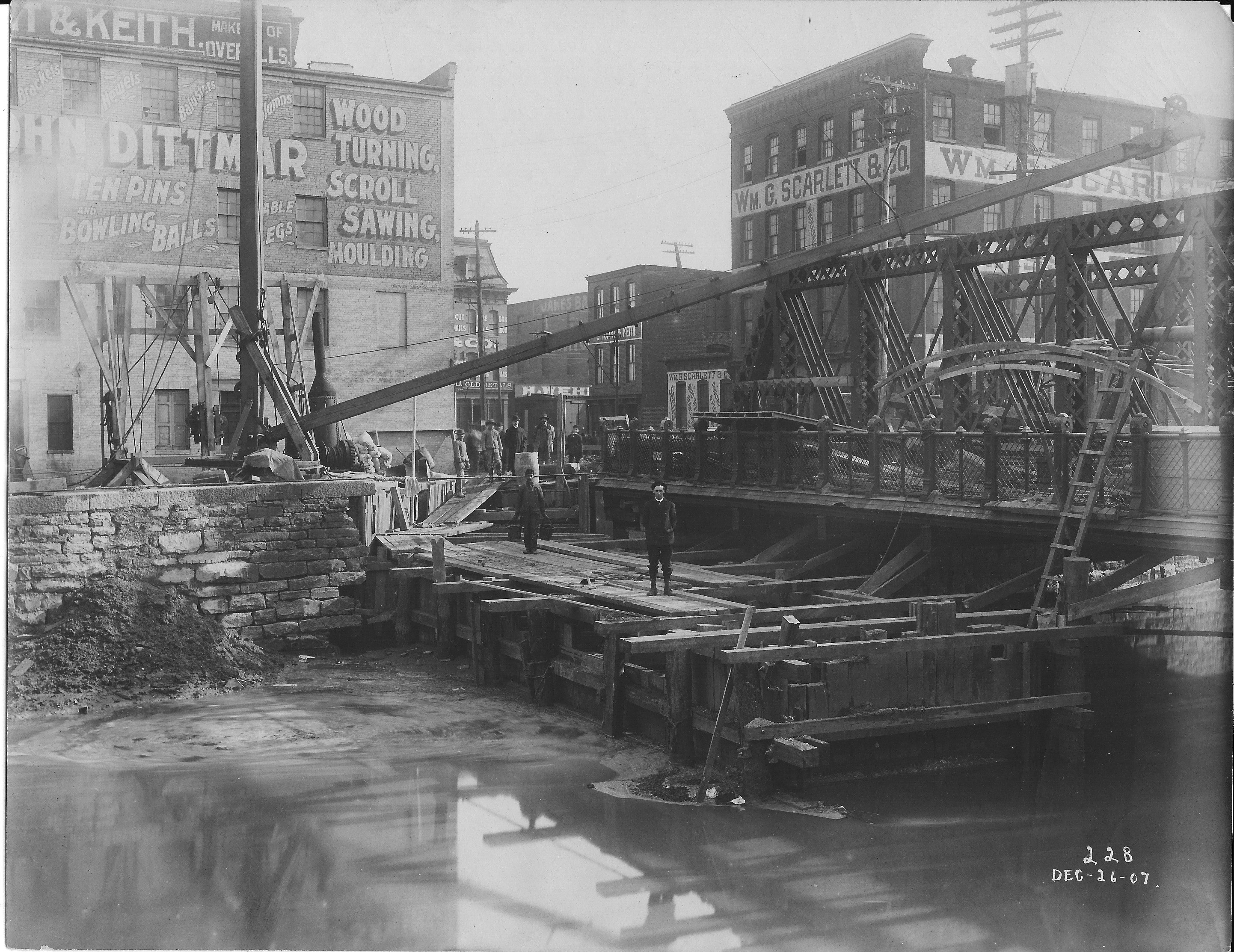
Report of the Low Level Division, Kenneth Allen, Engineer: Section One begins at the Sewerage Pumping Station at President St and Eastern Ave. and extends through President street to Pratt street, and thence westerly to Center Market Space, crossing under Jones Falls on the north side of the Pratt street bridge. General notes on construction. The excavation in general was through a dark material containing particles of sand which appears to be a compacted deposit of mud, with clay, sand, fullers’ earth, gravel and quicksand in places. Gravel was usually found at or near sub-grade, and where this or other firm material was absent the material was excavated and refilled with gravel. Near Pratt street and West Falls avenue, where the depth to sub-grade was some 23 feet, a fine running sand was encountered above sub-grade, which made progress slow and difficult. Previous to excavation, the corner of the four-story brick dwelling on the corner of West Falls avenue was hung by 5 sets of needle beams and twenty 8-ton jacks. Section Two: This section extends from Pratt street and Center Market Space to Pratt and Light streets. The diameter of the sewer is 74 inches throughout the section.

005-119Section #1 Center Market Place showing supports to conduits in foreground and supports to large conduits leading to United (?) & Electric company Power House.

009-148

Section #2 Backfilling from Carson Trench Machine.

016-228

Section #1 Cofferdam for going under the Jones Falls at Pratt Street.

Rendition – Sewage Pumping Station

07 Monday Mar 2016

Posted by Ronald Parks in Baltimore, HISTORY, Sewage History

≈ Leave a comment

Tags

art, Baltimore, engineering, Health, HISTORY, Jones Falls, Museum, Sewage History

Below is an artist rendition of what the Eastern Avenue Pumping Station was to look like in 1907. I found this water color drawing at the DPW Museum, tucked behind a bunch of wet, moldy boxes (some museum pieces were damaged by water and fire years ago). I am hoping to take this art work and have it restored soon. I like that the artist also included the Baltimore Shot Tower in the background, to the right. With the coal bins above the steam boilers, that ran the pumps, the coal was unloaded from rail cars and ships, then conveyed to the top of the building. It fell into hoppers and the hoppers fed the boilers. Engineering marvel. The building is being considered as a Historic Landmark.

The building is still pumping sewage every day. Where the boilers once were, had been converted into the DPW Museum, which has been closed for a few years.

IMG_1797

Eastern Ave Pumping Station

04 Friday Mar 2016

Posted by Ronald Parks in Baltimore, Sewage History

≈ Leave a comment

Tags

Baltimore, engineering, HISTORY, Jones Falls, Public Works, sewage, Sewage History

Another “Breaking Ground” ceremony took place in 1908, with Mayor Mahool. It was for the start of construction, for the Eastern Avenue Pumping Station. The plans for this were started in 1906 and the first contract was let in 1907 for the purchase from Bethlehem Steel, three pumps. Later the contract was let for the building itself. Not only did they break ground, they also broke the pile driver used to set the foundation. Because the building was to be so close to the harbor, they had to go deep to hit solid rock. The 3 pumps were going to be heavy.

I hope to be able to find the original photographs in the archives, so I can stop using the pictures from the reports. The first shows the Mayor breaking ground. The second is a panoramic view of the construction site. The third is the broken pile driver.

1908 mayor

img106Pano

pile

Where to Start?

03 Thursday Mar 2016

Posted by Ronald Parks in HISTORY, Sewage History

≈ Leave a comment

Tags

Baltimore, engineering, HISTORY, Jones Falls, Museum, Public Works, sewage, writing

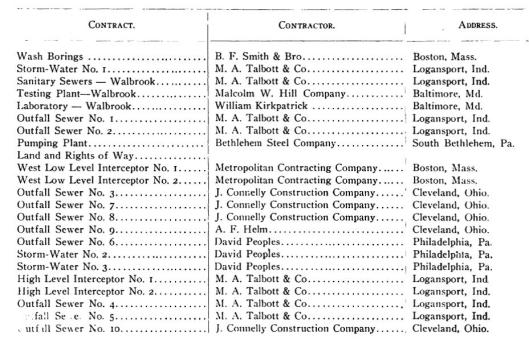
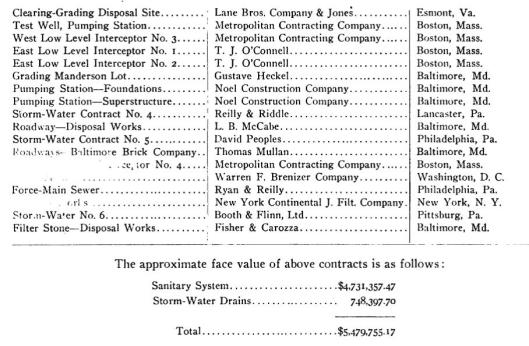
My original intention, to post on here, was to do so in chronological order, the building of Baltimore’s Sewage and Storm-Water systems. But, as can be seen in the tables below, a lot was going on all at one time. So the photographs and comments will be scattered. My new book will not be, hopefully!

The information that I present here comes from a wide variety of reports that I have read and sorted out. A couple years ago I was asked to document the archives from the Public Works Museum in Baltimore. I also was asked to move these archives to another location, which I have done. The artifacts, files, photographs, etc were stored in a fairly haphazard way. Scanning, photographing, reading, inventory, documenting….well, this is what I do.

So much information and so little time!

From the 1908 Annual Report: It is reported that the City has saved upwards of $1 million on construction cost due to breaking the work up into smaller portions so the competition for bidding would be greater. List of contracts and contractors.

chart

chart2

Testing Plant

25 Thursday Feb 2016

Posted by Ronald Parks in HISTORY, Sewage History

≈ 2 Comments

Tags

Baltimore, engineering, FILTRATION, glass plate negatives, HISTORY, Jones Falls, sewage, water history

1906 – Before building a complete, City-wide sewerage system, a Testing Station was built to figure out the best means of treatment.

At Hampden and Walbrook, surveys were made and every house located, and in each place a plan for a comprehensive sewerage system was made. As a result of these studies Walbrook was selected as offering the most advantages.

Establishment of experimental testing station at Walbrook: In accordance with the Chief Engineer’s recommendation, the Commission on June 14th, 1906 authorized the erection of an experimental Testing Station. On October 2nd sufficient land was secured, without charge, from the Walbrook Land Corporation for the site of the Testing Station, for a period of seven years. On October 10th the contract for the erection of this testing station was awarded to the lowest responsible bidder, Malcolm W. Hill Company of Baltimore, Md., at their bid of six thousand, nine hundred and thirty dollars and forty-seven cents ($6,930.47). The contract for the Laboratory Building in connection with the Testing Station was awarded to the lowest responsible bidder, Wm. Kirkpatrick, of Baltimore, Md., on October 18th, at his bid of three thousand, seven hundred and fifty dollars ($3,750.00). The contract for the permanent sanitary sewers which will lead to the Testing Station was awarded to the lowest responsible bidder, M. A. Talbott & Company, of Baltimore, Md., on October 29th, at their bid of thirty-three thousand, two hundred and thirty dollars and ninety-eight cents ($33,230.98).

1907 – “Sir: In obedience to the requirements of Section I, Chapter 349, of the Acts of the General Assembly of Maryland for 1904, this Commission has the honor to make a report of its official transactions for the year 1907.” The first sanitary sewers to be constructed were those in Walbrook for the drainage of houses embraced within a prescribed area, and which were constructed as auxiliary to the experimental testing station, as part of the permanent system. Work on outfall sewer and interceptors was begun. There was criticism as to the size chosen for the sewers, but the Commission stuck to the plans of the advisory engineers: Rudolph Hering, Samuel Gray and Frederick Stearns.

These photos show constructing the Testing Station and Lab. Also the sprinkling filters.

81_6_56 81_6_159 img041

1908 sewage map walbrook

Here is the only reference I could find concerning the exact location of the Testing Plant.It comes from the Johns Hopkins Sheridan Library. I cut it down in size for viewing here. The location is never mentioned in any of the Annual Reports other than “Walbrook”. The testing plant is represented by the two circles at the bottom of the dark lines, just above Patterson Ave.

From Sewage Commissioner’s Report: The sewage testing part of the laboratory has been closed for a number of months, but the testing of all materials for construction work is being carried on, which has proved of great value in getting desired results. The plant is continuing to receive and purify the sewage carried to it from the system of sewers throughout Walbrook. On account of the disposal plant being operated by gravity, the cost of maintenance is reduced to a minimum.

1904 Fire

24 Wednesday Feb 2016

Posted by Ronald Parks in Baltimore, HISTORY, Sewage History, water history

≈ Leave a comment

Tags

Baltimore, engineering, HISTORY, Jones Falls, sewage, water, water history

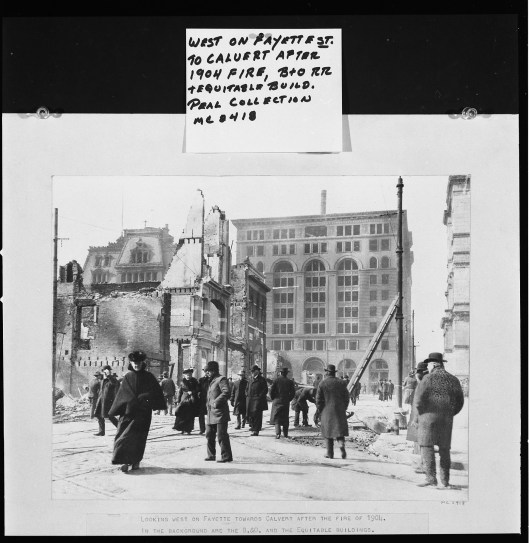
Many of the history books that I have read concerning Baltimore, all point to the Great Fire as the reason for new water and sewer systems. But as I read thru the records of the Commissioners and Engineer’s Annual Reports, it shows that the need for new sewage works was on the minds of every Baltimorean as early as 1815. With the increase of the water supply, from the Gunpowder River in 1881, there was an enormous amount of waste – cesspools and privies overflowed so badly that the Baltimore Harbor became a disgrace.

Here is a view of the 1904 fire in Baltimore: Courtesy of the DPW Museum and the Peale Museum

img092

← Older posts
Newer posts →

Blogroll

  • Flouride Action Network
  • lulu
  • My Book
  • WordPress.com
  • WordPress.org

Recent Posts

  • Bermuda 2023
  • ICELAND April 2023
  • George Chalmers of Fochabers
  • In Search of The Skipjack Ada Mae
  • Trap Pond Kayak

Blog at WordPress.com.

  • Subscribe Subscribed
    • Water and Me
    • Join 231 other subscribers
    • Already have a WordPress.com account? Log in now.
    • Water and Me
    • Subscribe Subscribed
    • Sign up
    • Log in
    • Report this content
    • View site in Reader
    • Manage subscriptions
    • Collapse this bar
 

Loading Comments...