• About
  • History Writings

Water and Me

Water and Me

Tag Archives: Health

Vacation

18 Sunday Sep 2016

Posted by Ronald Parks in Hiking, kayaking, vacation, Writing

≈ 4 Comments

Tags

boating, fishing, Health, Hiking, kayaking, photography, writing

Best vacation in a long time!

Ocean City for a couple days: Sun, dolphins, 11th floor balcony door opened – listening to the pounding of the surf on the beach, watching the sunrise and sunset, Thrasher Fries, junk food, good food, 9/11 memorial, biker week …

Snow Hill for kayaking at Goat Island, saw no goats but was a great adventure…

Assateague Island for more kayaking and hiking through water onto beaches…

Fishing off Deal Island (caught a lot of variety including crabs and a skate), boat around other islands…Princess Anne for dinner and historic tour…

Crisfield then to Smith Island…

Home. Great vacation except for two unpleasantries – daughter needs brain surgery and “service engine soon” light came on in truck.

Photos later..


Montebello Waste Lakes

05 Tuesday Jul 2016

Posted by Ronald Parks in Baltimore, water history

≈ Leave a comment

Tags

aerial, Baltimore, drone, engineering, FILTRATION, Health, HISTORY, Lake Montebello, maps, Montebello, POLITICS, Public Works, water, water history

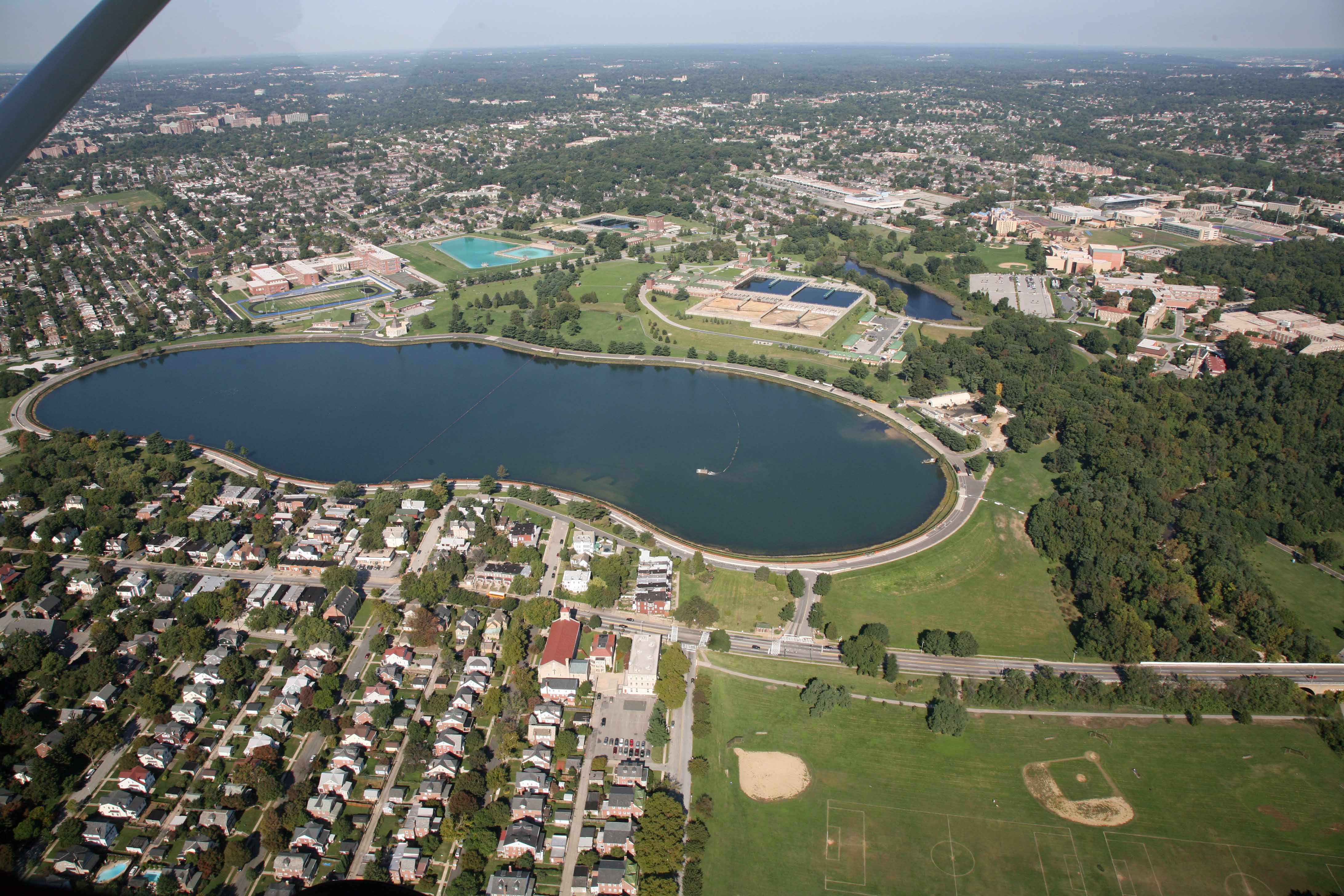
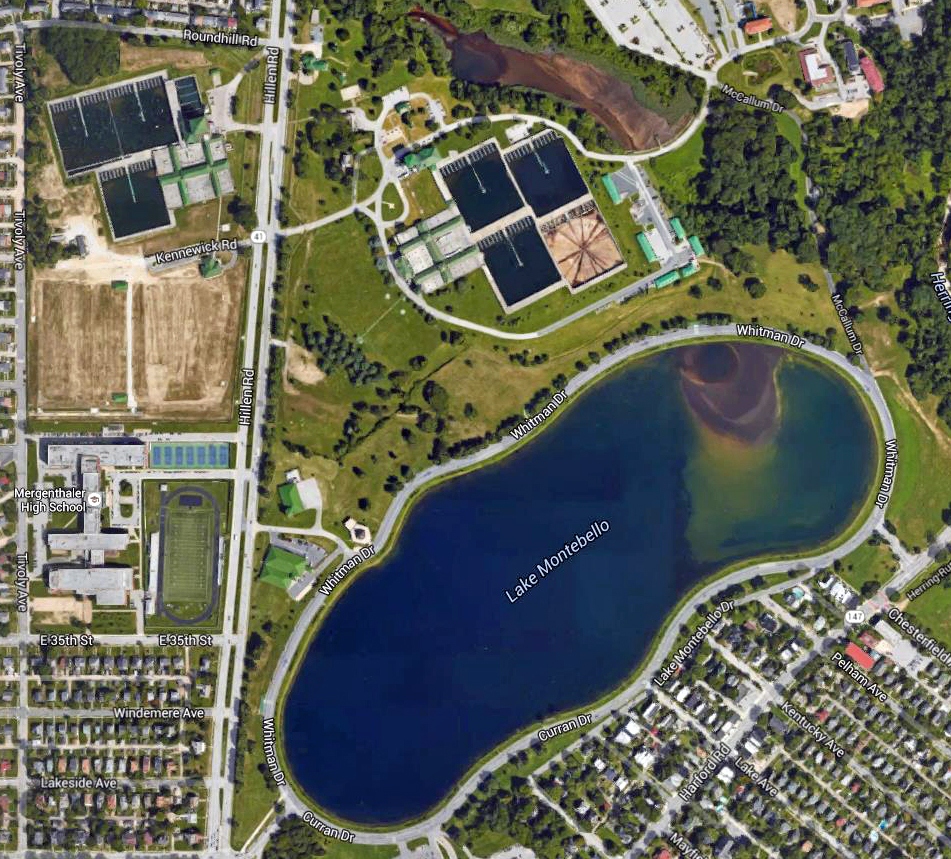
Yes, there are two waste lakes at Montebello. The large one that people use every day as a park and a smaller one, hidden from view, on the filtration plant property. The large one was at one time (1881-1915) used as drinking water. The small one (1915) has always been used to settle out the waste by-products of the filtration process.

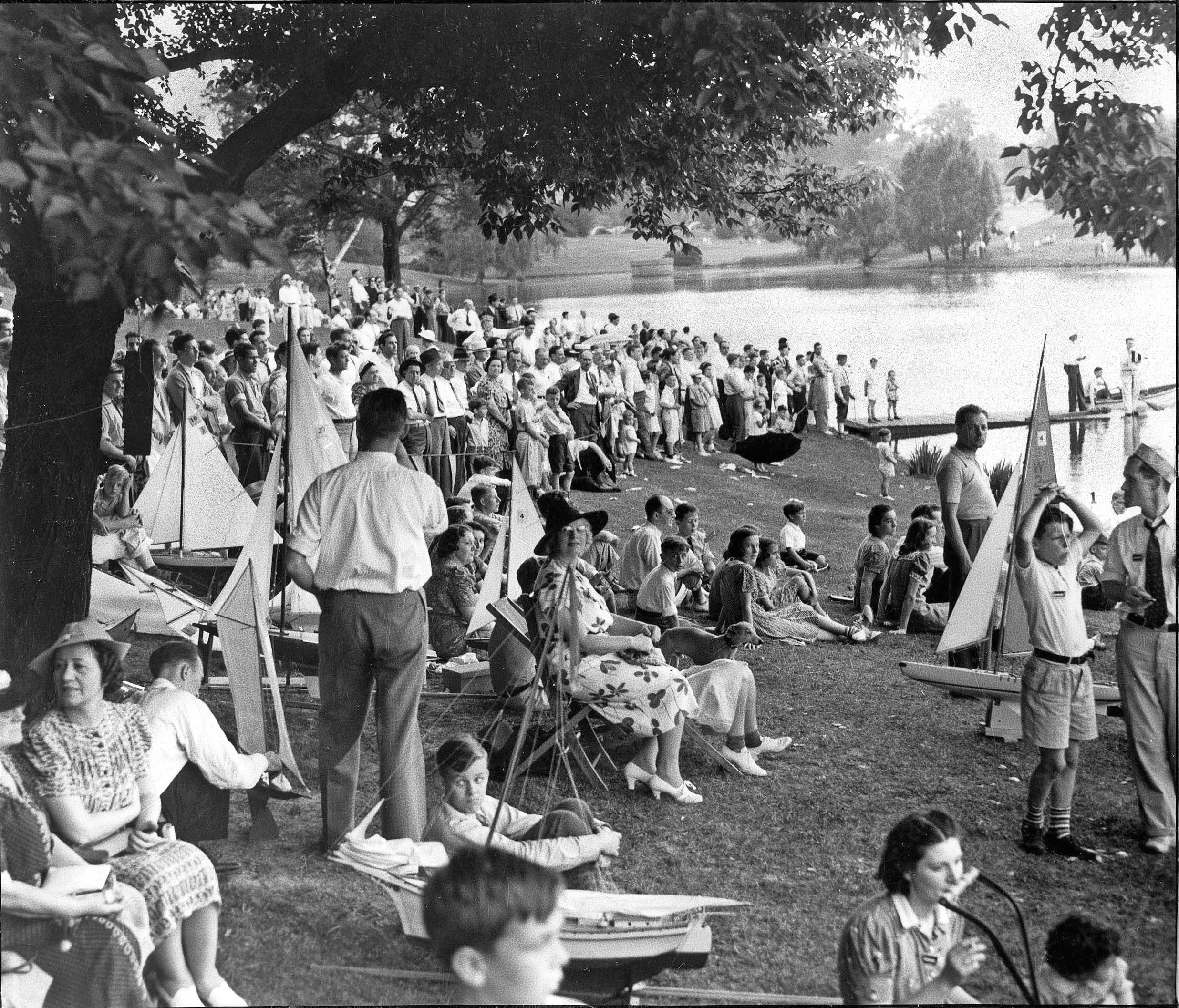
To the dismay of the Filter Engineer, he was forced to allow the Model Yacht Club to use the small lake for their club activities in the late 1930s. Sometimes when he was pissed off, he would drain the lake down. At the start of WWII, for security reasons, the club could no longer use the lake.

wl1939

wl1939b

Because of the amount of water processed and the waste created by this process, the lakes would need dredging. It was a lot easier to dredge the smaller one than to do the big one. Unfortunately, the dredged material would be pumped into the big lake. That one was to be dredged every 30 years. An optimal plan would be to dredge the small lake every five years.

wl1978

In 1978 thru 1984, the small lake was dredged.

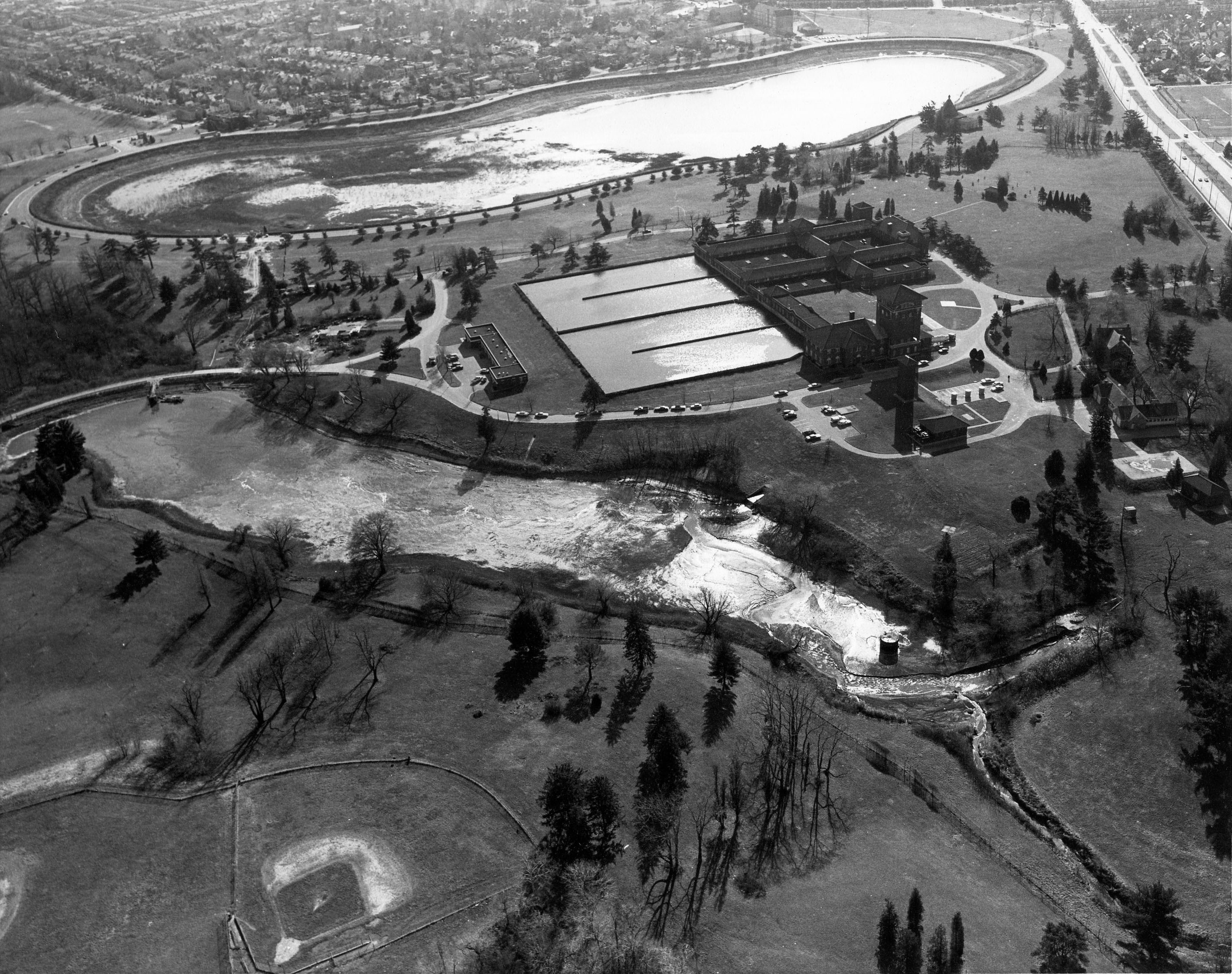
wl1984

What was called a “sonic survey” took place in 1984, this was to show the nearby residents what needed to be done to the lakes. Both lakes were partially drained to show the amount of sludge build-up.

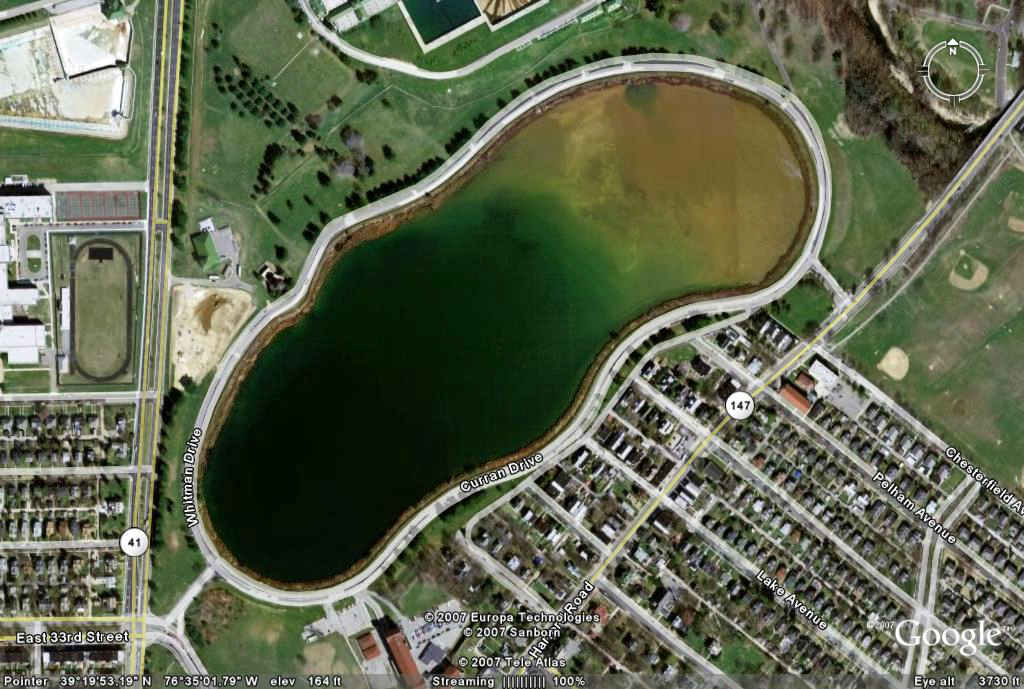
wl2003

This is a google map aerial of the lake in 2003. The brown sludge build-up is the overflow from the small lake. (Note that Google Map dates are not always correct)

wl2007

2005-2007 a portion of the small lake was dredged and a little over 1/3 of the big lake. Why? Money constraints. They should have completely dredged both lakes, but consulting engineers and politics dictates what goes on.

wl2010

By 2010 the small waste lake is practically filled, again (to the lower right of the 4 square basins) and it is now flowing into the large lake (Hard to see but it is in the lower right corner)

wl2015

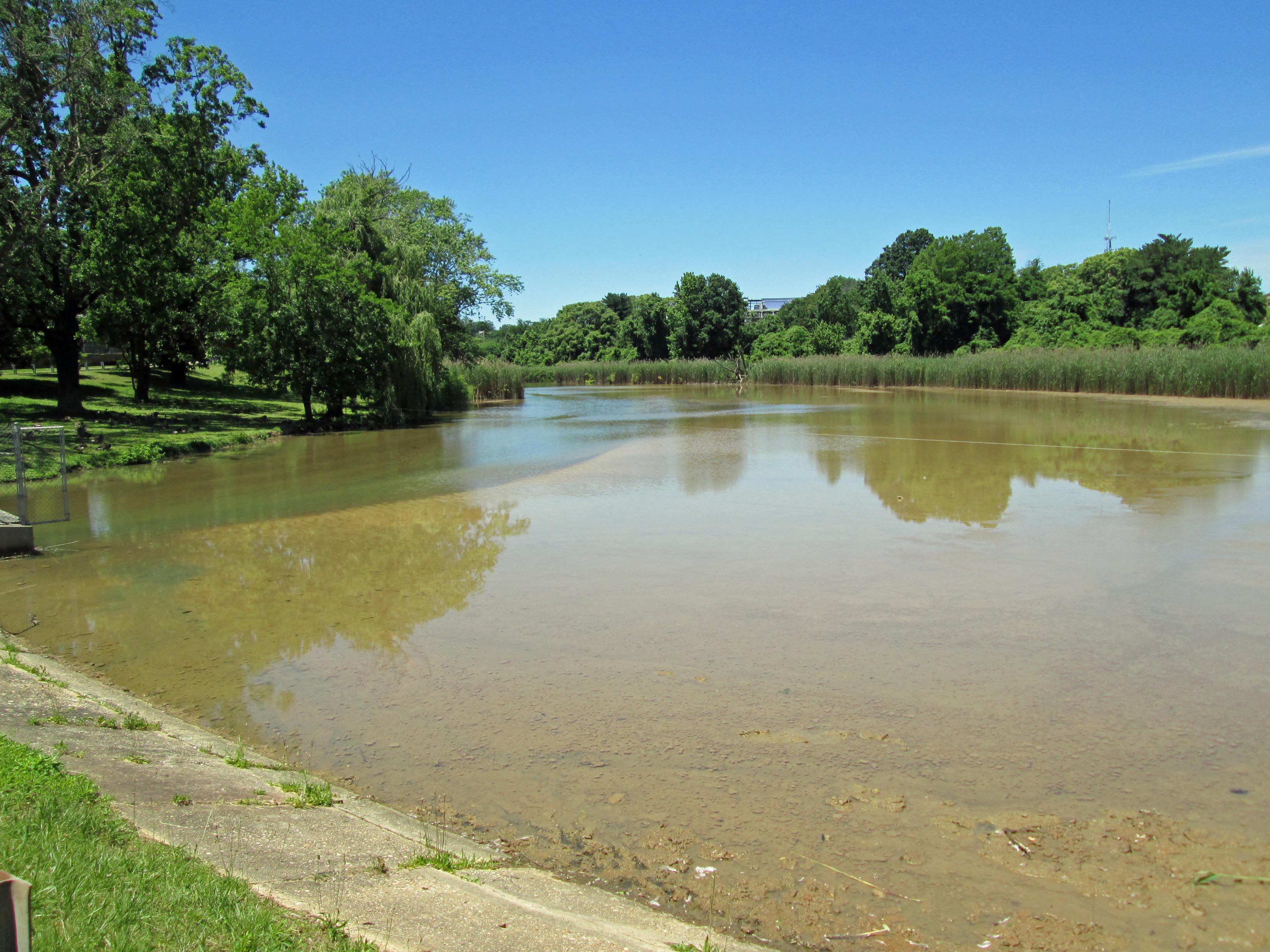
By 2013 the big lake starts filling up rather quickly. The small lake is full

wl2016b

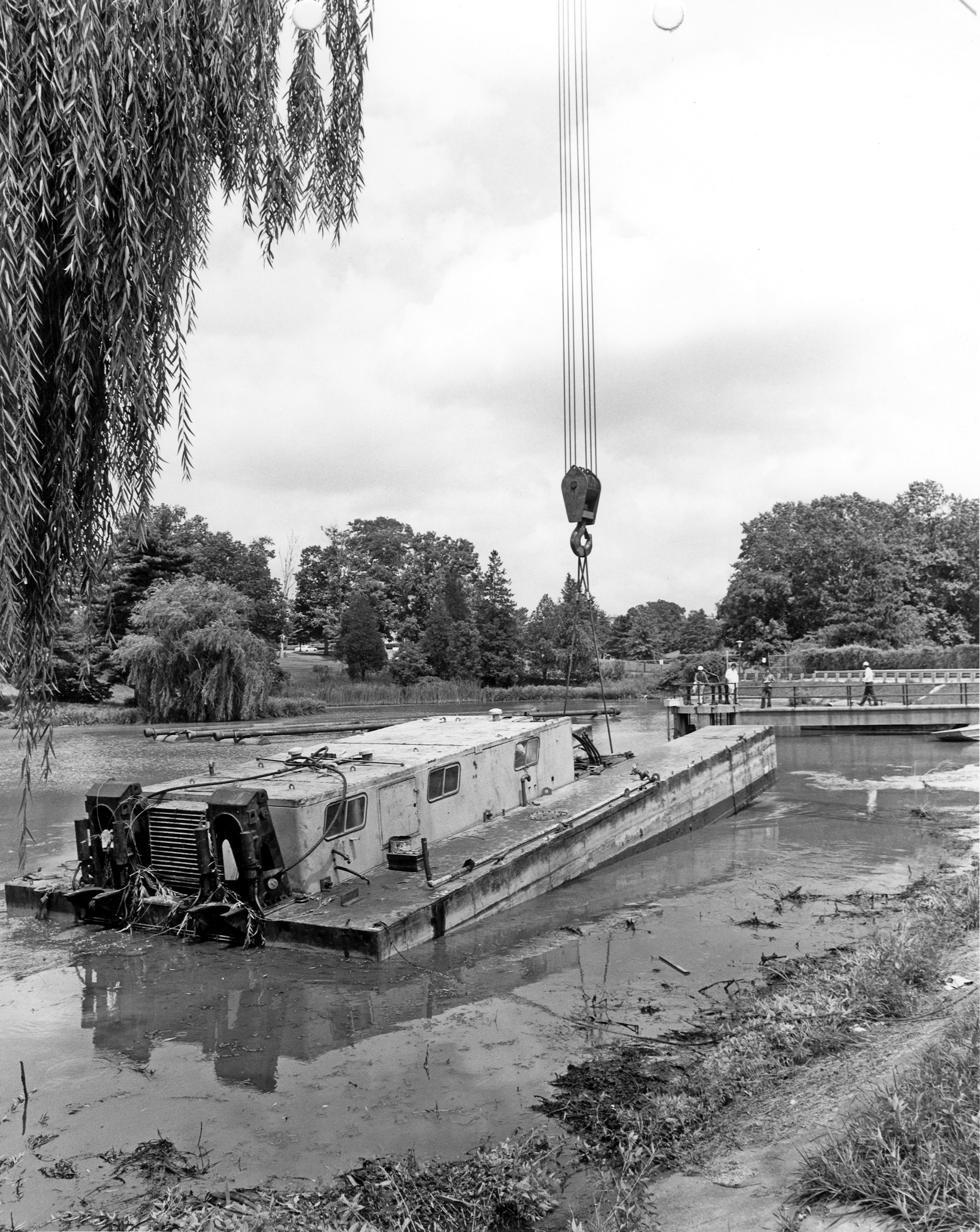
In 2016 it was decided to start dredging the small lake, only partially??

wl2016

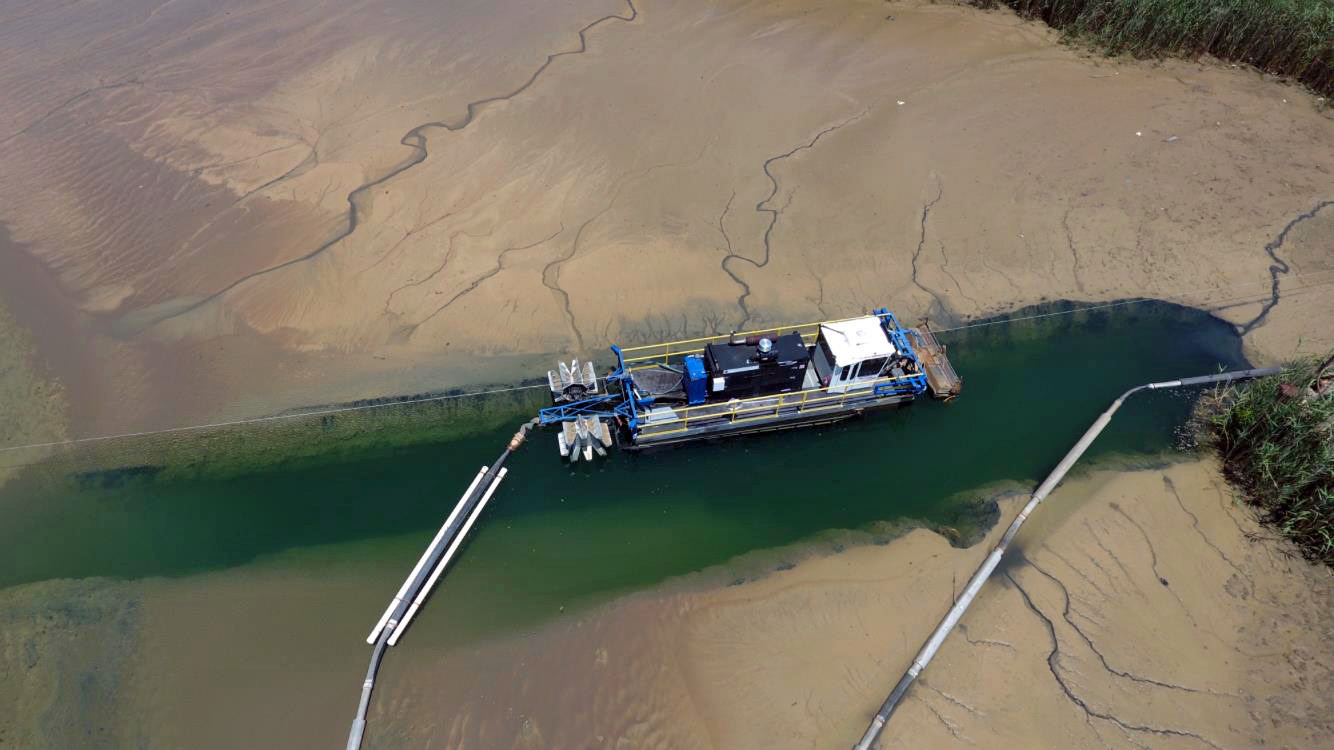
The present day dredge cutting a path thru the sludge. The waste lake is about 30 feet deep here. they have only reached 17 feet (Photo courtesy Merrill Bros. drone)

Bridges Along the Jones Falls

17 Friday Jun 2016

Posted by Ronald Parks in Baltimore, HISTORY, Sewage History

≈ 3 Comments

Tags

Baltimore, boats, bridges, engineering, glass plate negatives, Health, HISTORY, Jones Falls, POLITICS, Public Works, sewage, Sewage History, water history

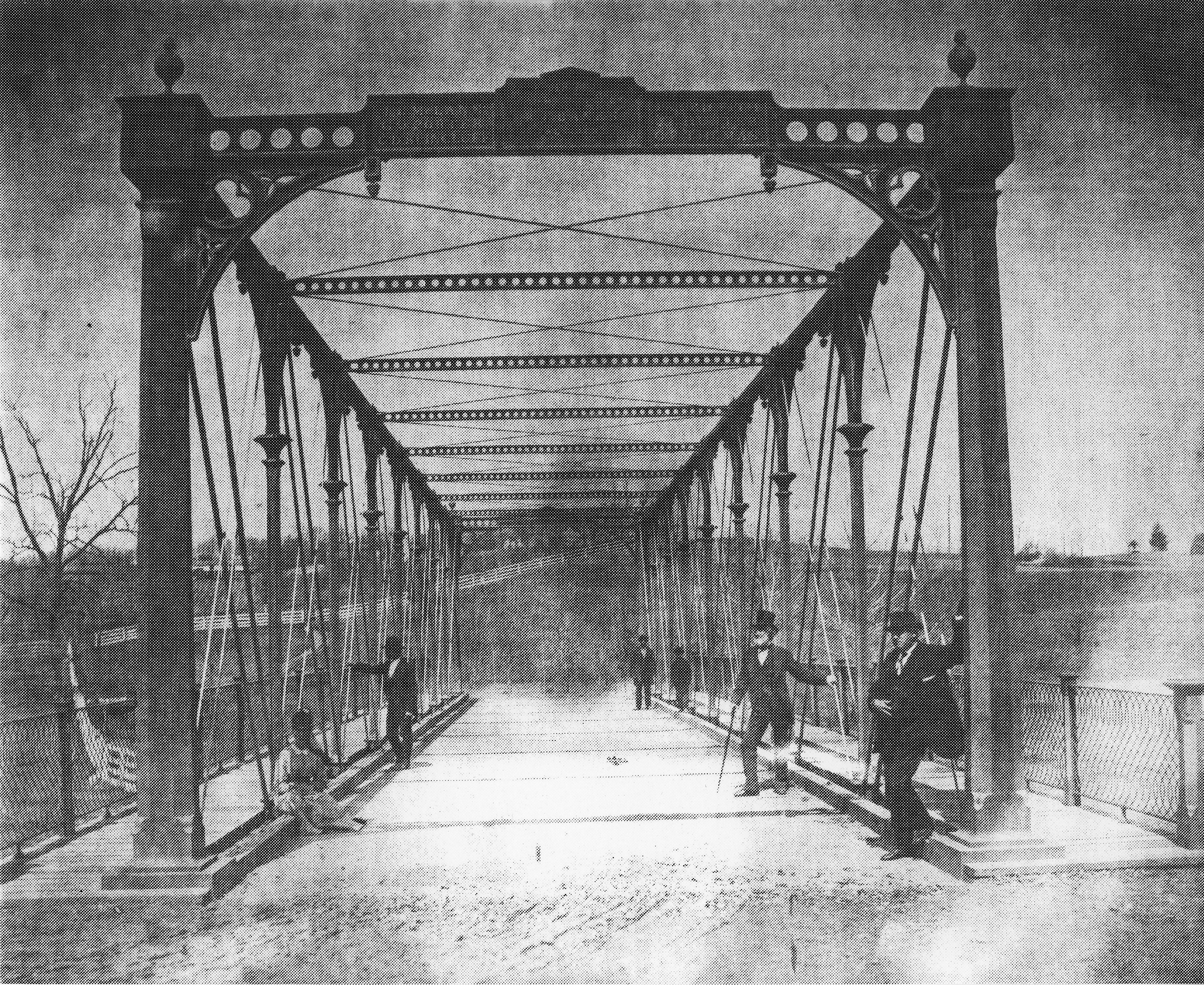
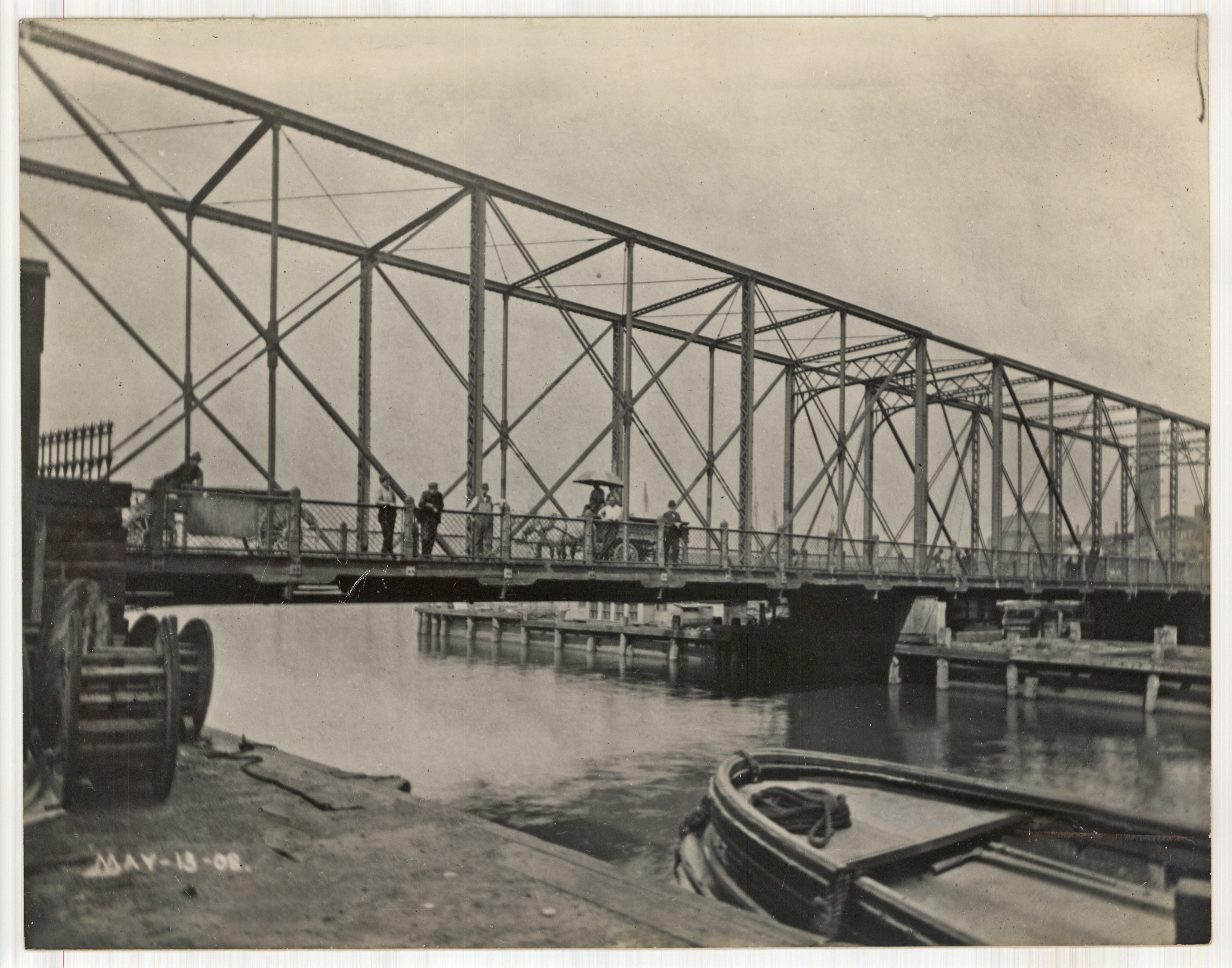
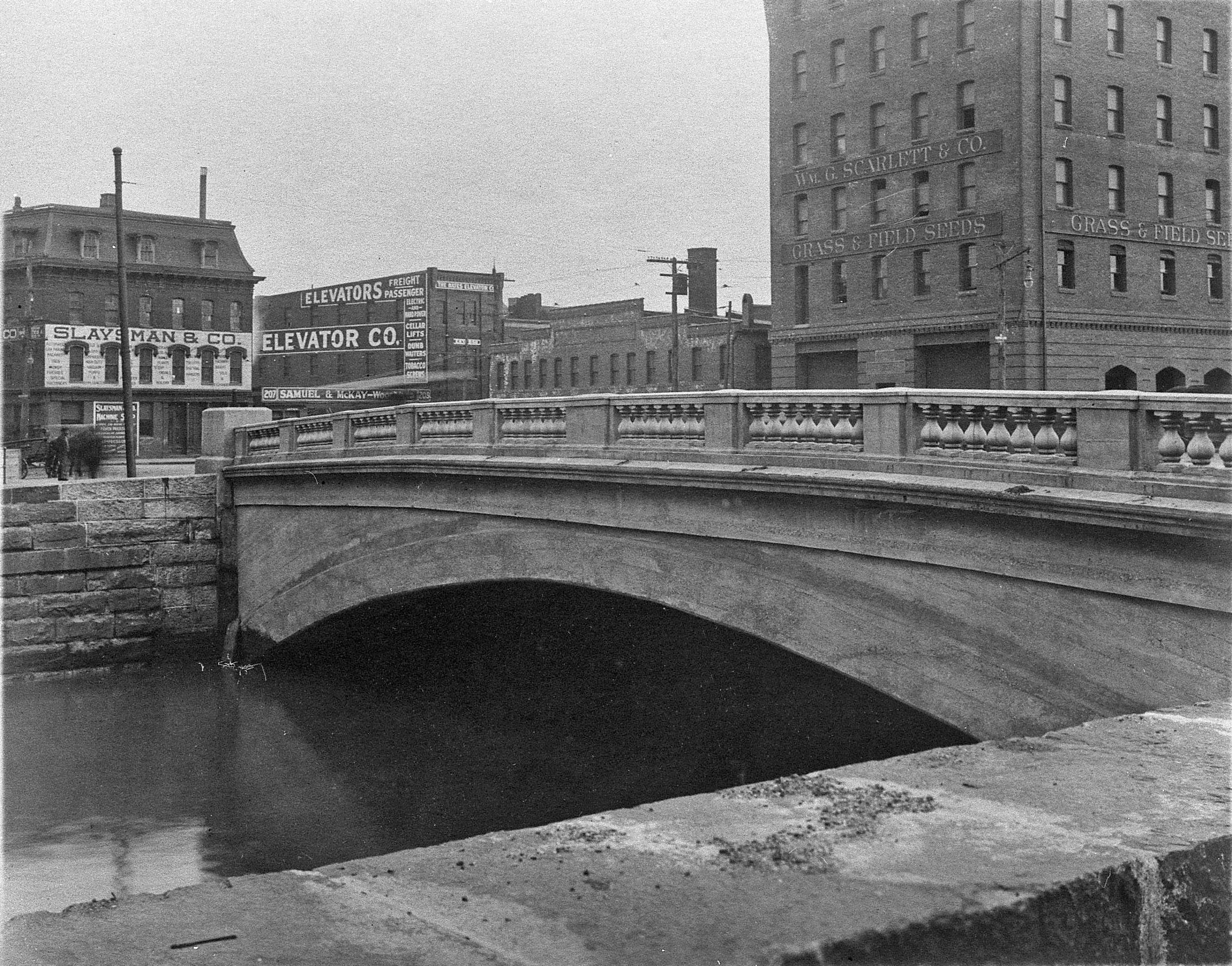
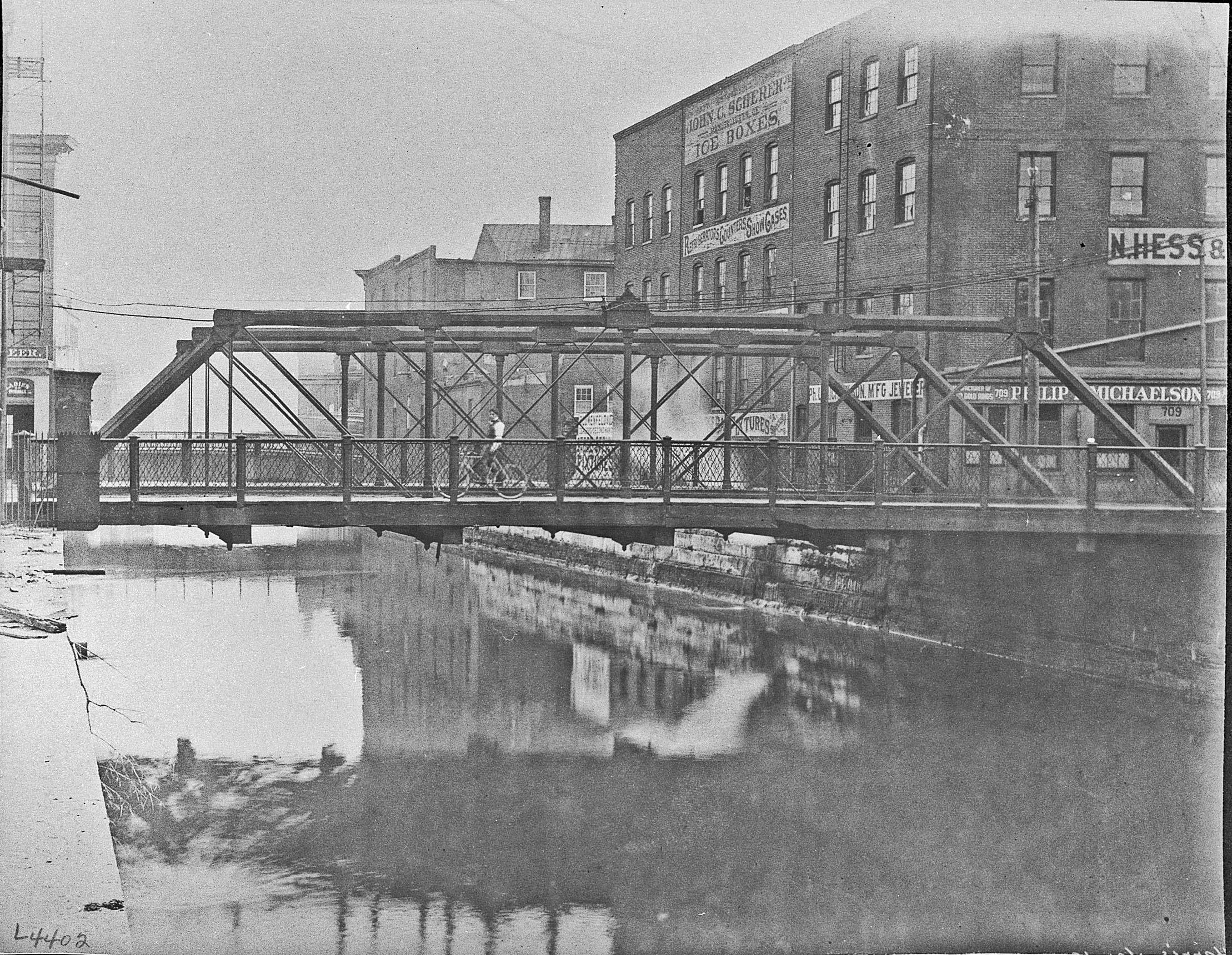
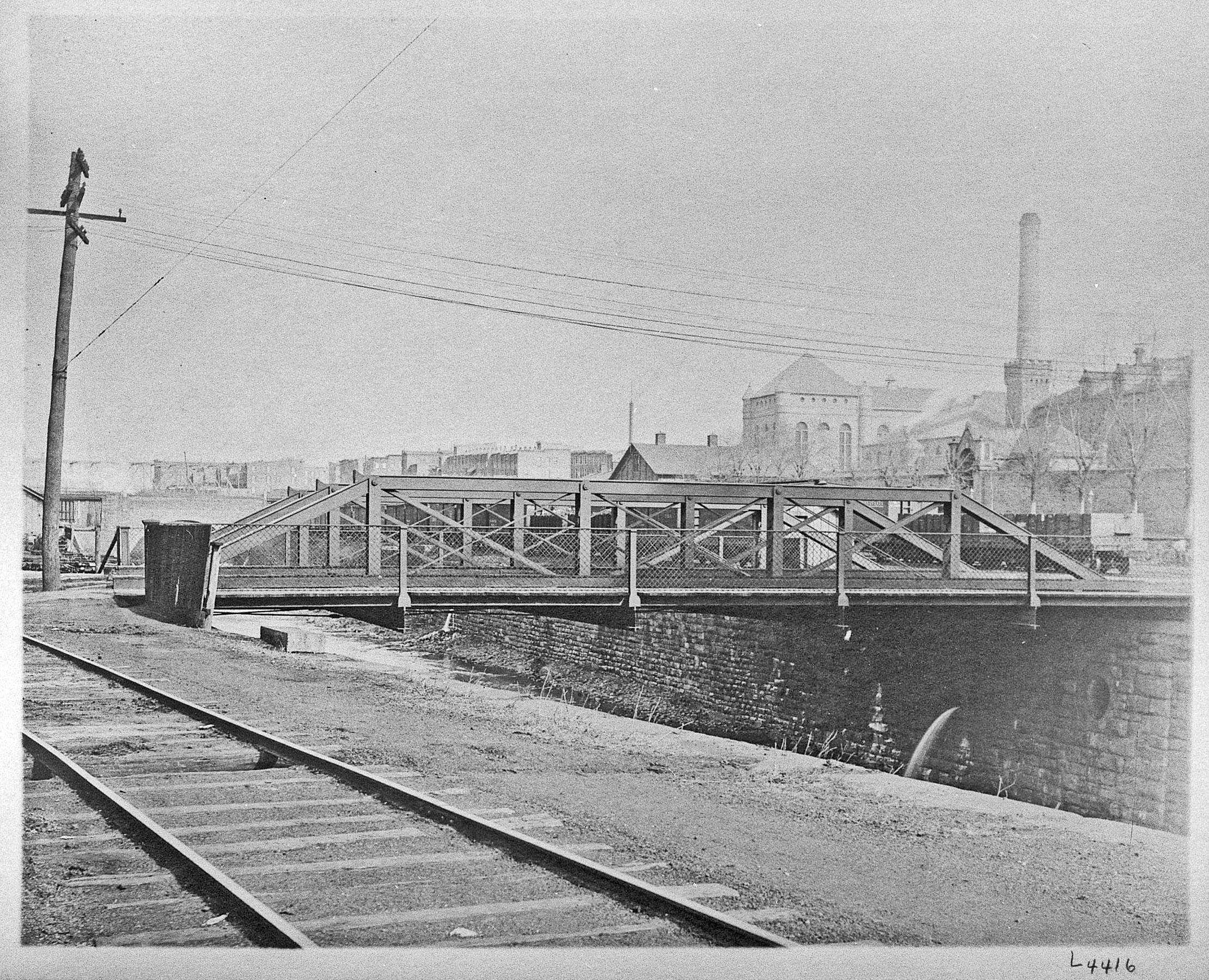
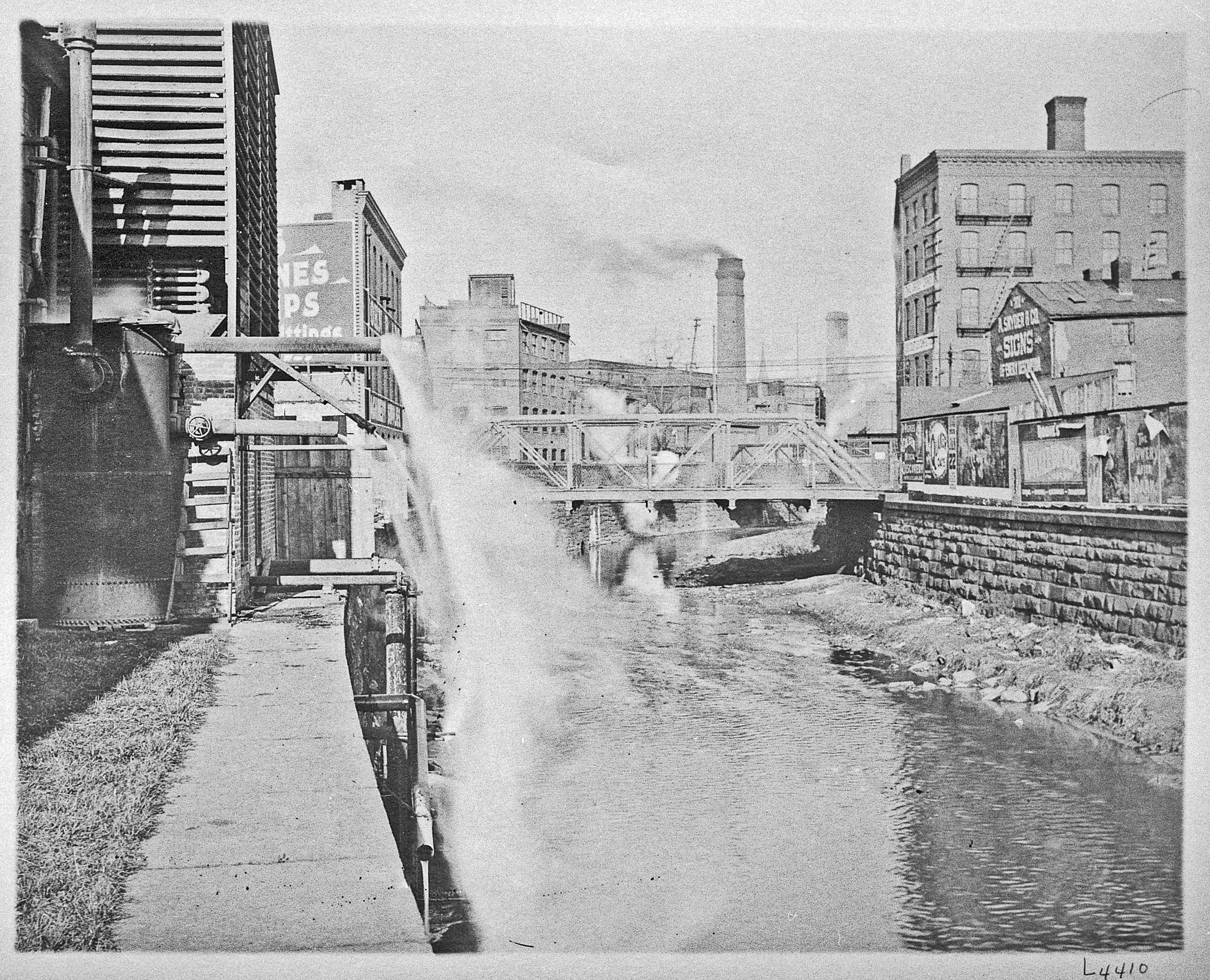
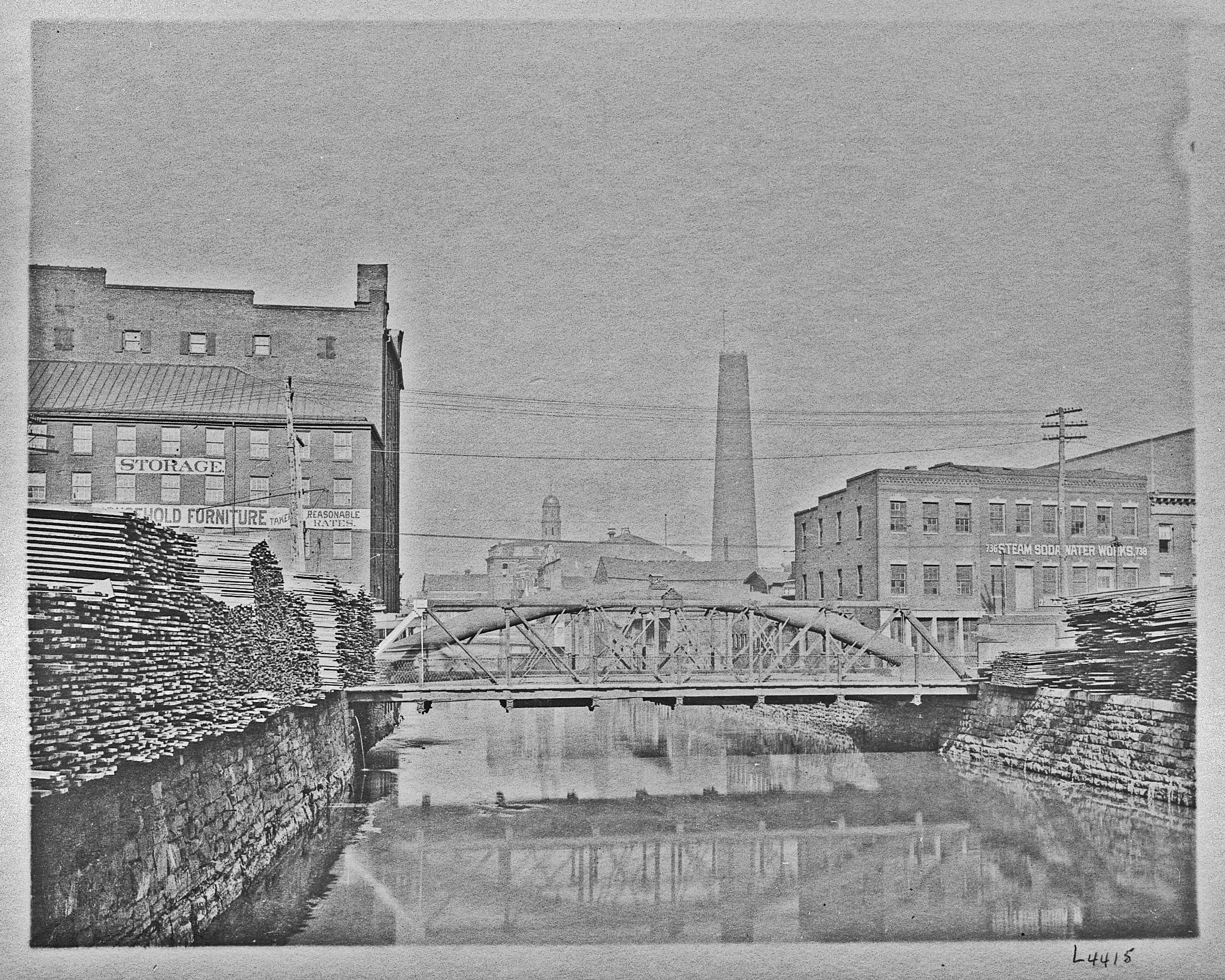
Here are some photos from the DPW collection of various bridges along the Jones Falls. These negatives were all in an unmarked box. I posted them on Facebook a while ago and people told me the names as best they could guess. I am no longer on FB and unfortunately I did not write down the names they told me. Some are marked. Some are duplicates from other views – north to south or south to north.

If you can correctly name these bridges I will send you a copy of my book – Baltimore’s Water Supply History. Thanks.

img075

br045

img517

img515

img511

img510img509

img507

img506

img504

img501

img395c

img395b

img003b

img001e

img001d

img001a

81_6_1338

Lime

24 Tuesday May 2016

Posted by Ronald Parks in Baltimore, Sewage History, water history

≈ Leave a comment

Tags

Baltimore, engineering, FILTRATION, Gunpowder Falls, Health, HISTORY, Lake Montebello, Montebello, Public Works, sewage, Sewage History, water, water history

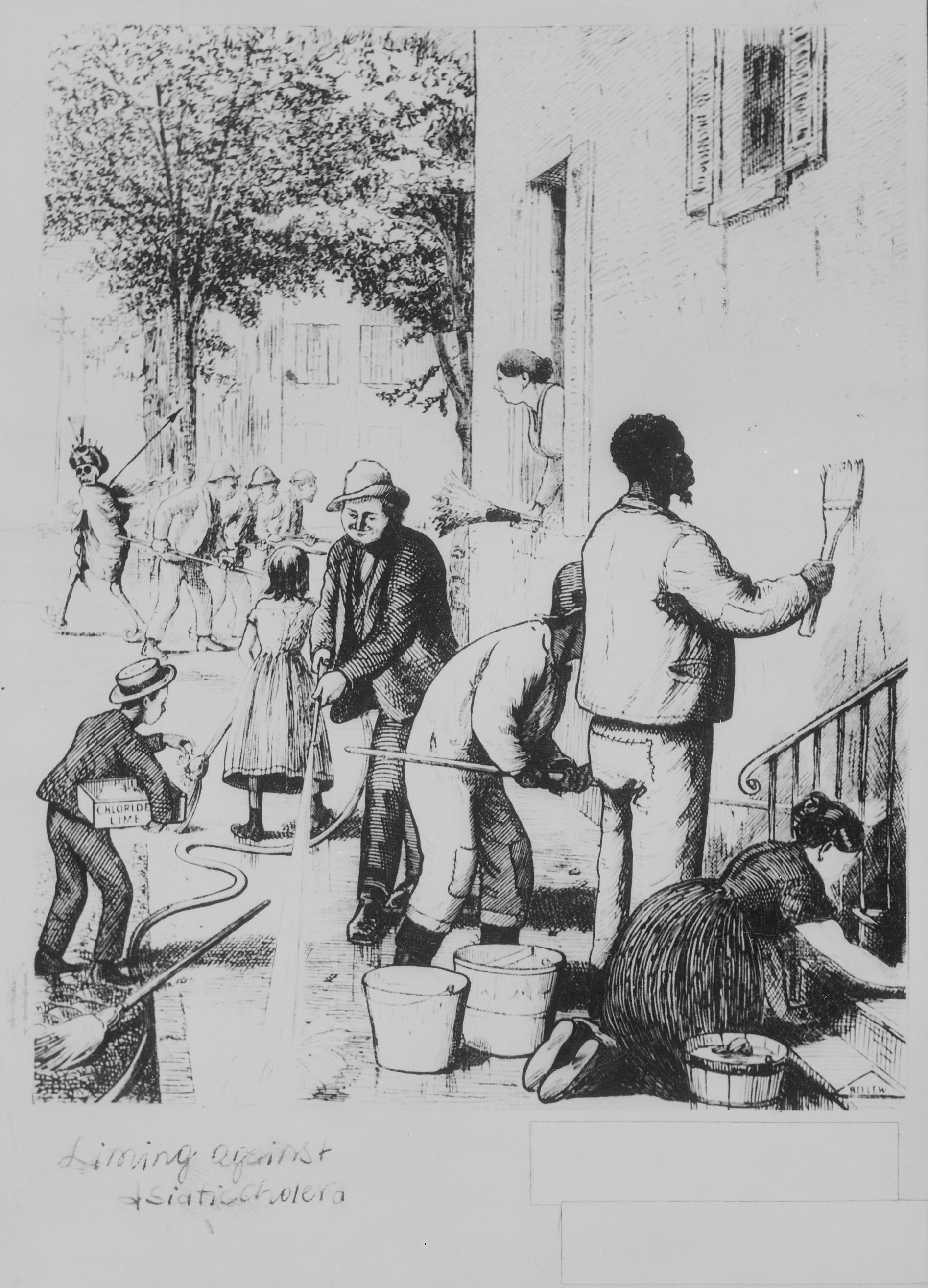
As can be seen from the list below, Lime has been used as a disinfectant for many years as far as the sewerage system and health goes.

1865 – Board of Health: The general health account shows an expenditure of $2,918.11. This account includes the appropriation for enclosing the Eastern Potter’s Field, erecting a dead house &c. and that for lime and incidentals.

1866 – Board of Health: 11,000 oysters were thrown away (This was in response to a cholera epidemic where 9 of 10 cases were found from eating oysters). We have used lime, Ridgewood’s and Sim’s disinfectant, and carbolic acid freely in the alleys and sewers.

1880 – General Superintendent of Streets: Your instructions in reference to the free use of lime in all alleys, gutters, vacant lots and places where stagnant pools of water were to be found, have been faithfully carried out.

1886 – Health Department: Disinfection – There was distributed in the streets, lanes, and alleys six hundred and thirty-seven cart-loads of lime. In addition, the Department manufactured and distributed twenty-two (22) tons of disinfectants; the principal portion of which was used in sewers and inlets.

1888 – Assistant Health Commissioner’s Report – During the year six thousand and thirty-one (6031) cart loads of refuse were removed from sewers, inlets and covered gutters. Six hundred and ten loads of lime and twelve tons of carbolate of lime were distributed for the purposes of purification and disinfection.

Liming against Asiatic Cholera.

Lime1

In 1910 Baltimore used chloride of lime (along with calcium hypochlorite and intermittent applications of alum sulfate) as a disinfectant in the water supply. And in 1922 it was specifically used for corrosion control.

Mont 8-12 050

The above photo, from a previous post, was before the Montebello Filtration Plant was built. The water supply came from the Gunpowder River (7 miles away), directly to this gate house and emptied into the Montebello Lake.

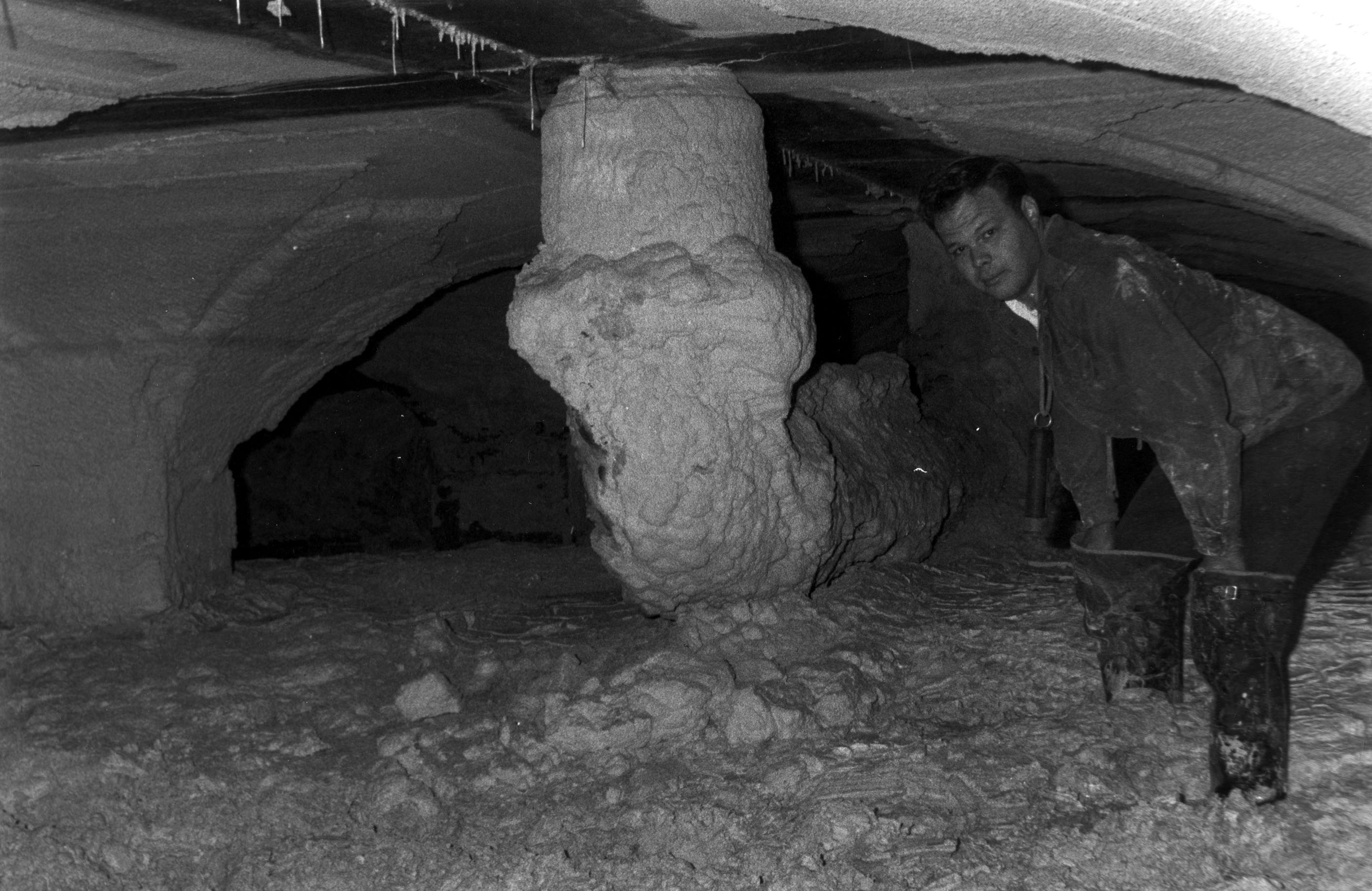
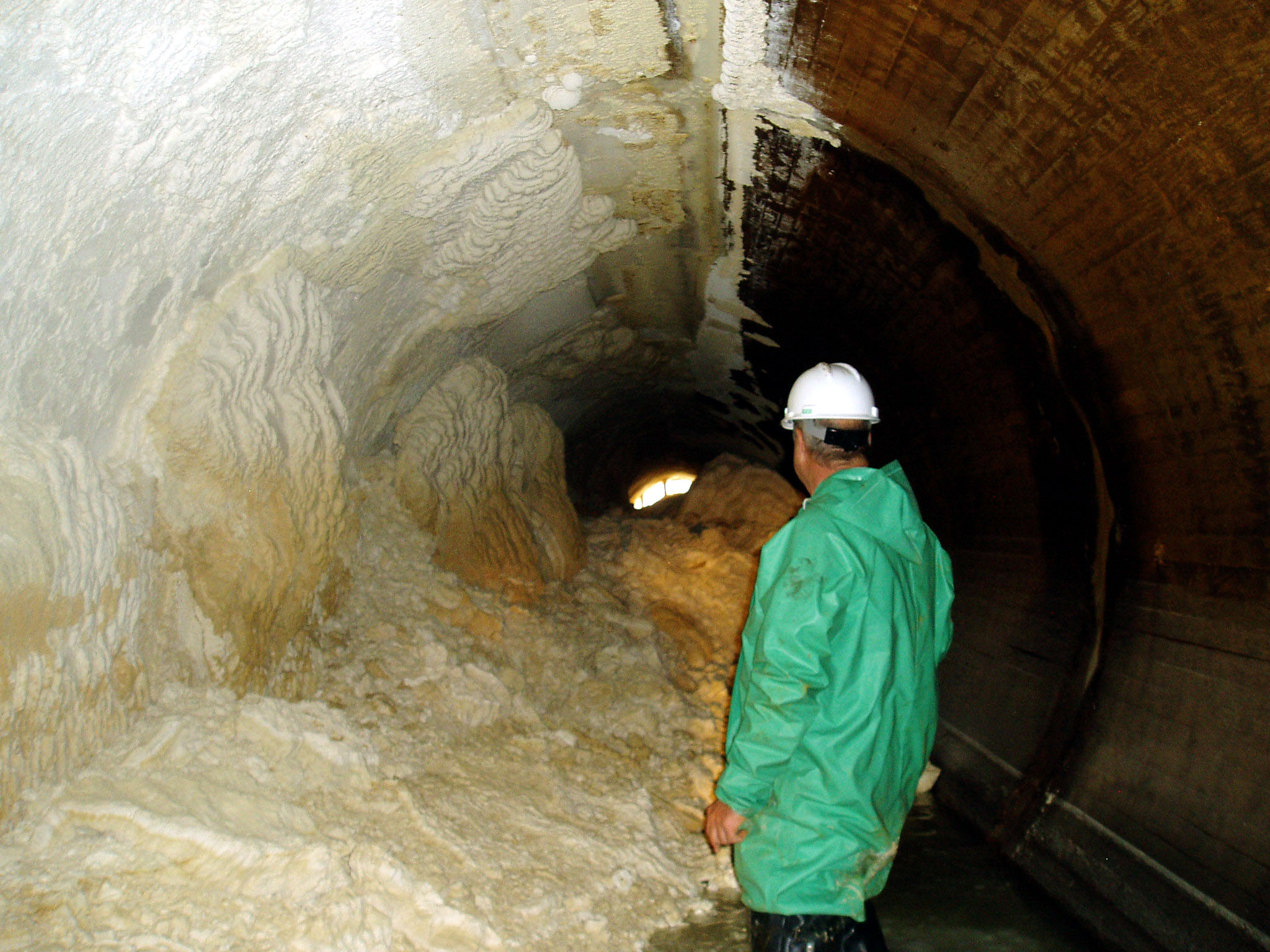
As can be seen, too much lime is not a good thing.

Lime2

This is after about 10 years of lime application, under the clear-well at Plant 1 Montebello.

OLYMPUS DIGITAL CAMERA

And this is after about 20 years. No clear-well at Plant 2, this pipe goes directly to the reservoir. There is about a 6″ pipe overhead that drops lime directly into this conduit.

Perception

20 Friday May 2016

Posted by Ronald Parks in Baltimore, Sewage History

≈ Leave a comment

Tags

Baltimore, Health, HISTORY, Jones Falls, POLITICS, Public Works, sewage, Sewage History

Below is the art work of Francis Guy (Brooklyn Museum). Showing what Baltimore looked like in 1802-1803.

Balt 1802

And this is what the mayor had to say about Baltimore in 1803:

Mayor’s Message – February 14, 1803: Mayor Calhoun. Experience evinces that no measure we can take contributes so much to protect us from the malignant effects of fever as cleanliness, and therefore that every exertion ought to be made to remove from the City all impure substances and putrefactive matter, and to fill up low and sunken situations which retain stagnant water and filth; much has already been done in this respect since we have been incorporated, and every observant mind must view with pleasure the great improvements that have been made, as well in the east part of the City as the west, in filling up low and sunken grounds, and in making streets, that were before quagmires, not only passable but elegant; these, together with a variety of other matters, such as watching and lighting the City, erecting and repairing bridges, repairing and improving markets, assisting to build and to support an hospital, erecting a powder magazine, deepening and improving the Harbour, sinking wells and keeping pumps in repair, cleaning the streets, etc., etc., have been attended with heavy expense to the City, and have borne hard on many individuals, but I trust they will reflect that the expense has been unavoidable, and was the only means whereby their property could have been rendered valuable to them.

Hard to see, for me at least, how one is related to the other. The artist shows Baltimore as a clean, nice little town on the Patapsco Basin. The mayor paints a picture of Baltimore as a “quagmire”; talking the politics of how much has improved.

To quote the Talking Heads – it is “The same as it ever was…”

Sewage Contraption

17 Tuesday May 2016

Posted by Ronald Parks in Baltimore, Sewage History

≈ Leave a comment

Tags

Baltimore, engineering, FILTRATION, Health, Public Works, sewage, Sewage History

Nothing says ‘Great Report’ than having a long title. (I had heard or read somewhere that long titles made books/reports more impressive)

1887: The Sanitation of Cities and Towns and the Agricultural Utilization of Excretal Matters Report on Improved Methods of Sewage Disposal and Water Supplies. By C. W. Chancellor, M.D., Maryland State Board of Health. To His Excellency Henry Lloyd, Governor of Maryland: Dear Sir, In pursuance of a resolution passed by the State Board of Health on the 19th day of November, 1886, and approved by your Excellency, authorizing me to proceed to Europe to investigate the most recent plans in practical operation for the disposal and utilization of household sewage, especially with reference to the sanitation of Maryland towns, and to report thereon, I herewith present the result of my labors. Undertaking the investigation with no preconceived notions of my own as to how the problem was to be solved; determined not to be influenced by appeals in favor of any particular scheme, however highly recommended; anxious to receive testimony from all parties, to hear all that could be said and to see all that could be seen, I have been guided not only by a fairly intimate acquaintance with what has been made public during the last ten or fifteen years on the “vexed question” of town sewerage, but by such experience as could be derived from a personal examination of. the principal systems in operation in England, France, Germany, Belgium, and Holland.

Evils Resulting from the Improper Disposal of Sewage – It cannot be too often repeated that the “water-carriage” plan of Tout a L’egout is without doubt the worst devised system of sewerage imaginable for getting rid of excrementitious matters, and should the attempt be made to treat the sewage of Baltimore city in this way, it will undoubtedly prove an expensive and fatal blunder. (Not only does this guy get to go to Europe to do this report – he starts speaking French!)

The bottom line of this nearly 200 page report is that he wants to sell his own invention for sewage removal:

sewage catcher

The Reader’s Digest version of his invention: Waste enters through down-pipe ‘F’. The heavier solids go into ‘E’. Liquid is pushed up through a layer of wool ‘D’, travels to ‘A’ where it is filtered, then out of ‘a’ to the nearest stream.

…but for the Grace of God

11 Wednesday May 2016

Posted by Ronald Parks in 12 steps, Addiction, Baltimore, Health, Recovery, Writing

≈ Leave a comment

Tags

Addiction, Baltimore, garbage, Health, HISTORY, Recovery, sewage

While doing research, for my upcoming book on Baltimore’s Sewage History, I come across tidbits of information that I find interesting or that just hits home with me in a way that makes me grateful for my life today. Since re-doing this blog a while back, I have been trying to refrain from writing on my personal life; that this blog will be about historic information concerning the Department of Public Works. Water and Sewage. But as usual, something I read strikes a chord with me. As in the case of the paragraph below. This comes from The Reports of the City Officers and Departments Made to the City Council of Baltimore for the Year 1904. Of course the majority of this two volume report concerns the Great Fire of Baltimore for that year, but as in most reports, regardless of what was happening at the time – various wars, droughts, pestilence, etc. – the reports always, after a brief notation on whichever calamity was occurring, become ‘Business as usual’.

“Report from City Charities on addiction – Amanda Orr* is representative of a class of persons who cannot resist the temptation of liquor. She has been committed to Bayview and the House of Correction many times for drunkenness and disorderly conduct. The only remedy for this class is to be confined indefinitely until cured of their disease in some place where they can be held in restraint and given healthy work and proper treatment. Incurable cases should be confined for life. This method of treatment is the most humane for the victim of the drink or opium habit and discourages the intemperate use of liquor and drugs. It is also much the cheapest method for the public in the long run. We need legislation to provide for indeterminate commitments for such cases.”

*State’s Attorney’s Office, Court House, Baltimore, February 21, 1905.

To the Police Justices of Baltimore City.

Dear Sirs—Allow me to call your attention to Section 868 of the City Charter, which provides for the commitment of paupers, habitual beggars, vagrants and vagabonds, lately construed by His Honor Judge Stockbridge in the Amanda Orr case. Under the decision of His Honor Judge Stockbridge in that case, the magistrate committing under said section should always commit said paupers, habitual beggars, vagrants and vagabonds to the House of Correction, and not to Bayview, except in special cases provided for in said Section 868 of City Charter. Before the magistrate can lawfully commit such pauper, etc., to the Almshouse (Bayview), it must positively appear that the person to be committed is not able-bodied, or is aged, or is seriously crippled, or infirm. In case of any doubt on the part of the committing magistrate as to the physical condition of the party to be committed, the magistrate by a short detention of the pauper, etc., at the station-house, can easily satisfy himself as to the alleged infirmities of the pauper, vagrant, etc., by the examination of the pauper by a physician. It is suggested that if this policy be pursued the State may be saved the trial of many habeas corpus cases and illegal commitments avoided. If you will be so kind as to leave this letter on file in your office for the benefit of any magistrate sitting in your absence, you will greatly oblige

Yours very truly,

Albert S. J. Owens,

State’s Attorney.

What’s this have to do with Baltimore’s Sewerage History? Being an alcoholic/addict I have lived in the gutters of Baltimore – waiting to be swept away at any minute like the other garbage laying there. Washed into the harbor…but for the grace of God….

I was Amanda Orr. Think of all the Amanda Orr’s since the above was written, who didn’t know they had a choice to ‘not use’.

Trash Day

10 Tuesday May 2016

Posted by Ronald Parks in Baltimore, POLITICS

≈ Leave a comment

Tags

Baltimore, engineering, garbage, Health, HISTORY, Public Works

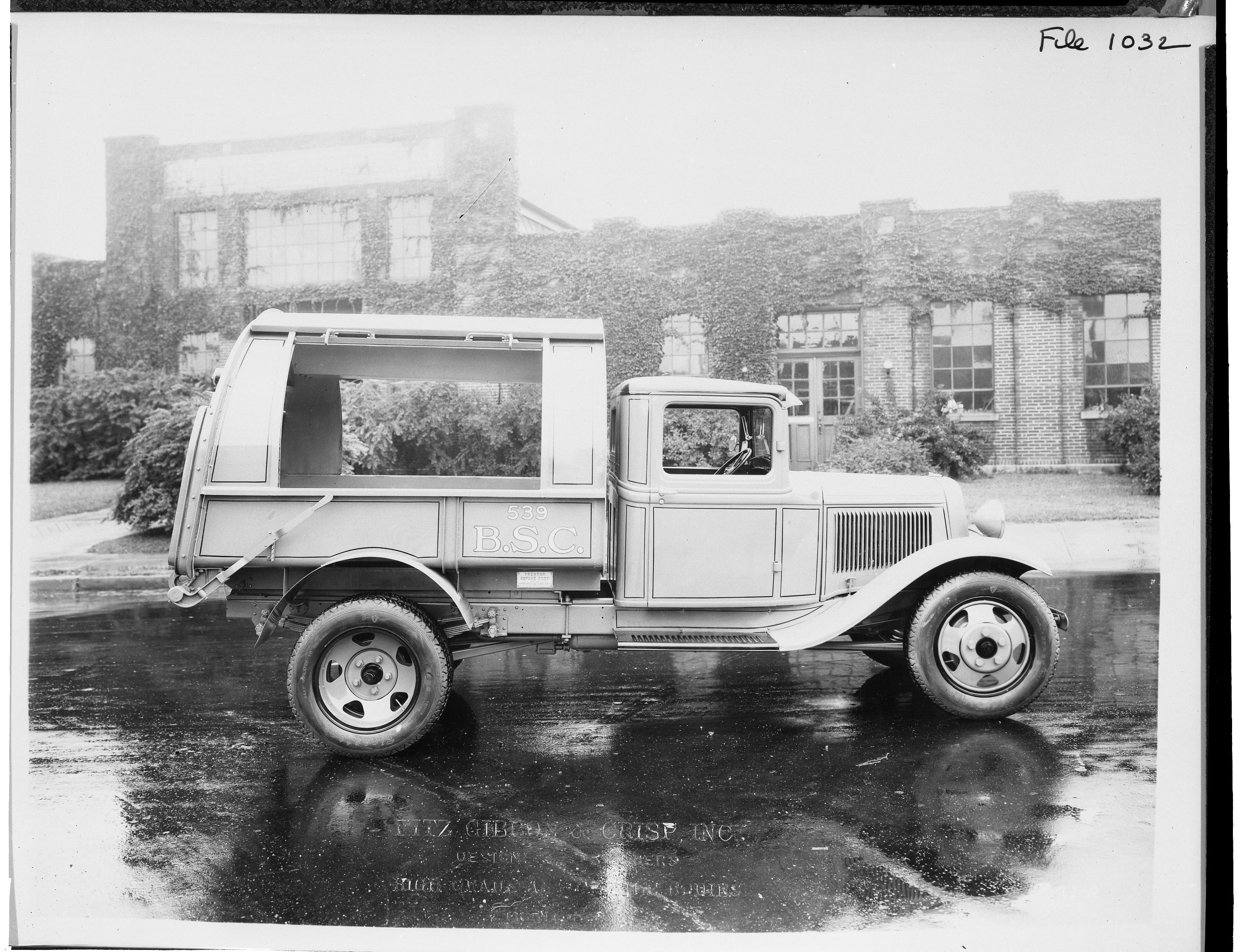
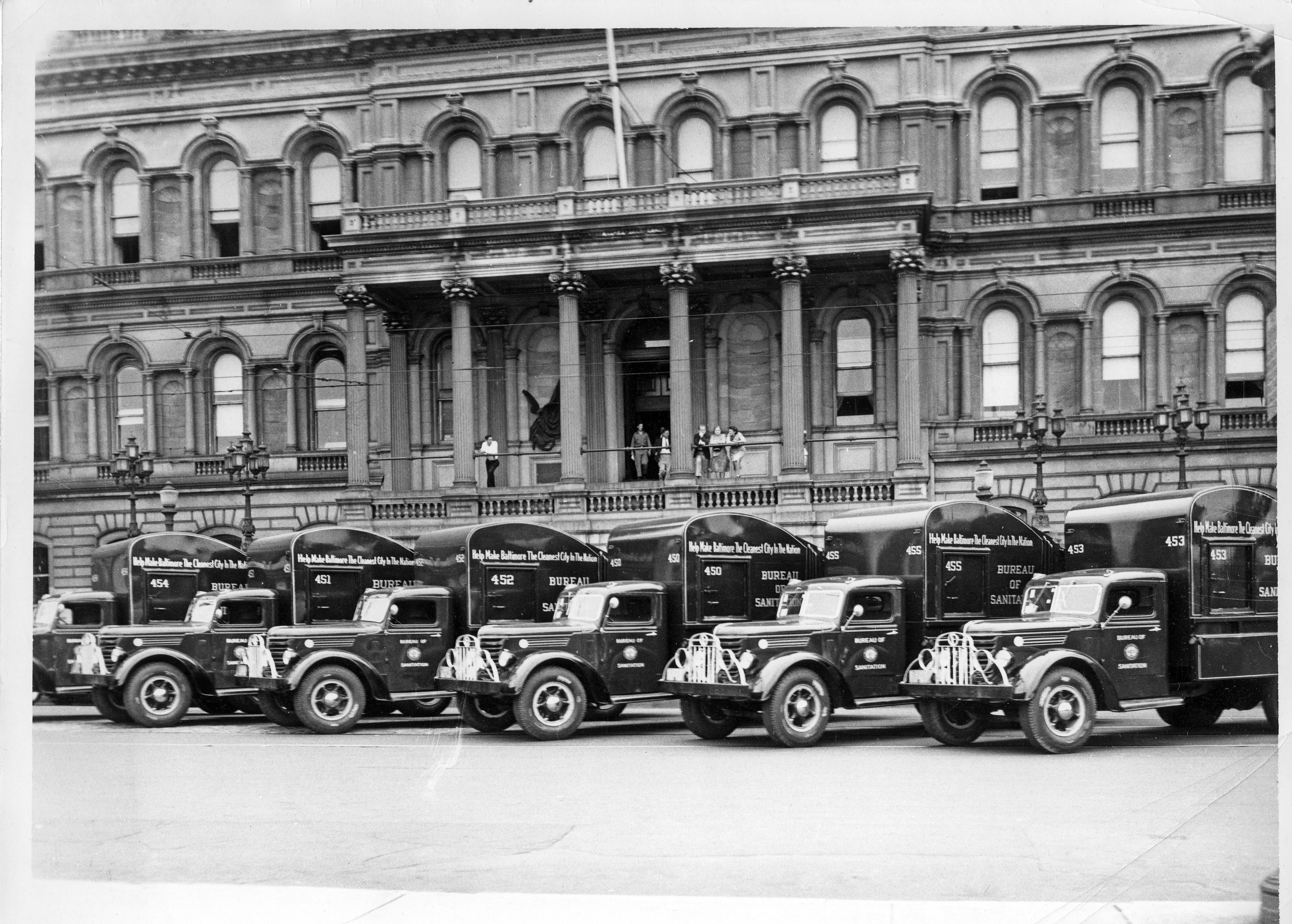
The Mayor spent $10,000,000.00 (Ten Million) on new trash cans for Baltimore residents. This I imagine also included the cost for the new attachment for the trash trucks, to pick up these over-sized cans?  Her reasoning is good – help reduce the rat population and to help the workers, so they don’t hurt themselves lifting the old cans and bags.
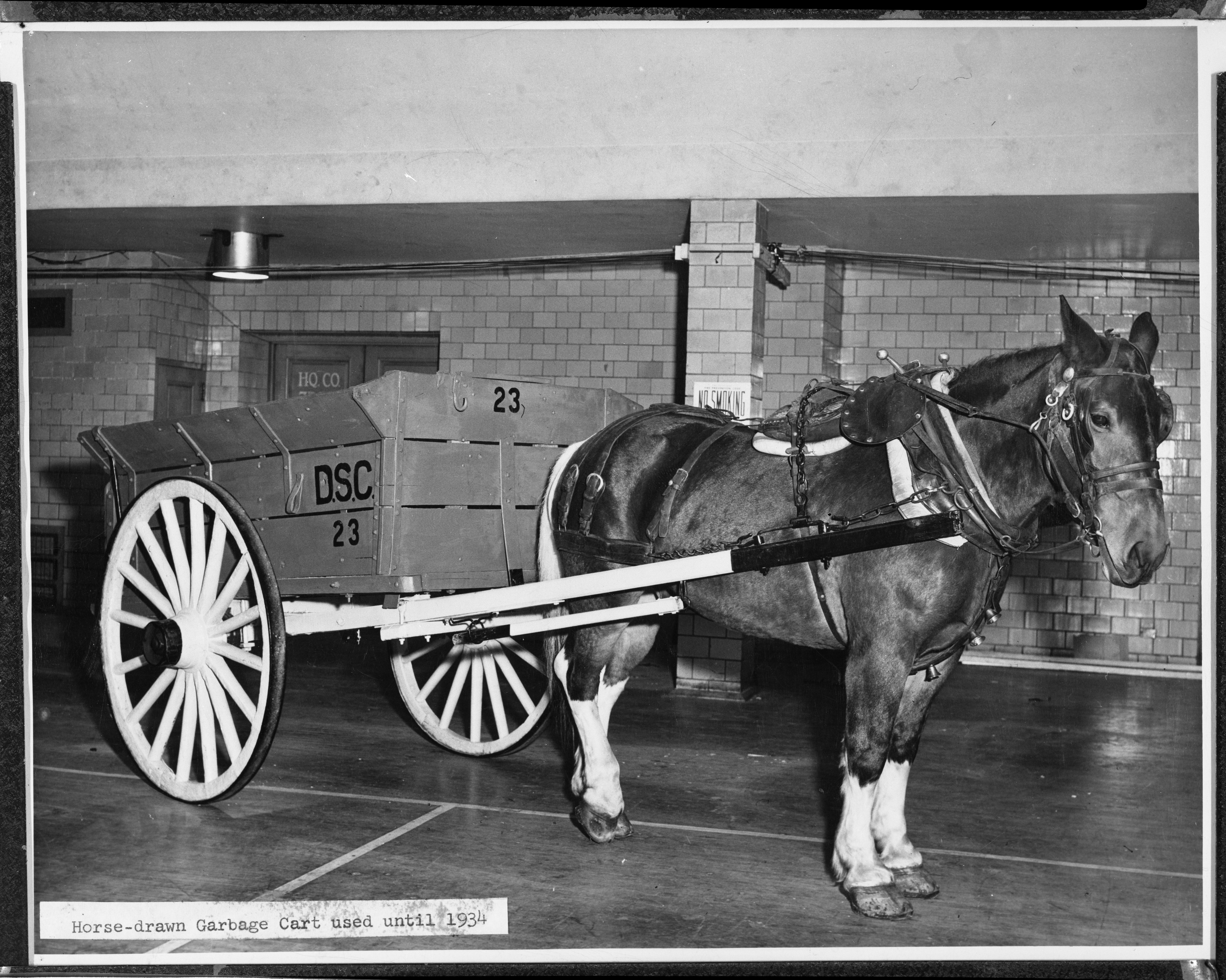
On occasion I get home from work in time to see the trash men on my street. And what did I see? The trash men reaching into the new cans and pulling the trash out by hand. Why? Because it takes way too long to put the new can on the new attachment so the trash truck can do all the work!! Residents are still putting out bags and the old metal cans and the trash guys are still taking it.

img031 (2)

img034

img200

Odorless Excavating Apparatus

29 Friday Apr 2016

Posted by Ronald Parks in Baltimore, Health, Sewage History

≈ Leave a comment

Tags

Baltimore, engineering, FILTRATION, garbage, Health, HISTORY, Jones Falls, Lake Roland, POLITICS, Public Works, sewage, Sewage History, water, water history

Baltimore, situated as she is, with one main water course through her center (Jones Falls), she had plenty of water for the people. Pure, clean drinking water….until people started dumping their sewage into it. Many Health Commissioner’s Reports talk about what to do with the sewage of Baltimore. Contractors were hired to haul it away. Here are a couple HCRs on what happened over a few short years in Baltimore, until a proper system of sewage could be built.

1865 – The withdrawal of a large share of the water flowing in this stream (Jones Falls), by the completion of the lake and storage reservoirs (Lake Roland, originally called Swann Lake), with the extension of the water works in the city, has left too small a portion of water to keep the original course clean if nothing was thrown into it; but to this deficiency of water add its use as a receptacle for every species of offal from factories, foundries, tanneries, stables and dwelling houses, and we are not surprised at its present condition. We have had one of these sources of nuisance carefully examined, and find that not only are most of the privies attached to dwellings on the streets adjoining the Falls drained into it, by means of private sewers, but that wherever a sewer leading to it can be reached, this sewer is connected with privies for drainage purposes.

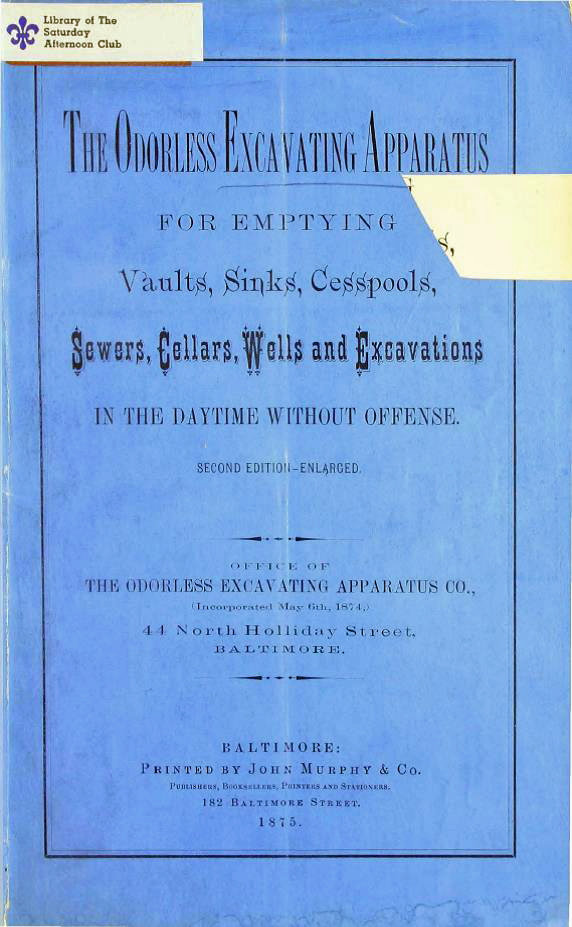
1873 – The late City Council have distinguished their administration by the passage of an ordinance permitting the use of the “odorless excavating apparatus” for emptying privies in the day time. This is the inauguration of a new era, and destined to prove one of the greatest blessings of the age. As stated in a communication on this subject to the late City Council, your Commissioner holds that a large proportion of the cases of cholera infantum occurring in all large cities during the heated term are to be ascribed to the ancient and vile mode of doing this work, as well as to its transportation through the streets of the city, poisoning the air which is wafted into every open window.

1875 Odorless Apparatus2

1875 Odorless Apparatus1888 – The adoption of a proper system of sewers for the present privy-wells will assist the Health Department in its endeavor to bring the City to a point where the ordinary sanitary condition will be such that epidemics of disease, resulting from or aggravated by filth, could be avoided or reduced to a minimum. The danger is greater than the people realize; the trouble is deep-seated and not to be reached by the Spring ‘cleaning up’ nor even by inspection. In most of the houses of this City there exists a latent power for evil, which is liable when its hour arrives to exert itself to the full of its terrible might.

I don’t believe that this apparatus lasted too long. It is no longer mentioned after the 1876 report.

Montebello Lake

25 Monday Apr 2016

Posted by Ronald Parks in Baltimore, filtration, HISTORY, water history

≈ 1 Comment

Tags

Baltimore, engineering, FILTRATION, Health, HISTORY, Lake Montebello, Montebello, photography, Public Works, water, water history

Last week I received a request from my boss to check out the Montebello Lake. That it was reported that someone was seen dumping petroleum and chlorine into the lake. My first question was – “Did the person who spotted this call the police?” It is a crime to tamper with the water supply, let alone dump toxic chemicals into a lake on our property. This lake is no longer part of the city water supply system, other than being a settling basin for what goes on in the filtration plant. It is a by-product of filtration, waiting to settle out before flowing into Herring Run. Most people, even the neighbors don’t know this. They still believe the lake is drinking water. It hasn’t been drinking water since 1915.

I go and check out the lake but didn’t find anything amiss. (Not only do people NOT call the police, but after 35 years of being here, I learn to take those calls for lake problems with a grain of salt. Most are not true and unsubstantiated, but they do need to be checked out)

004

This is the view across the lake towards the gate house. The brown you see in the water is sludge build-up. This lake was dredged in 2005-2007, but the contractors only did a small portion of the smaller lake where most plant sludge is collected before flowing to this lake. That lake will soon be dredged. (It should be every 3-5 years, with the big lake not needing to be done for 30 years)

040 031 006

The ducks, turtles, fish and other wildlife all seem to be fine. No effects from a toxic dump here. I also did not see any dead growth on the grass which would indicate dumping.

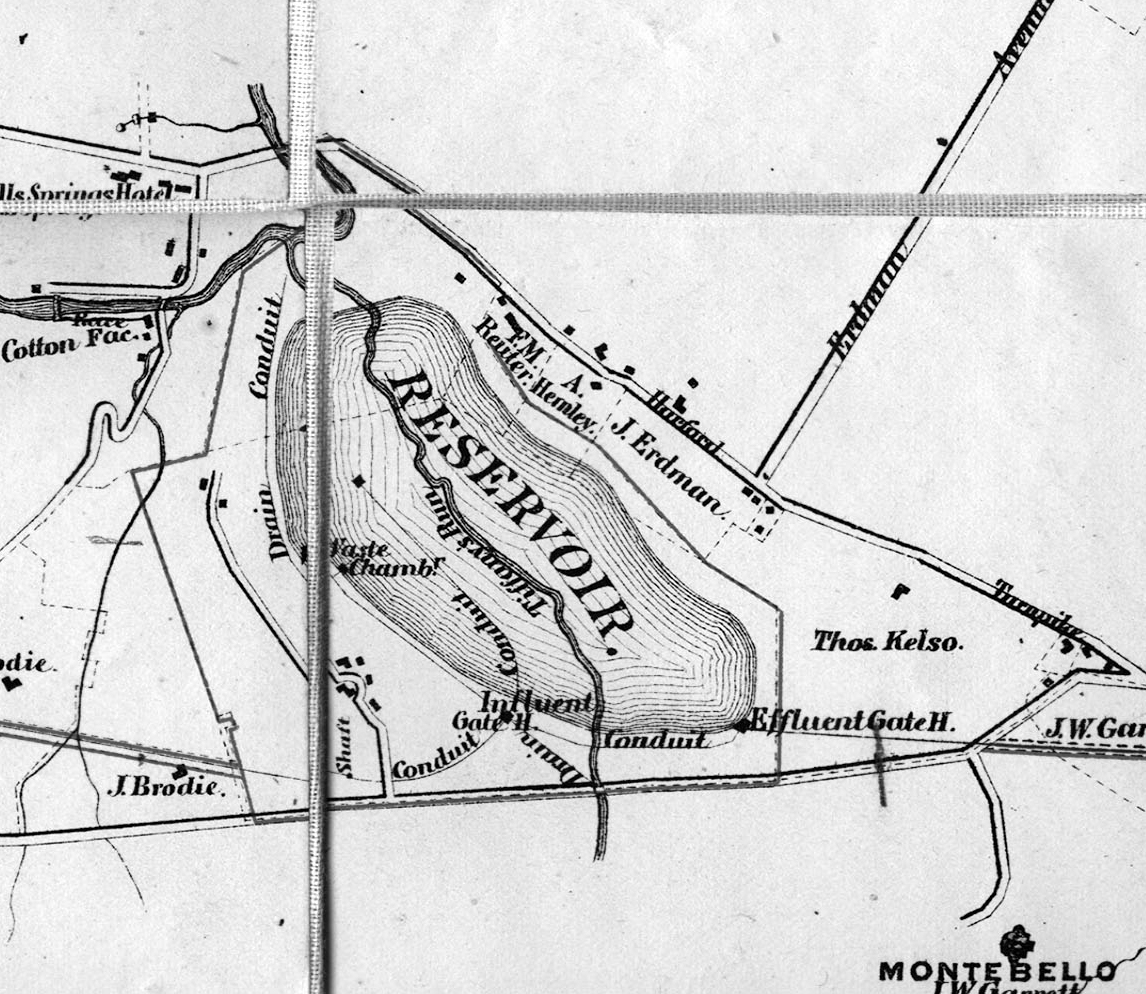
tiffanyrThis is one of the original drawings from 1875 showing the lake being built over Tiffany Run, which dumps into Herring Run. The run was diverted into a tunnel from the gate house, lower left of lake then heads along, marked as drain conduit to Herring Run.

016

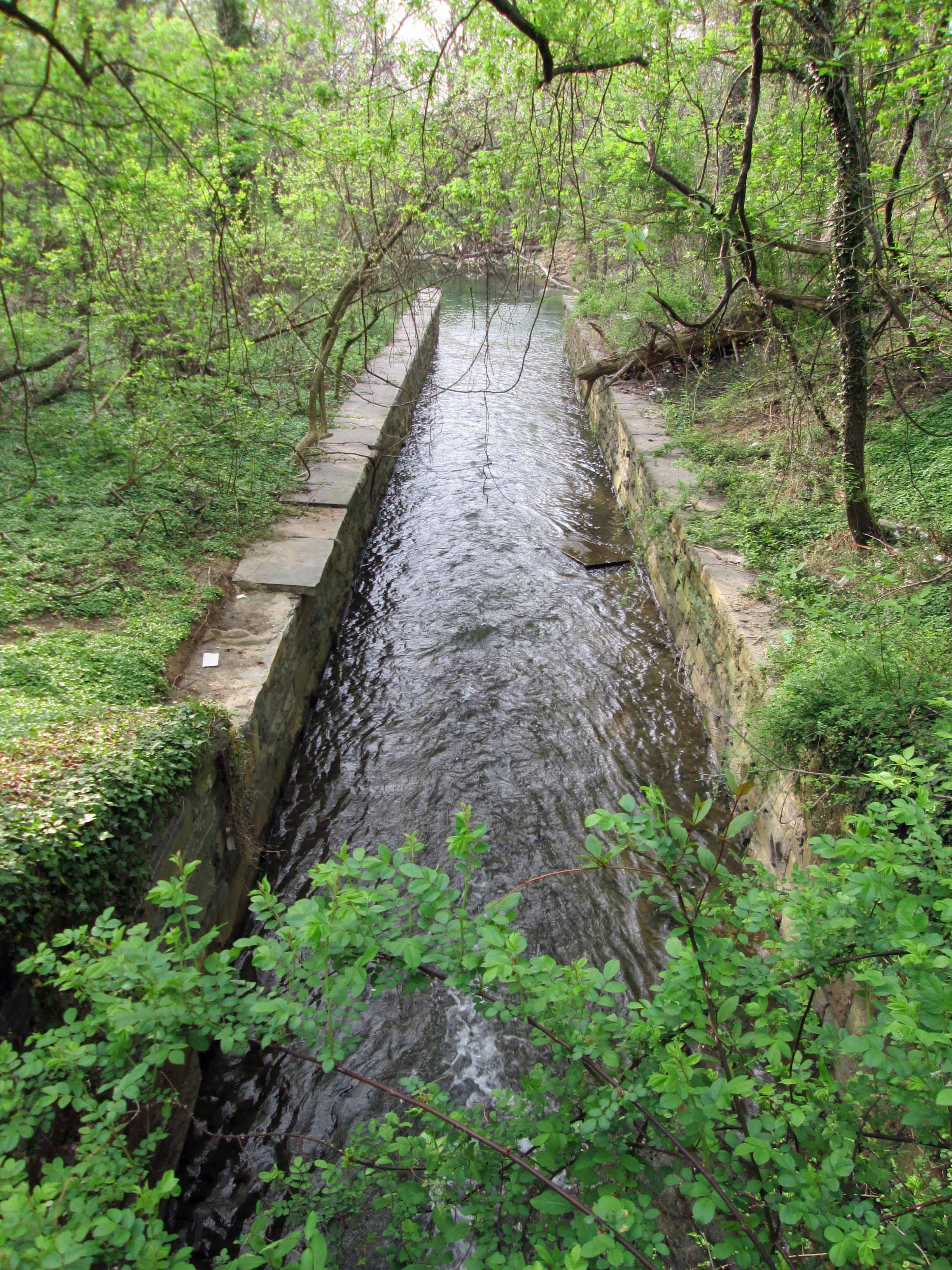
This is the original 1880s Tiffany Run drain. It has been relined a couple times since being built.

011

Channel from Tiffany drain to Herring Run. This is probably the best part of my job, other than historical research – getting to roam around in the woods. All 300 acres.

← Older posts
Newer posts →

Blogroll

  • Flouride Action Network
  • lulu
  • My Book
  • WordPress.com
  • WordPress.org

Recent Posts

  • Bermuda 2023
  • ICELAND April 2023
  • George Chalmers of Fochabers
  • In Search of The Skipjack Ada Mae
  • Trap Pond Kayak

Blog at WordPress.com.

  • Subscribe Subscribed
    • Water and Me
    • Join 231 other subscribers
    • Already have a WordPress.com account? Log in now.
    • Water and Me
    • Subscribe Subscribed
    • Sign up
    • Log in
    • Report this content
    • View site in Reader
    • Manage subscriptions
    • Collapse this bar
 

Loading Comments...