• About
  • History Writings

Water and Me

Water and Me

Tag Archives: Sewage History

The Walls of Jones Falls

14 Tuesday Jun 2016

Posted by Ronald Parks in Baltimore, HISTORY, Sewage History

≈ Leave a comment

Tags

Baltimore, engineering, HISTORY, Jones Falls, POLITICS, Public Works, sewage, Sewage History

February 12, 1816: Edward Johnson notes his retiring as mayor after eight years. Jones Falls – A Law has been passed by the General Assembly of Maryland at their late session, authorizing a Lottery to raise a sum of money, not exceeding fifty thousand dollars, clear of all expenses. One half of the net proceeds of which is to be appropriated under the direction of the managers named in the law, to the deepening of Jones’ Falls and walling the public streets binding thereon; the other half in conveying a stream of water that passes down Harford Street in a culvert or tunnel, below the surface of the street into the cove.

January 5, 1829: Jones Falls – The hand rail on Jones’ Falls and Harford Run has been completed, as directed by the resolution No. 15, of February, 1828, and affords security to our citizens. The walling of Harford Run has been continued southerly, as directed by Ordinance. The walling of a part of Jones’ Falls, as directed by the Resolution of April, 1828, has been executed; but the efforts of the City Commissioners in enforcing the provisions of the Ordinance of February, 1826, requiring the owners of property on Jones’ Falls to erect walls, etc., have continued to prove unavailing. It is submitted whether the City Commissioners should not be authorized to have the work done, thereby to avoid future injury to the navigation; and require the owners of property to pay the expenses thereof.

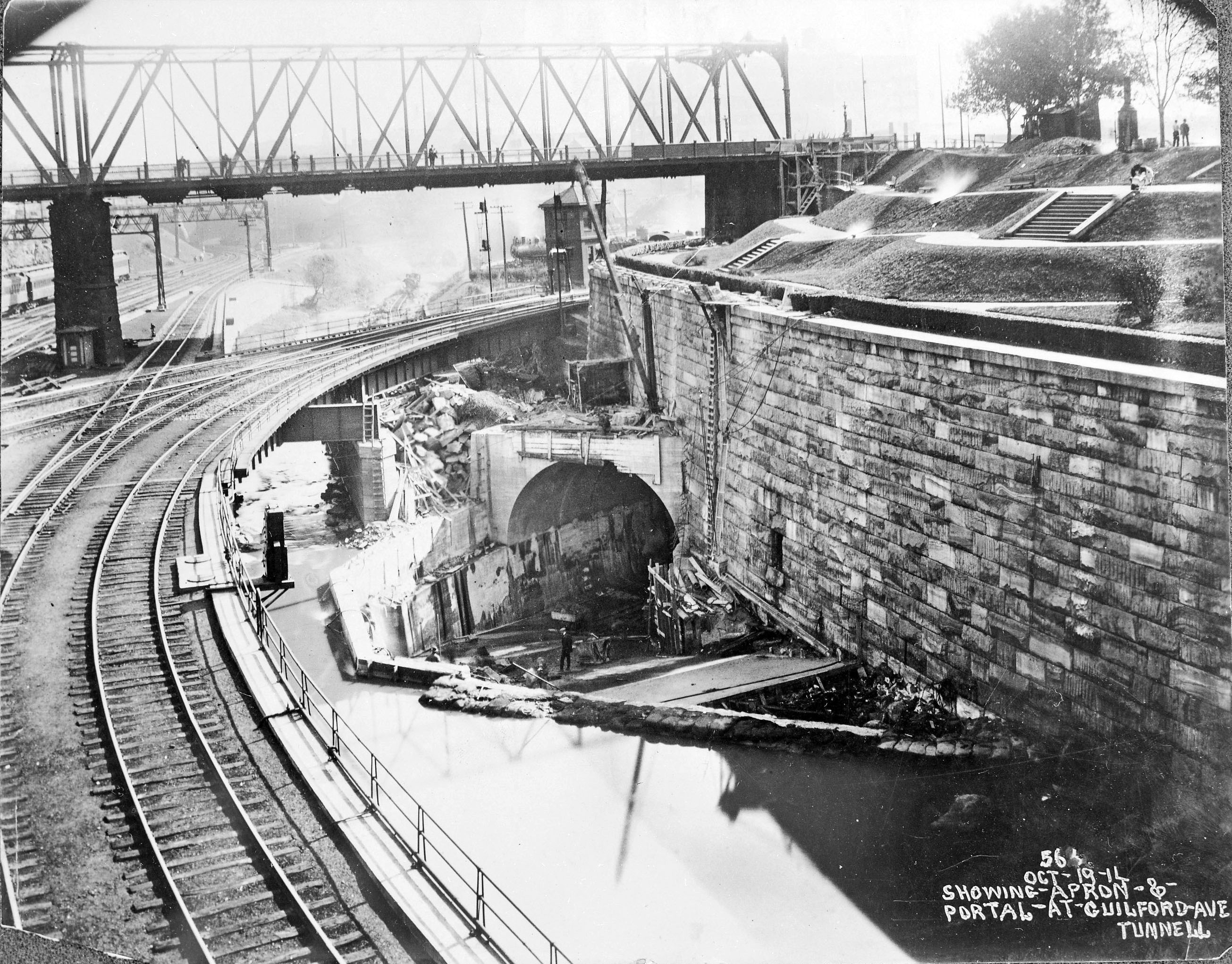
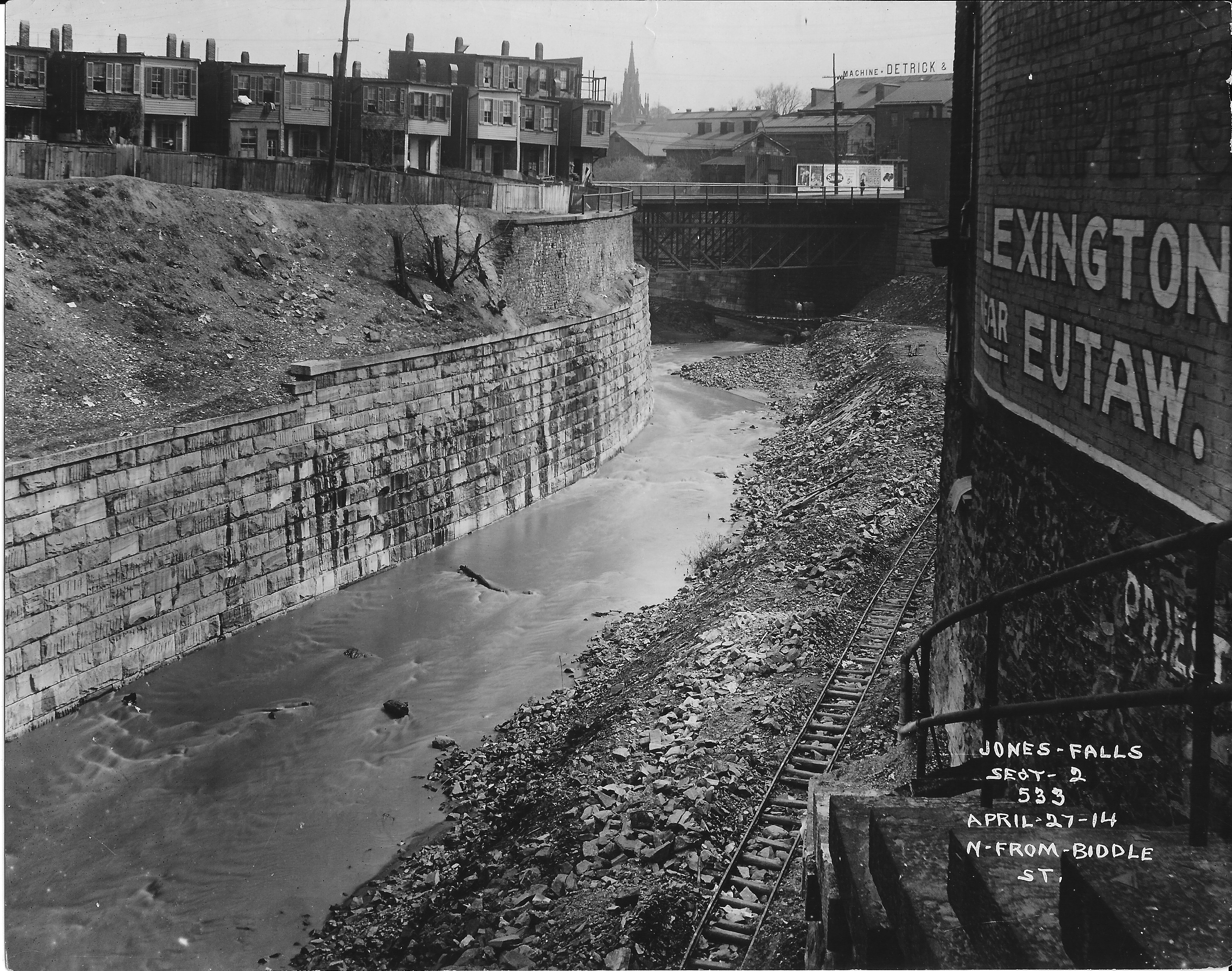
Walls will be built. Walls will be knocked down or tunneled through, all to try and change the course of the Jones Falls, flowing through the city.

wall1

Walls upon walls.

wall2

Tunneling through the walls (I would liked to have seen the park up above)

wall3

Close up of one of the walls (Is that graffiti to the right? HW)

Possible Treasure Trove

10 Friday Jun 2016

Posted by Ronald Parks in Baltimore, HISTORY, Sewage History

≈ Leave a comment

Tags

Baltimore, engineering, FILTRATION, HISTORY, Jones Falls, Museum, photography, Public Works, sewage, Sewage History, water history

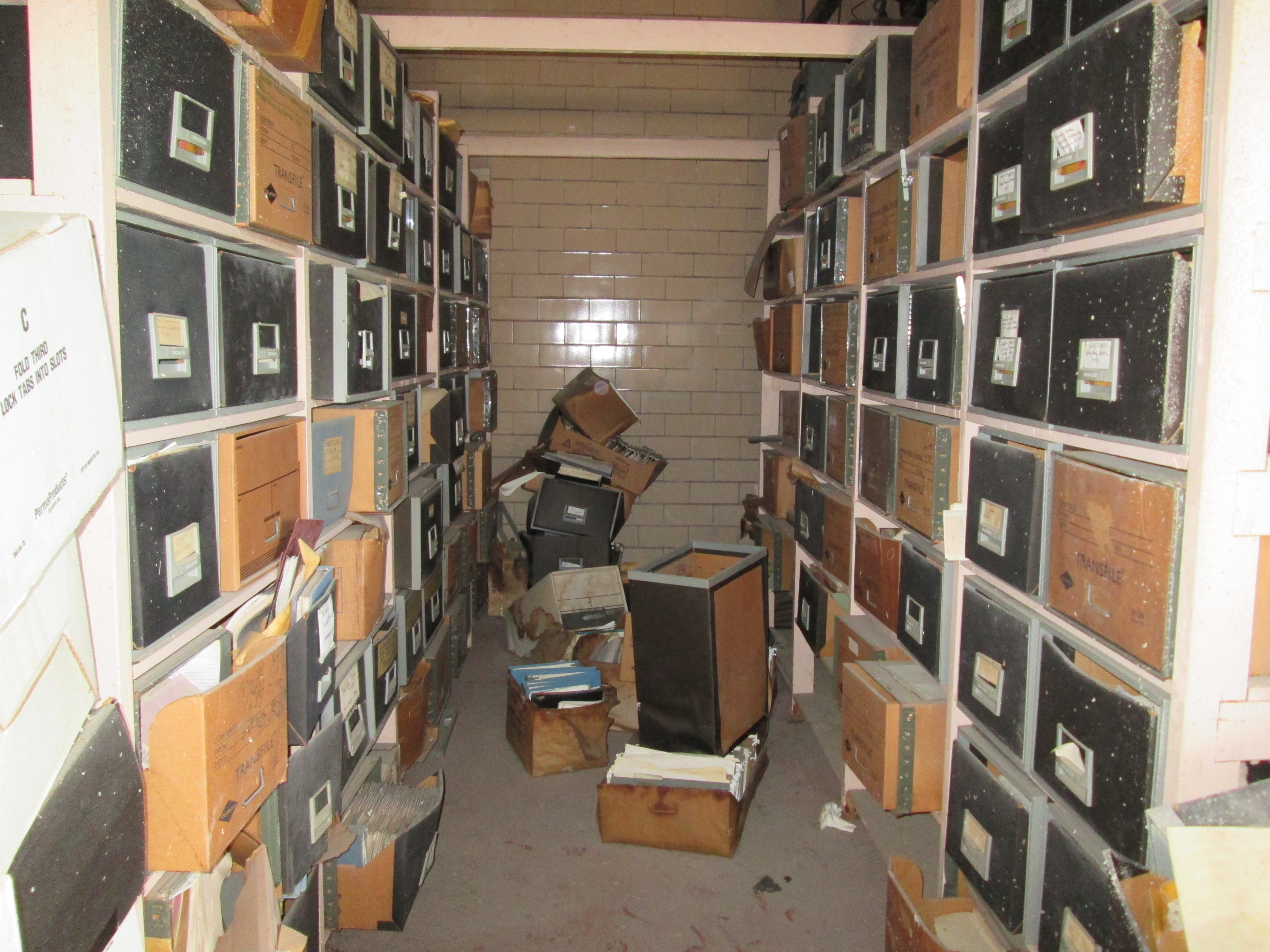
A few years ago, before I was asked to relocate the DPW Museum Archives, I was researching Baltimore’s Water History. I knew there were files kept down at Back River, in the museum storage area and after repeatedly pestering people to let me have access to the building, I was told ok – the only problem being, they sent me to the wrong ‘archives’ area. This building was old, dark, damp and a disaster. I was unable to find anything I could use. (It was so dark, I had to use my camera’s flash to get around!) I told the admin down there that if they were to put in some lights, I would volunteer to clean, organize and document the files. No response. A while later I was given access to the museum files, the ones I originally wanted to see.

For my Sewerage History, I again asked for access to the old building. The museum files have since been moved to my work location, but I knew there were others down at Back River, in that original building I was sent to. The place is still a mess but at least I could see inside. The boards on the windows have rotted and fallen down. Sunlight filtered in. There are a lot of old records in there that need preserving. Maybe someone will give me permission this time to do what needs to be done.

019

Early contracts, specification books and drawings.

011 (2)

Three floors of Early Sewerage History!

003

There are even photographs from water filtration. These are of the renovations at Ashburton. Why they are at Back River is beyond me!

Sewage at Back River

03 Friday Jun 2016

Posted by Ronald Parks in Baltimore, HISTORY, Sewage History

≈ 3 Comments

Tags

Baltimore, engineering, HISTORY, POLITICS, Public Works, sewage, Sewage History

I read with some interest a blog on Baltimore’s disposal plant at Back River, where it was stated that the Outfall Sewer, which connects to the plant, has sunk about four feet and that millions of dollars will be spent to correct this problem. (For 35 years working in the water department, it always amazed me that there was work going on non-stop at Back River. Billions of dollars’ worth. Nothing for the drinking water side though!) It was also mentioned that this ‘sinking’ was possibly caused by poor construction and engineering. I guess it is easier to blame people who are no longer around that can defend their work! The system is over 100 years old. Below is some info on construction.

1906 – The Board of Police Commissioners caused a census of the city to be taken by the Police Force, which was completed about April 10, 1906, and showed that by the police computation the population of the city at that time was 543,034. A later estimate made in September, 1906, gives the city a population of 555,000. The capacity of the system in whole, will be for a projected one million persons. The Outfall Sewer extends from Chase and Durham streets to Monument street and Loney’s Lane inside the city limits, a distance of 7,016 feet, or 1.33 miles. This portion is under contract and construction was begun on December 24th. From Chase and Durham streets to Madison and Luzerne streets the sewer will be 10 feet 9 inches high and 12 feet wide; thence to the Disposal Plant it will be 11 feet high and 12 feet 3 inches wide. It will be built of concrete, the lower half being lined with brick. From the city limits the line continues east in Monument street to the Union Railway, thence on the south side of the Union Railway, and with a general easterly and southeasterly direction in Fayette street extended and across private property to the Disposal Area on the west shore of Back River south of Eastern avenue, a distance of 23,354 feet, or 4.42 miles, in Baltimore County, making the total length of the Outfall Sewer 30,369 feet, or 5.75 miles.

1908 – Disposal Works – The fact of being able to intercept two-thirds of the City’s sewage and carry it by gravity to the disposal works, where the sewage of the entire City is to be treated, is an item that future generations will appreciate, as it means an enormous saving for all future time in the cost of operation of the sewerage system.

1908 Engineer Hendrick’s report – “It has been our endeavor to treat the work, both as to letting contracts and the employment and promotion of the men, entirely on a business and merit basis, resulting in an excellent class of work and men, including both contractors and engineers. I wish to express thanks to Mr. W.W. Crosby, Chief Engineer of the Maryland Geological Survey and State Roads Commission, for making various rattler tests on brick; to Dr. E. B. Mathews, Professor of Mineralogy and Petrography, for making examinations of various stones, and to Prof. Earle B. Phelps, of Boston, for his assistance in our chlorine experiments at Walbrook. Considering the many difficulties arising daily in constructing two separate systems of sewers (sanitary and storm water) among the vast number of underground obstructions, in streets crowded with traffic and the rapidity and satisfactory manner in which the work has moved forward, which could not have been accomplished if it had not been for the faithfulness and devotion of everyone connected with the work, regardless of overtime and weather, I take this opportunity of expressing my high appreciation of the faithfulness of my staff, consisting of Mr. Albert M. Brosius, First Assistant Engineer; Mr. Herbert M. Knight, Storm-water and Low Level Divisions; Mr. Oliver W. Connet, High Level Division; Mr. Ezra B. Whitman, Disposal Division; Mr. Thomas D. Pitts, Office Division; also, including the engineers, rodmen and inspectors. As stated in a recent address I made to the Society of Civil Engineers in Washington, D. C., the sewage problem as a world factor is forcing itself to the front very rapidly, and our country is approaching a point where it will have to deal with the sewage question on a broad scale. As rivers run from one State to another, the States cannot deal with the problem without clashing, and it will soon have to be dealt with by a National Sewage Board, similar to those abroad. We have heretofore, on account of the vastness of our country and the size of our rivers, simply disposed of the sewage in the most economical manner at the time, regardless of results, such as dumping it directly into lakes and rivers. This has been a short sighted policy from the fact that large expenditures have been entered into in the way of sewers, which will necessarily have to be readjusted in order to conform to sanitary laws now being passed requiring the treatment of sewage before discharging it into rivers or lakes. The City of Baltimore is showing the same progressive spirit in handling this great sanitary problem that she has shown in many other enterprises of world-wide interest, causing cities all over the world to send committees and engineers to study the plans and methods of prosecuting our work.”200- 2
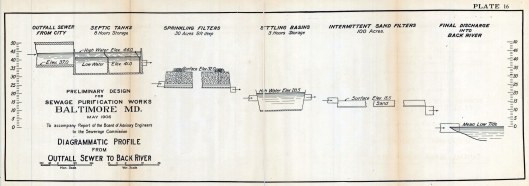
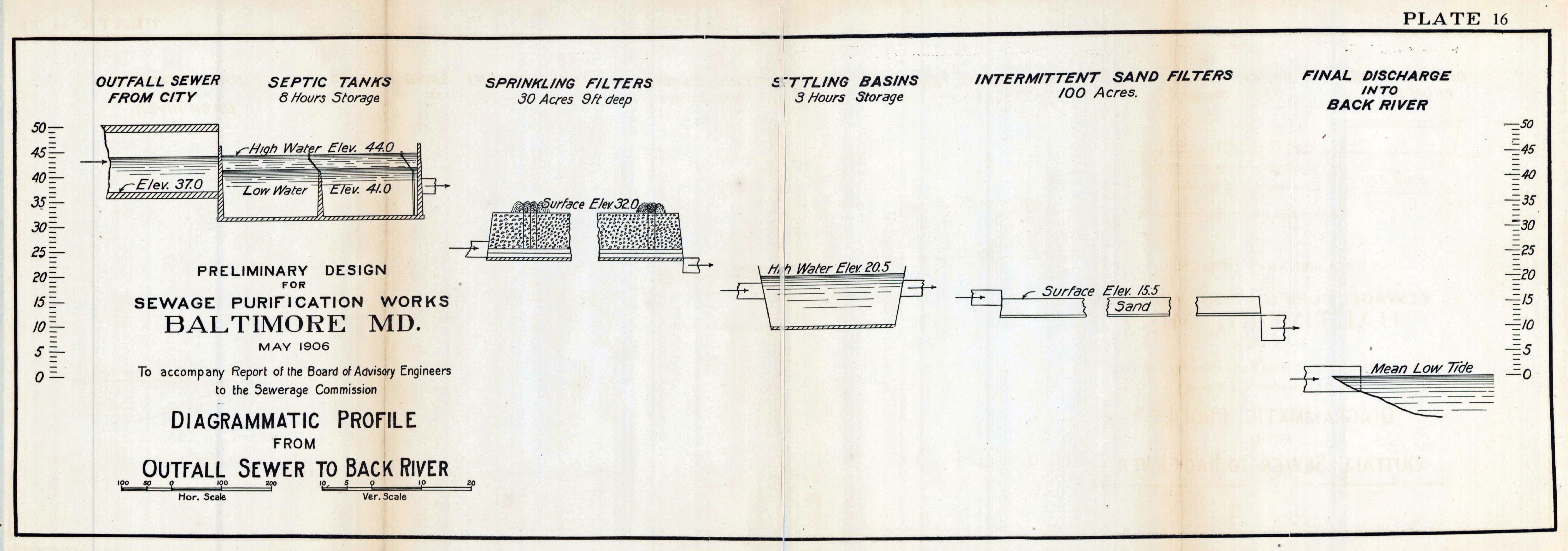
Here is a drawing showing to the left the supposed sunken outfall connection to the plant. img001b

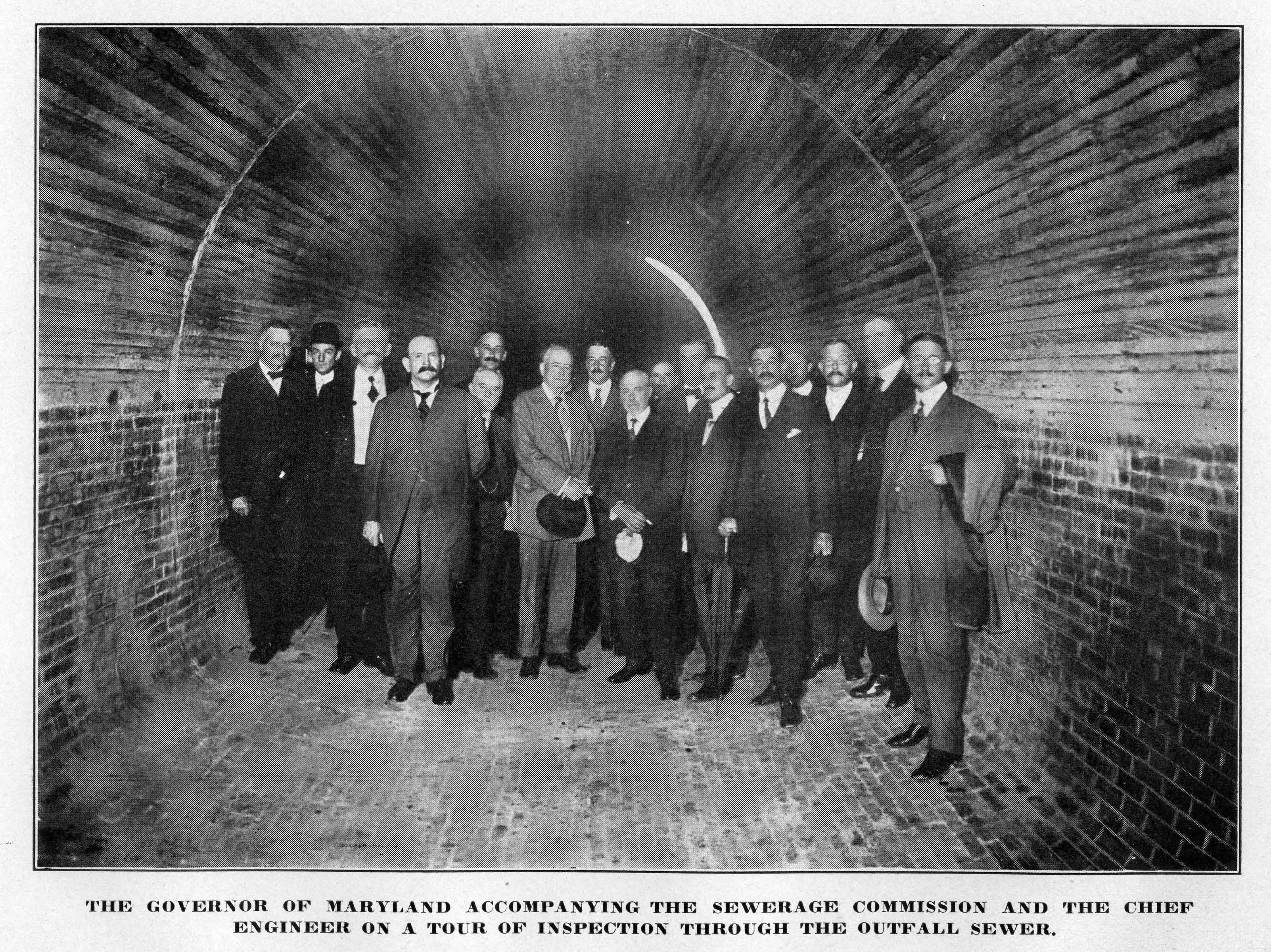
Here are the engineers that built this structure. It appears to me that if this brick-lined conduit did sink 4′ that there would be a mass amount of broken brick and concrete?

Lime

24 Tuesday May 2016

Posted by Ronald Parks in Baltimore, Sewage History, water history

≈ Leave a comment

Tags

Baltimore, engineering, FILTRATION, Gunpowder Falls, Health, HISTORY, Lake Montebello, Montebello, Public Works, sewage, Sewage History, water, water history

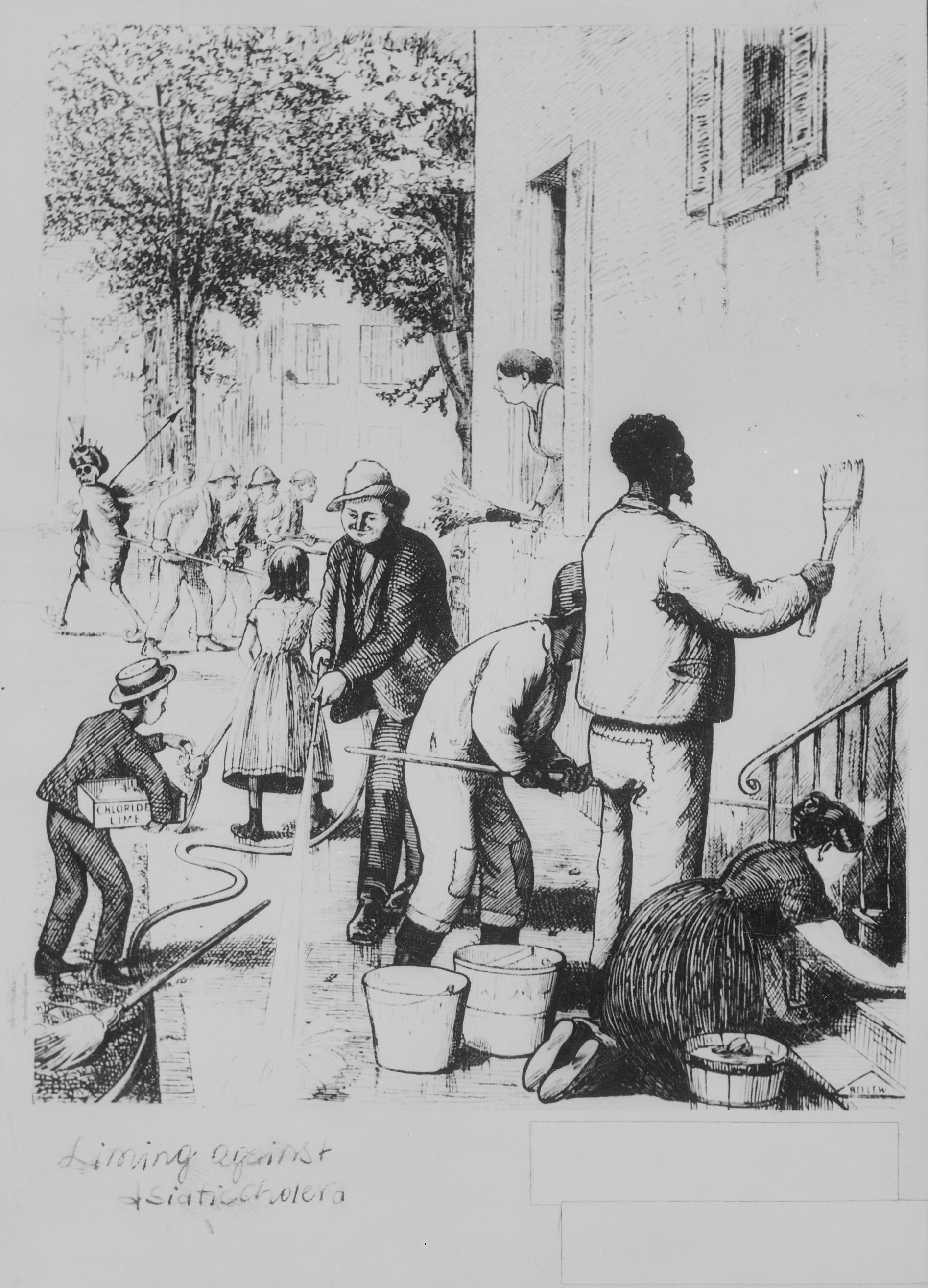
As can be seen from the list below, Lime has been used as a disinfectant for many years as far as the sewerage system and health goes.

1865 – Board of Health: The general health account shows an expenditure of $2,918.11. This account includes the appropriation for enclosing the Eastern Potter’s Field, erecting a dead house &c. and that for lime and incidentals.

1866 – Board of Health: 11,000 oysters were thrown away (This was in response to a cholera epidemic where 9 of 10 cases were found from eating oysters). We have used lime, Ridgewood’s and Sim’s disinfectant, and carbolic acid freely in the alleys and sewers.

1880 – General Superintendent of Streets: Your instructions in reference to the free use of lime in all alleys, gutters, vacant lots and places where stagnant pools of water were to be found, have been faithfully carried out.

1886 – Health Department: Disinfection – There was distributed in the streets, lanes, and alleys six hundred and thirty-seven cart-loads of lime. In addition, the Department manufactured and distributed twenty-two (22) tons of disinfectants; the principal portion of which was used in sewers and inlets.

1888 – Assistant Health Commissioner’s Report – During the year six thousand and thirty-one (6031) cart loads of refuse were removed from sewers, inlets and covered gutters. Six hundred and ten loads of lime and twelve tons of carbolate of lime were distributed for the purposes of purification and disinfection.

Liming against Asiatic Cholera.

Lime1

In 1910 Baltimore used chloride of lime (along with calcium hypochlorite and intermittent applications of alum sulfate) as a disinfectant in the water supply. And in 1922 it was specifically used for corrosion control.

Mont 8-12 050

The above photo, from a previous post, was before the Montebello Filtration Plant was built. The water supply came from the Gunpowder River (7 miles away), directly to this gate house and emptied into the Montebello Lake.

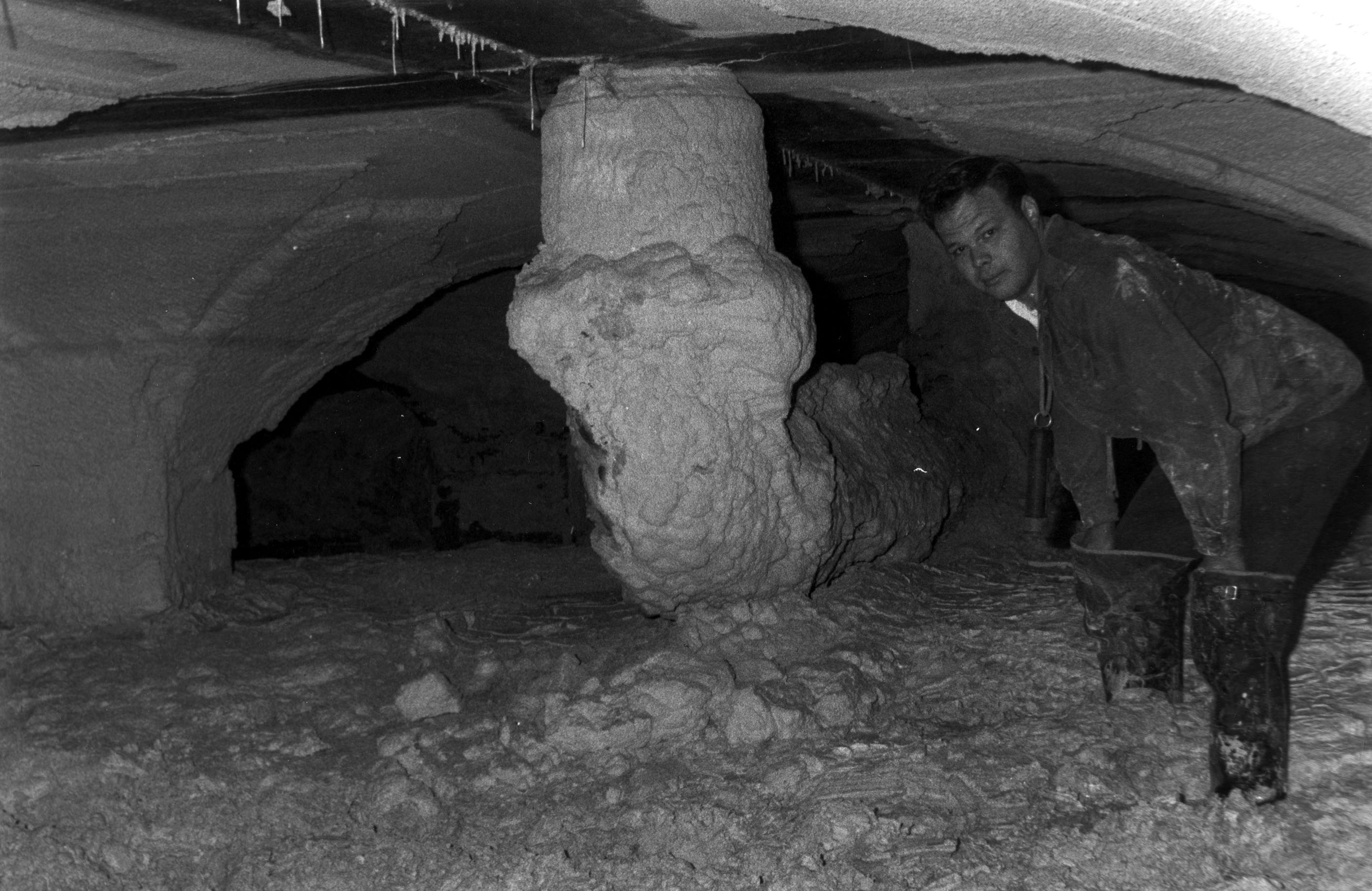
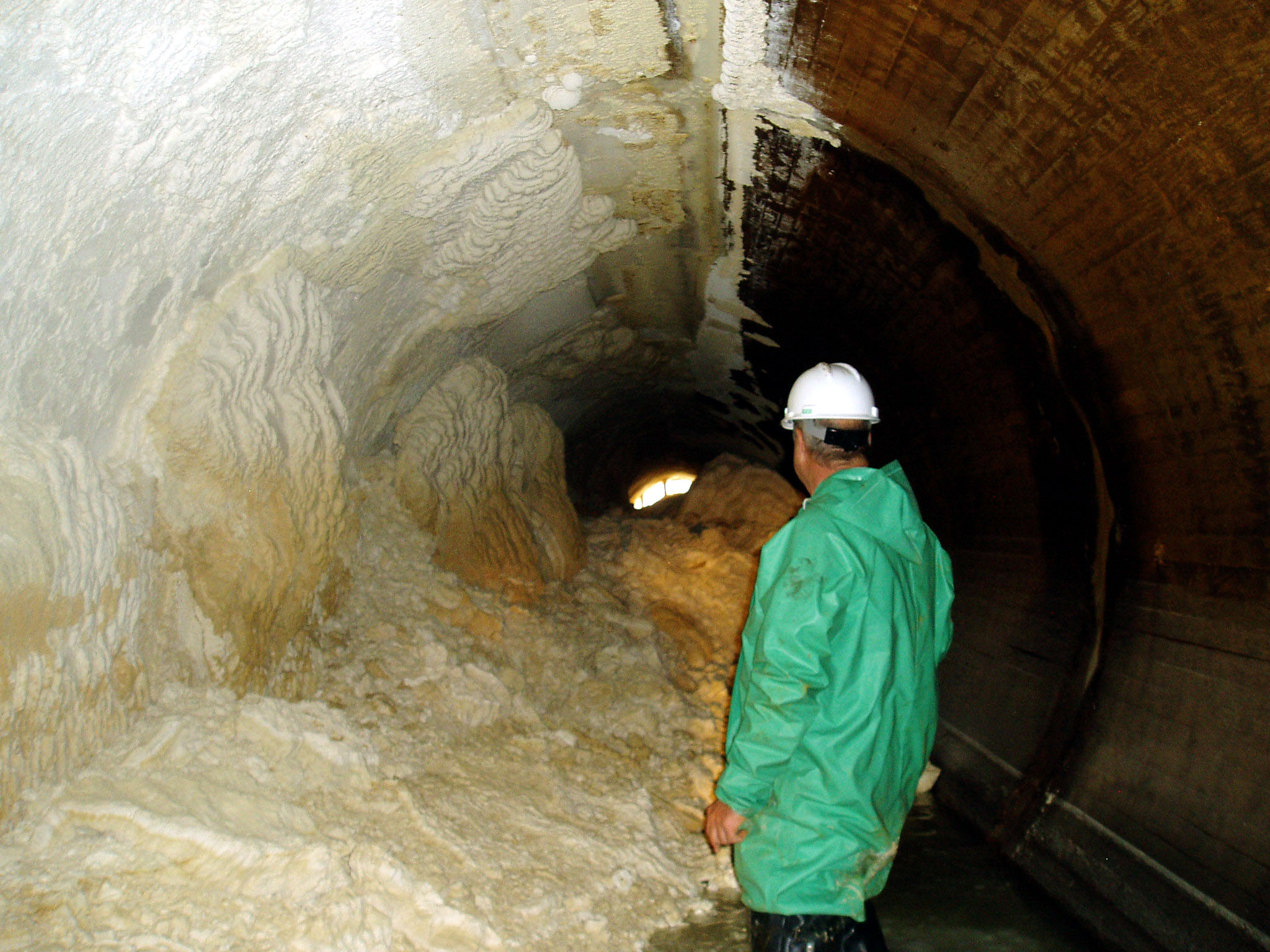
As can be seen, too much lime is not a good thing.

Lime2

This is after about 10 years of lime application, under the clear-well at Plant 1 Montebello.

OLYMPUS DIGITAL CAMERA

And this is after about 20 years. No clear-well at Plant 2, this pipe goes directly to the reservoir. There is about a 6″ pipe overhead that drops lime directly into this conduit.

Perception

20 Friday May 2016

Posted by Ronald Parks in Baltimore, Sewage History

≈ Leave a comment

Tags

Baltimore, Health, HISTORY, Jones Falls, POLITICS, Public Works, sewage, Sewage History

Below is the art work of Francis Guy (Brooklyn Museum). Showing what Baltimore looked like in 1802-1803.

Balt 1802

And this is what the mayor had to say about Baltimore in 1803:

Mayor’s Message – February 14, 1803: Mayor Calhoun. Experience evinces that no measure we can take contributes so much to protect us from the malignant effects of fever as cleanliness, and therefore that every exertion ought to be made to remove from the City all impure substances and putrefactive matter, and to fill up low and sunken situations which retain stagnant water and filth; much has already been done in this respect since we have been incorporated, and every observant mind must view with pleasure the great improvements that have been made, as well in the east part of the City as the west, in filling up low and sunken grounds, and in making streets, that were before quagmires, not only passable but elegant; these, together with a variety of other matters, such as watching and lighting the City, erecting and repairing bridges, repairing and improving markets, assisting to build and to support an hospital, erecting a powder magazine, deepening and improving the Harbour, sinking wells and keeping pumps in repair, cleaning the streets, etc., etc., have been attended with heavy expense to the City, and have borne hard on many individuals, but I trust they will reflect that the expense has been unavoidable, and was the only means whereby their property could have been rendered valuable to them.

Hard to see, for me at least, how one is related to the other. The artist shows Baltimore as a clean, nice little town on the Patapsco Basin. The mayor paints a picture of Baltimore as a “quagmire”; talking the politics of how much has improved.

To quote the Talking Heads – it is “The same as it ever was…”

Sewage Contraption

17 Tuesday May 2016

Posted by Ronald Parks in Baltimore, Sewage History

≈ Leave a comment

Tags

Baltimore, engineering, FILTRATION, Health, Public Works, sewage, Sewage History

Nothing says ‘Great Report’ than having a long title. (I had heard or read somewhere that long titles made books/reports more impressive)

1887: The Sanitation of Cities and Towns and the Agricultural Utilization of Excretal Matters Report on Improved Methods of Sewage Disposal and Water Supplies. By C. W. Chancellor, M.D., Maryland State Board of Health. To His Excellency Henry Lloyd, Governor of Maryland: Dear Sir, In pursuance of a resolution passed by the State Board of Health on the 19th day of November, 1886, and approved by your Excellency, authorizing me to proceed to Europe to investigate the most recent plans in practical operation for the disposal and utilization of household sewage, especially with reference to the sanitation of Maryland towns, and to report thereon, I herewith present the result of my labors. Undertaking the investigation with no preconceived notions of my own as to how the problem was to be solved; determined not to be influenced by appeals in favor of any particular scheme, however highly recommended; anxious to receive testimony from all parties, to hear all that could be said and to see all that could be seen, I have been guided not only by a fairly intimate acquaintance with what has been made public during the last ten or fifteen years on the “vexed question” of town sewerage, but by such experience as could be derived from a personal examination of. the principal systems in operation in England, France, Germany, Belgium, and Holland.

Evils Resulting from the Improper Disposal of Sewage – It cannot be too often repeated that the “water-carriage” plan of Tout a L’egout is without doubt the worst devised system of sewerage imaginable for getting rid of excrementitious matters, and should the attempt be made to treat the sewage of Baltimore city in this way, it will undoubtedly prove an expensive and fatal blunder. (Not only does this guy get to go to Europe to do this report – he starts speaking French!)

The bottom line of this nearly 200 page report is that he wants to sell his own invention for sewage removal:

sewage catcher

The Reader’s Digest version of his invention: Waste enters through down-pipe ‘F’. The heavier solids go into ‘E’. Liquid is pushed up through a layer of wool ‘D’, travels to ‘A’ where it is filtered, then out of ‘a’ to the nearest stream.

Greenmount Cemetery

16 Monday May 2016

Posted by Ronald Parks in Baltimore, Sewage History

≈ 1 Comment

Tags

Baltimore, bodine, Cemetery, engineering, Graves, HISTORY, Public Works, sewage, Sewage History

This Saturday, Kathy and I will be doing a walking tour of Greenmount Cemetery in Baltimore. I had previously done this tour about a year ago but it was very disorganized – by myself. I roamed around aimlessly, searching for famous people among the 9,000+ graves. This time we will be part of a tour given by historian Wayne Schaumberg. Some of the more notable headstones I hope to see are of Johns Hopkins, Enoch Pratt, John Garrett (B&O Railroad), Bodine (photographer), Booth (performer and assassin), Mayor Swann (Swann Lake which became Lake Roland in Robert E Lee park which is now Lake Roland Park) and Mayor Chapman (Lake Chapman, which is now Druid Lake) The Findagrave website lists all the graves.

Here are some sewerage notes and photos from the Sewage Commission:

1866 – We (Commission) constructed a wall on Greenmount Ave to Hoffman and extended the tunnel under Hoffman. Then made the necessary lateral sewer and inlet to carry off the surface water from the avenue (Greenmount). It is a great improvement for the Cemetery Company.

1887 – Monument to Hon. John Lee Chapman, ex-mayor – By Ordinance No. 105, approved October 10, 1887, the Mayor and City Commissioner were directed to have a monument constructed and erected in the lot where repose the remains of John Lee Chapman, one of the mayors of Baltimore; and to contract with the Greenmount Cemetery Company to keep the lot in good and proper order forever. Under this ordinance a contract has been made with Messrs. Bevan & Sons for the construction and erection of the monument at a cost of four hundred and seventy-five dollars, the plan presented by them having been approved. The contract will be made with the Cemetery Company in due time for keeping the lot in order.

1906 – Tablet to commemorate the beginning of sewer construction. On November 20th the Chief Engineer was authorized to design a suitable tablet to commemorate the beginning of sewer construction at the intersection of Ensor and Lanvale streets; the tablet to be placed in the face of the wall of Greenmount Cemetery, which is only a few feet from the point at which ground was broken for the work. The Chairman was requested to obtain permission from the Cemetery authorities to insert the tablet at the point named. The Chairman accordingly communicated with Mr. John A. Whitridge, President of the Greenmount Cemetery Company, and obtained permission from him to place the tablet as desired. A suitable tablet of bronze has been designed and will be placed in position as soon as completed.

1908 photo – Diver – SWC 3. Outlet of Gay St drain, Gay and North showing diver at work. (The 1908 Annual report includes this photo but the caption reads Gay at Pratt Sts.)

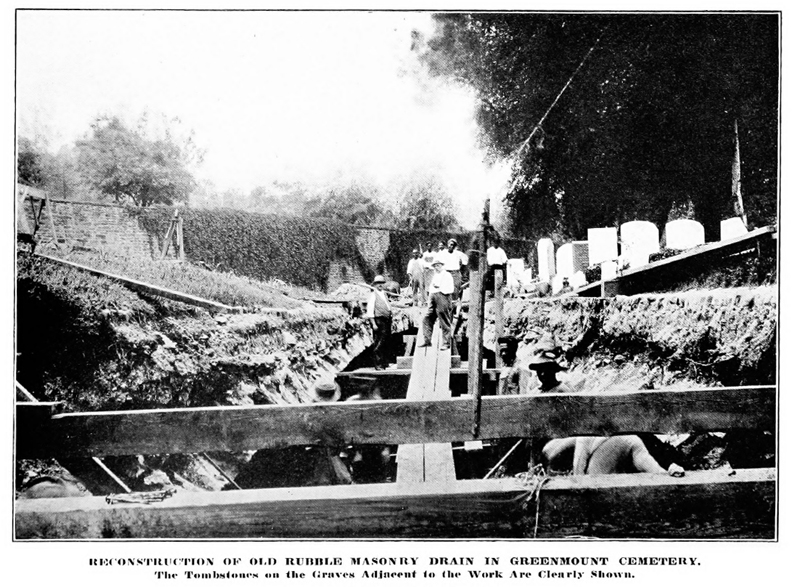
1911 – More photos of alley work and obstructions. Photograph of reconstruction of old rubble masonry drain in Greenmount Cemetery, showing gravesites.

Looking at the maps from back then, I was amazed at how close the Jones Falls is to the cemetery.

81_6_335r 81_6_4488 81_6_4842 81_6_4844 Untitled-1

Odorless Excavating Apparatus

29 Friday Apr 2016

Posted by Ronald Parks in Baltimore, Health, Sewage History

≈ Leave a comment

Tags

Baltimore, engineering, FILTRATION, garbage, Health, HISTORY, Jones Falls, Lake Roland, POLITICS, Public Works, sewage, Sewage History, water, water history

Baltimore, situated as she is, with one main water course through her center (Jones Falls), she had plenty of water for the people. Pure, clean drinking water….until people started dumping their sewage into it. Many Health Commissioner’s Reports talk about what to do with the sewage of Baltimore. Contractors were hired to haul it away. Here are a couple HCRs on what happened over a few short years in Baltimore, until a proper system of sewage could be built.

1865 – The withdrawal of a large share of the water flowing in this stream (Jones Falls), by the completion of the lake and storage reservoirs (Lake Roland, originally called Swann Lake), with the extension of the water works in the city, has left too small a portion of water to keep the original course clean if nothing was thrown into it; but to this deficiency of water add its use as a receptacle for every species of offal from factories, foundries, tanneries, stables and dwelling houses, and we are not surprised at its present condition. We have had one of these sources of nuisance carefully examined, and find that not only are most of the privies attached to dwellings on the streets adjoining the Falls drained into it, by means of private sewers, but that wherever a sewer leading to it can be reached, this sewer is connected with privies for drainage purposes.

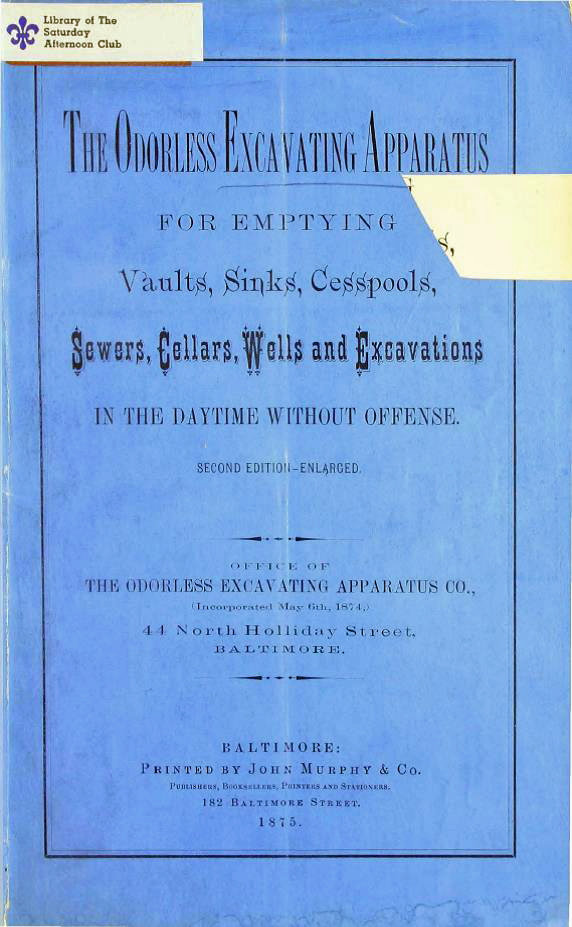
1873 – The late City Council have distinguished their administration by the passage of an ordinance permitting the use of the “odorless excavating apparatus” for emptying privies in the day time. This is the inauguration of a new era, and destined to prove one of the greatest blessings of the age. As stated in a communication on this subject to the late City Council, your Commissioner holds that a large proportion of the cases of cholera infantum occurring in all large cities during the heated term are to be ascribed to the ancient and vile mode of doing this work, as well as to its transportation through the streets of the city, poisoning the air which is wafted into every open window.

1875 Odorless Apparatus2

1875 Odorless Apparatus1888 – The adoption of a proper system of sewers for the present privy-wells will assist the Health Department in its endeavor to bring the City to a point where the ordinary sanitary condition will be such that epidemics of disease, resulting from or aggravated by filth, could be avoided or reduced to a minimum. The danger is greater than the people realize; the trouble is deep-seated and not to be reached by the Spring ‘cleaning up’ nor even by inspection. In most of the houses of this City there exists a latent power for evil, which is liable when its hour arrives to exert itself to the full of its terrible might.

I don’t believe that this apparatus lasted too long. It is no longer mentioned after the 1876 report.

Dumps and Incinerators

21 Thursday Apr 2016

Posted by Ronald Parks in Baltimore, HISTORY, Sewage History

≈ Leave a comment

Tags

Baltimore, engineering, garbage, glass plate negatives, Health, HISTORY, Jones Falls, POLITICS, Public Works, sewage, Sewage History, water history

In the 1884 Street Cleaning report are listed the following five dumps: Canton, Spring Garden, Back Basin, Eager St. and South Baltimore. By the 1920s, Baltimore was burning its garbage at two incinerators. One at Sisson and 28th street. The other on Philadelphia road. What does this have to do with sewage? Both places are on streams. Sisson street on Jones Falls, which still has a household hazardous waste collection site (original building appears to be gone). And Philadelphia road, as seen in the one photo below dumped right into Herring Run, which empties into Back River then on to the Chesapeake Bay. These photographs come from glass plate negatives that were broken due to improper storage. If you have GPNs, handle them with care.

img008r

The horse drawn cart was replaced by the modern dump truck. Here they are backing into the Sisson Street Incinerator, also known as #1 incinerator.

img002r

Instead of just piling the refuse into a dump, hoping somehow it would disappear, the garbage was sorted and then burned. #2 Incinerator on Pulaski Highway.

img010r

Pulaski Highway #2 Incinerator showing how any liquids and washed down materials were dumped into Herring Run. And yes, there use to be Herring in that stream.

Garbage 1886

20 Wednesday Apr 2016

Posted by Ronald Parks in Baltimore, Health, Sewage History

≈ Leave a comment

Tags

Baltimore, garbage, Health, HISTORY, Jones Falls, POLITICS, Public Works, sewage, Sewage History

1886 – From the Mayor’s Message: Health Department –  Garbage, etc. – The amount of garbage collected and removed during the past year was thirty-three thousand eight hundred and forty-nine cart-loads. Table G (below) shows the large number of dead animals, fowls, etc., collected and removed by this Department. The present methods of disposal of garbage and carrion are exceedingly unsatisfactory. Much annoyance and discomfort is experienced by residents adjacent to the present dumps, and frequent and continued complaints are made of the offensive odors. This annoyance, and menace to public health, can be obviated by burning them.

Chart gThis is a lot of dead animals. When this refuse was not picked up immediately and taken to the dumps (5 in the city), it was washed into the sewers which emptied into the Inner Harbor.

← Older posts
Newer posts →

Blogroll

  • Flouride Action Network
  • lulu
  • My Book
  • WordPress.com
  • WordPress.org

Recent Posts

  • Bermuda 2023
  • ICELAND April 2023
  • George Chalmers of Fochabers
  • In Search of The Skipjack Ada Mae
  • Trap Pond Kayak

Blog at WordPress.com.

  • Subscribe Subscribed
    • Water and Me
    • Join 231 other subscribers
    • Already have a WordPress.com account? Log in now.
    • Water and Me
    • Subscribe Subscribed
    • Sign up
    • Log in
    • Report this content
    • View site in Reader
    • Manage subscriptions
    • Collapse this bar
 

Loading Comments...