• About
  • History Writings

Water and Me

Water and Me

Author Archives: Ronald Parks

Saturday Night in York, Pa.

19 Monday Mar 2018

Posted by Ronald Parks in concerts, HISTORY, Theater

≈ 1 Comment

Tags

concerts, HISTORY, photography, Theater, York

Kathy and I went up to York this past Saturday, to see Lyle Lovett and Shawn Colvin in concert. It was a good concert but I’m really not a big fan of this type of music. I was glad there was a sort of comedy skit between the two of them after each song. That made it very enjoyable. (I actually would have been content to listen to them exchange stories for two hours!)

We arrived in York about 40 minutes before show time, so we didn’t have much time to explore the city. I would like to do a day trip one day, just to check out the town, something to ponder.
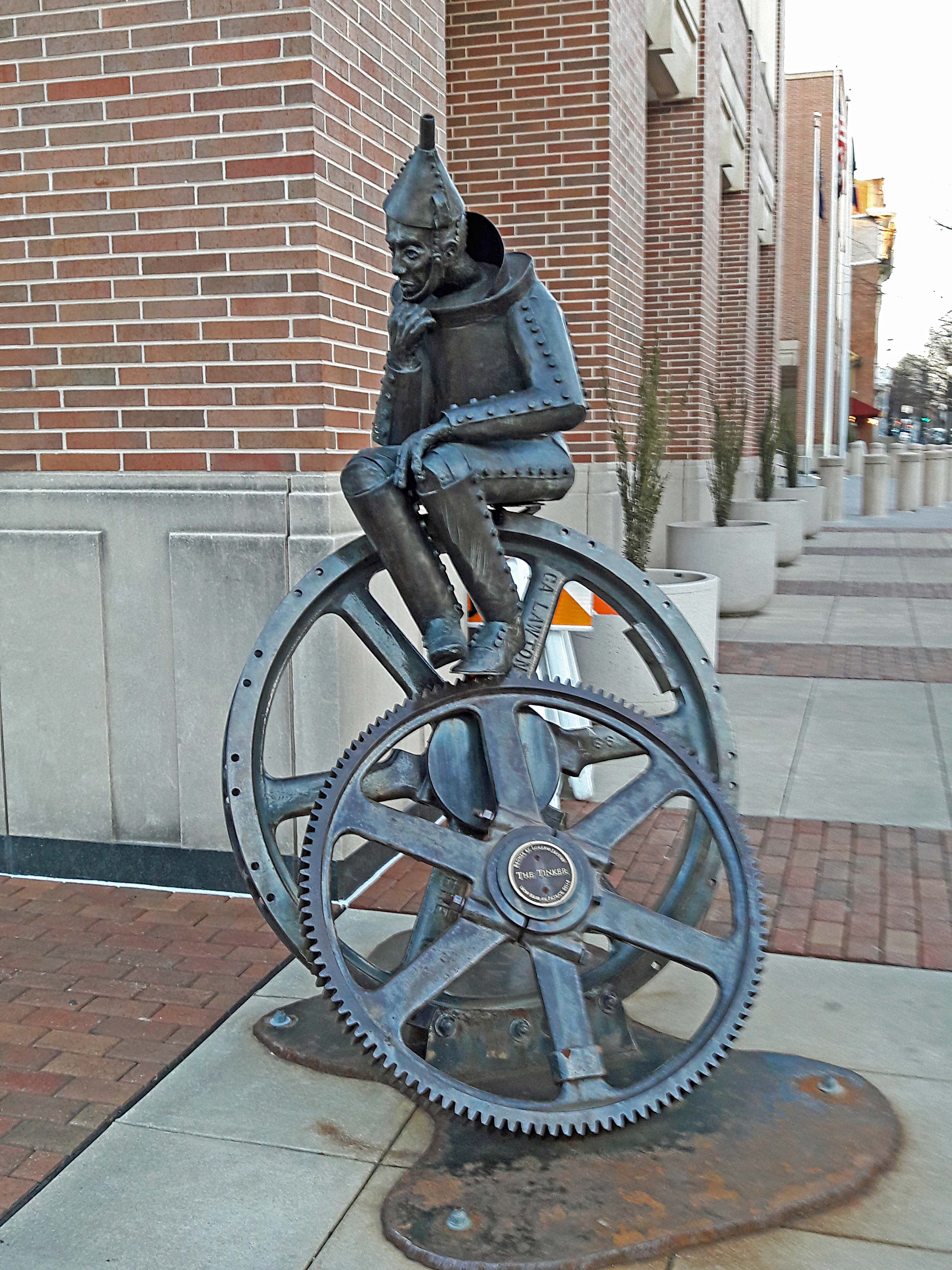
From what we saw during the drive in and looking for a parking space, York is a mixture of old and new buildings and residences. The theater itself is a good example.
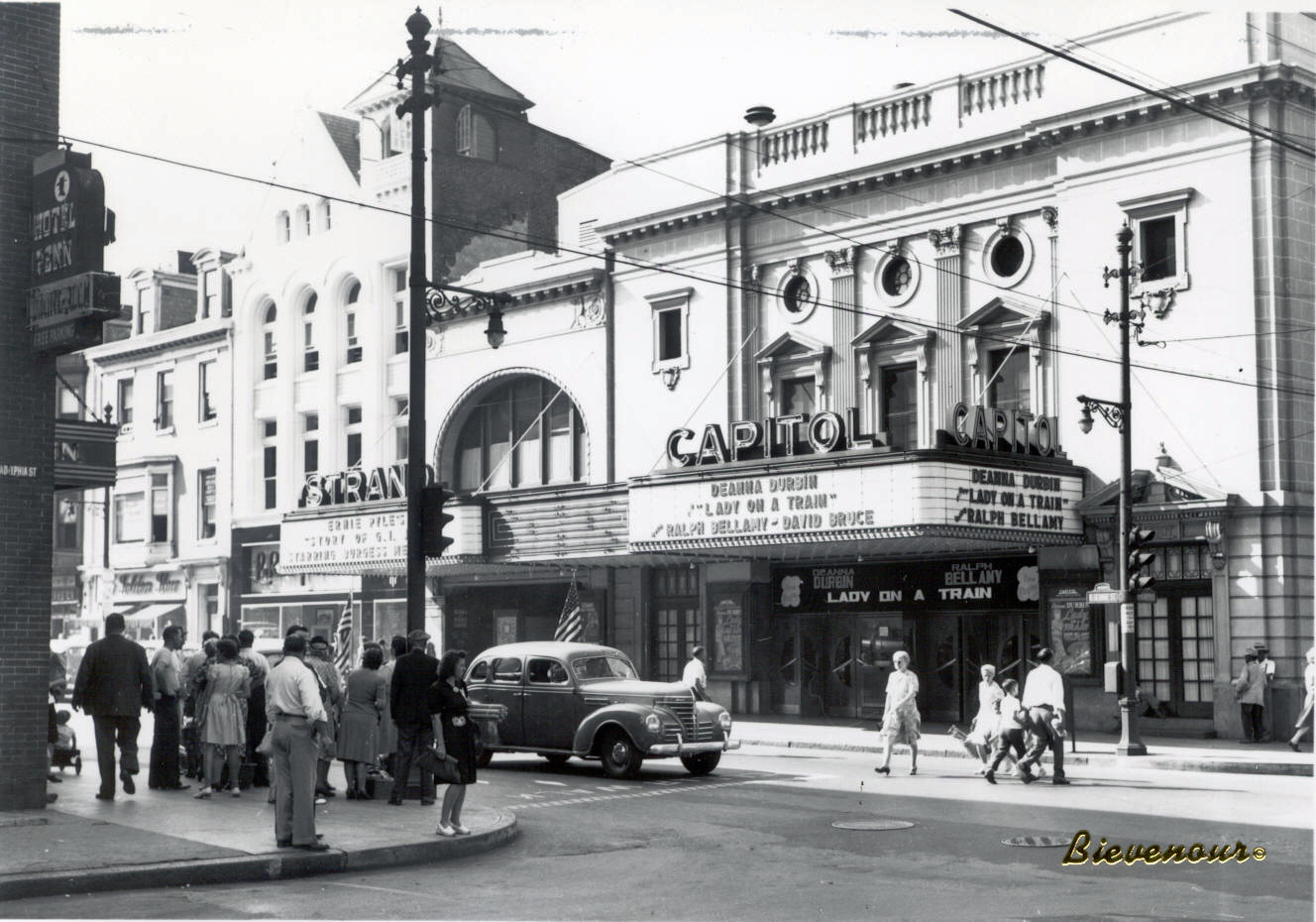
Here is what it looked like back in the day.
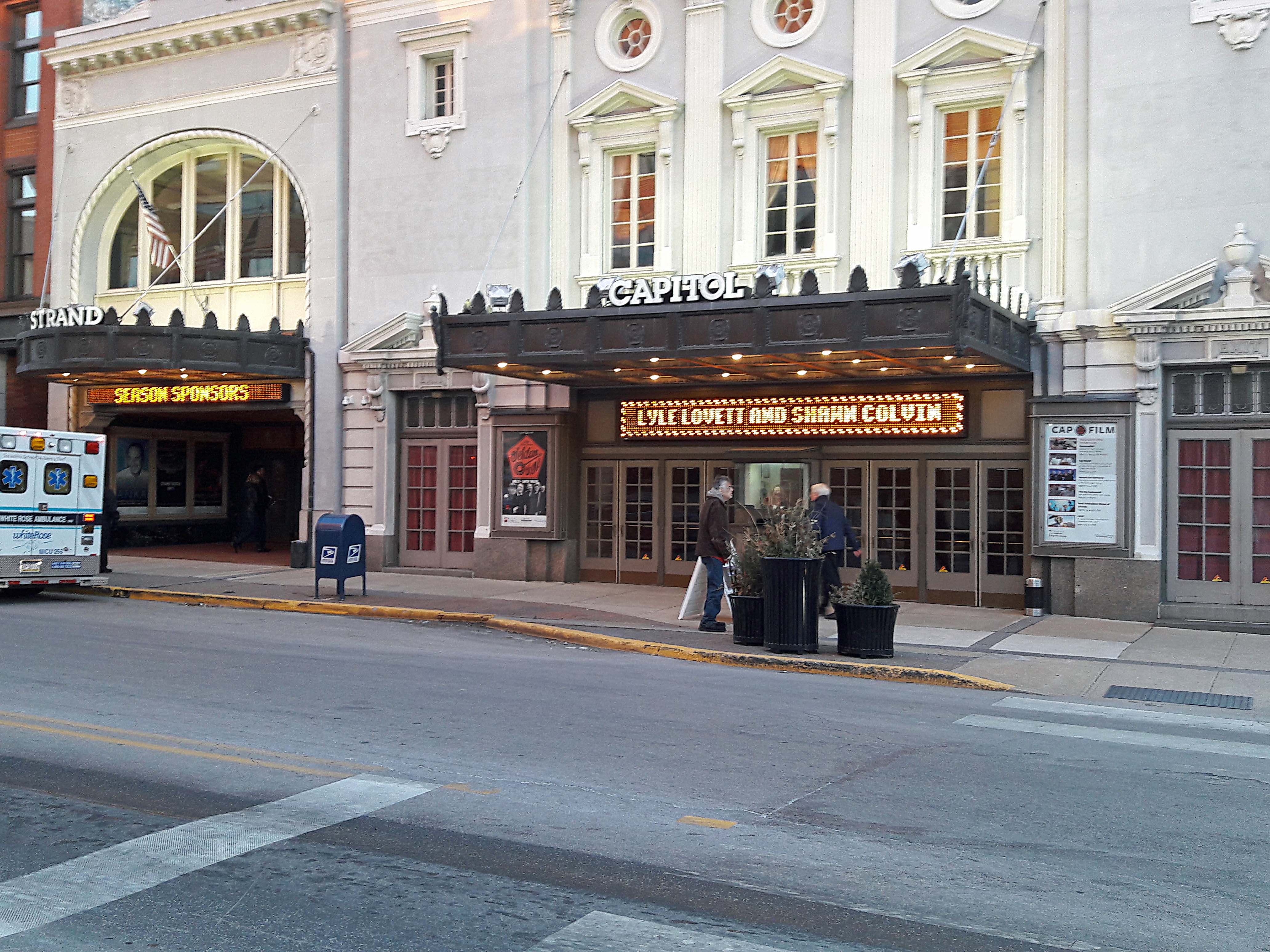
And this was Saturday. We were in the Strand. Both theaters together make up the Appell Center for the Performing Arts. The Strand was built in 1925 and had a seating capacity of 1,262 (It was packed Saturday!) There are 1,800 pounds of gold leaf adorning the murals and columns throughout the theater. (No cameras allowed, although many people were taking photos, and my cell phone sucks for photography, so no pics). The Strand cost $1m to build and was closed in 1976. Reopened in 1980 after renovations.

The Capitol, next door, was built in 1906 and was called the Theatorium and then the Jackson. Originally built as a dance hall and then a balcony was added in 1917, to show movies. This theater closed in 1977 and reopened in 1981.
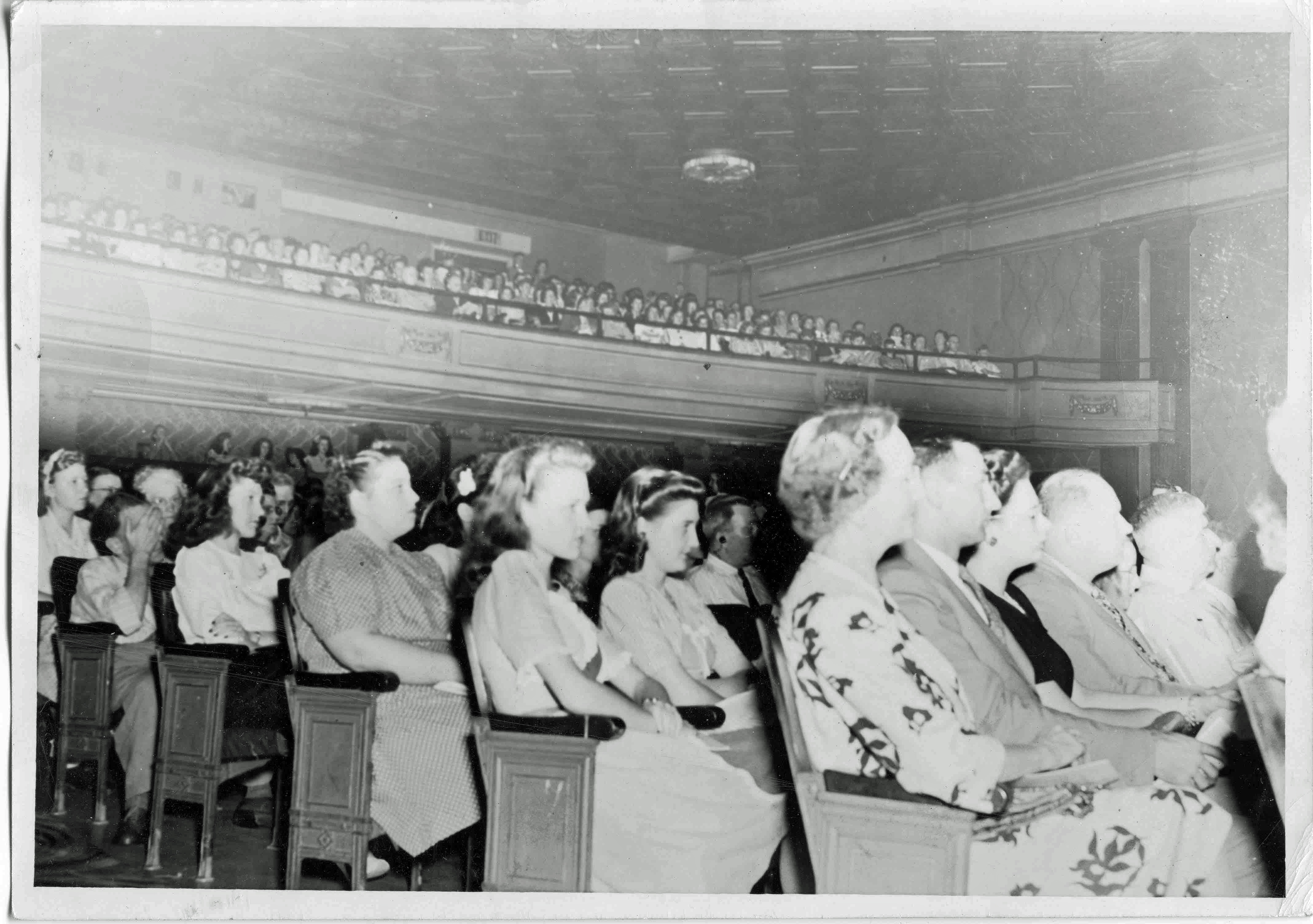
Someone took our photo! I’m to the left, covering my face.

Lyle and Shawn. Friends since 1991 and still touring together. All photos, except two are from the Appell website.
Terrapin Park

14 Wednesday Mar 2018

Posted by Ronald Parks in Hiking, National Parks, nature

≈ Leave a comment

Tags

Beach, bridges, Chesapeake Bay, Hiking, photography, Terrapin

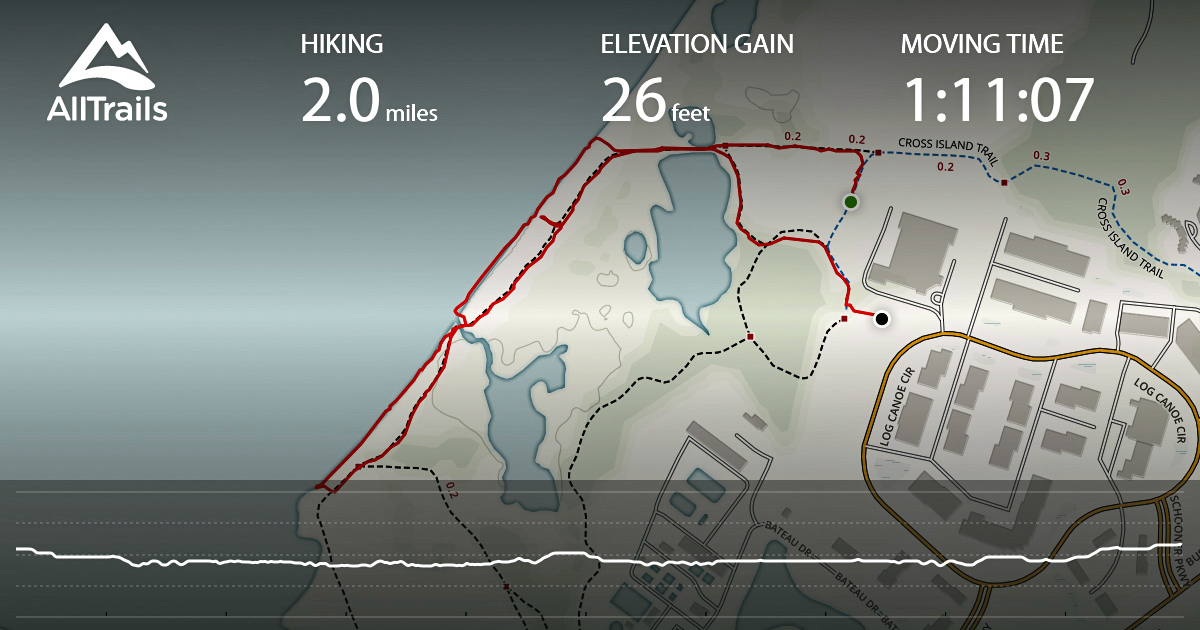
The last couple of times we visited this park, last summer, we were unable to hike the trails – too many people and too many cars in the parking lot. It was packed. I like that people and families go to the parks to enjoy themselves, I just don’t like it when large groups of people set up camp and stay all day – not allowing others to enjoy the park. It was so bad last summer, that the park service had to install Spot-o-Pots along the beach path. Here is our path:

It was a short hike. We just wanted to see and enjoy the Bay.

Along the Cross Island Trail, we stopped long enough to enjoy some of the beauty that is all around us.

Hitting the beach, our first view is of a ship going under the Bay Bridge. I don’t know how many times we travelled over that bridge and saw anywhere from 4 to 12 ships just parked on the other side. This is the first time we saw one actually heading to points north.

We always did want a home on the Eastern Shore!

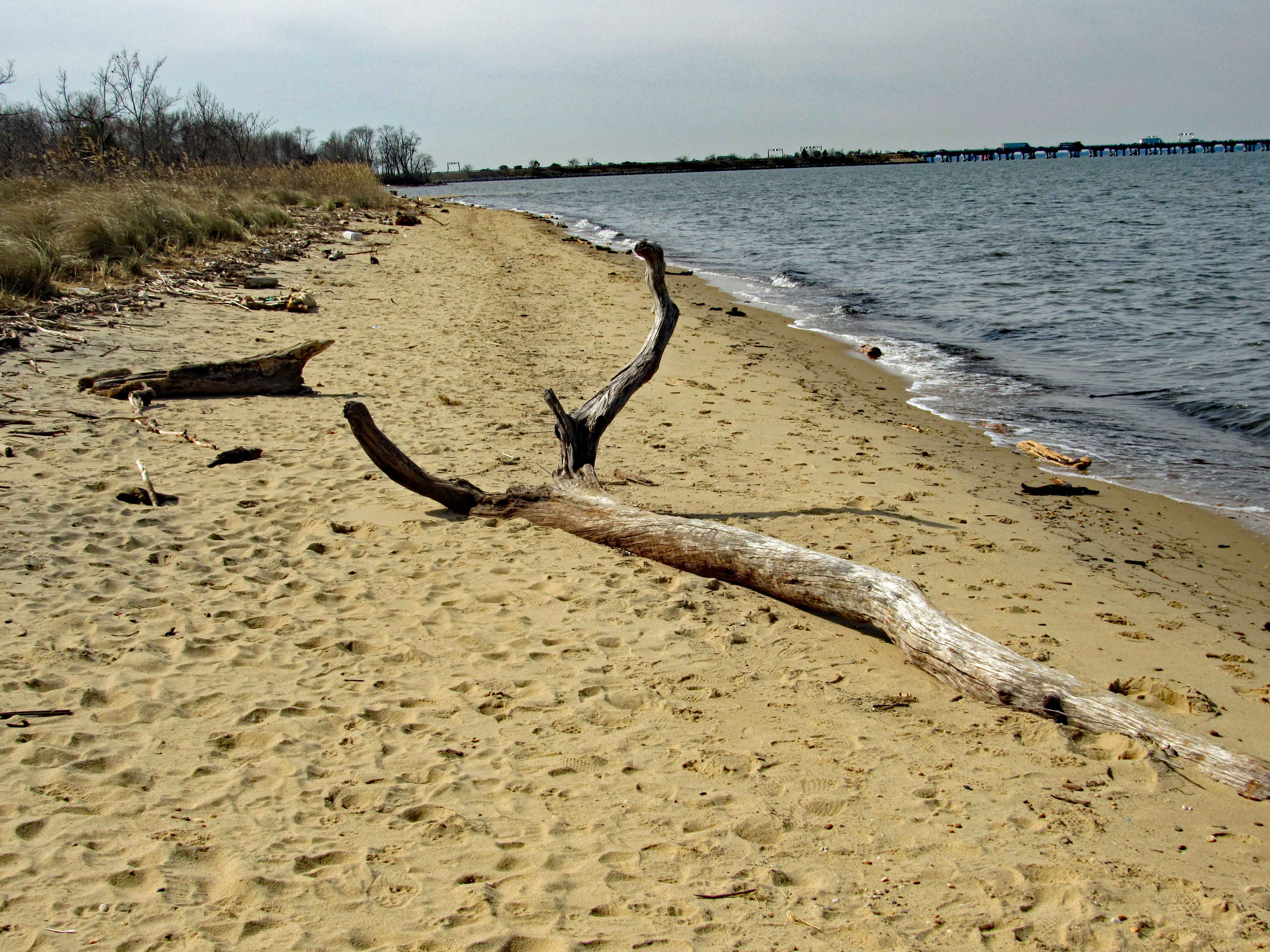
The recent storms that we had, left a lot of debris up on the dunes. And some along the beach.

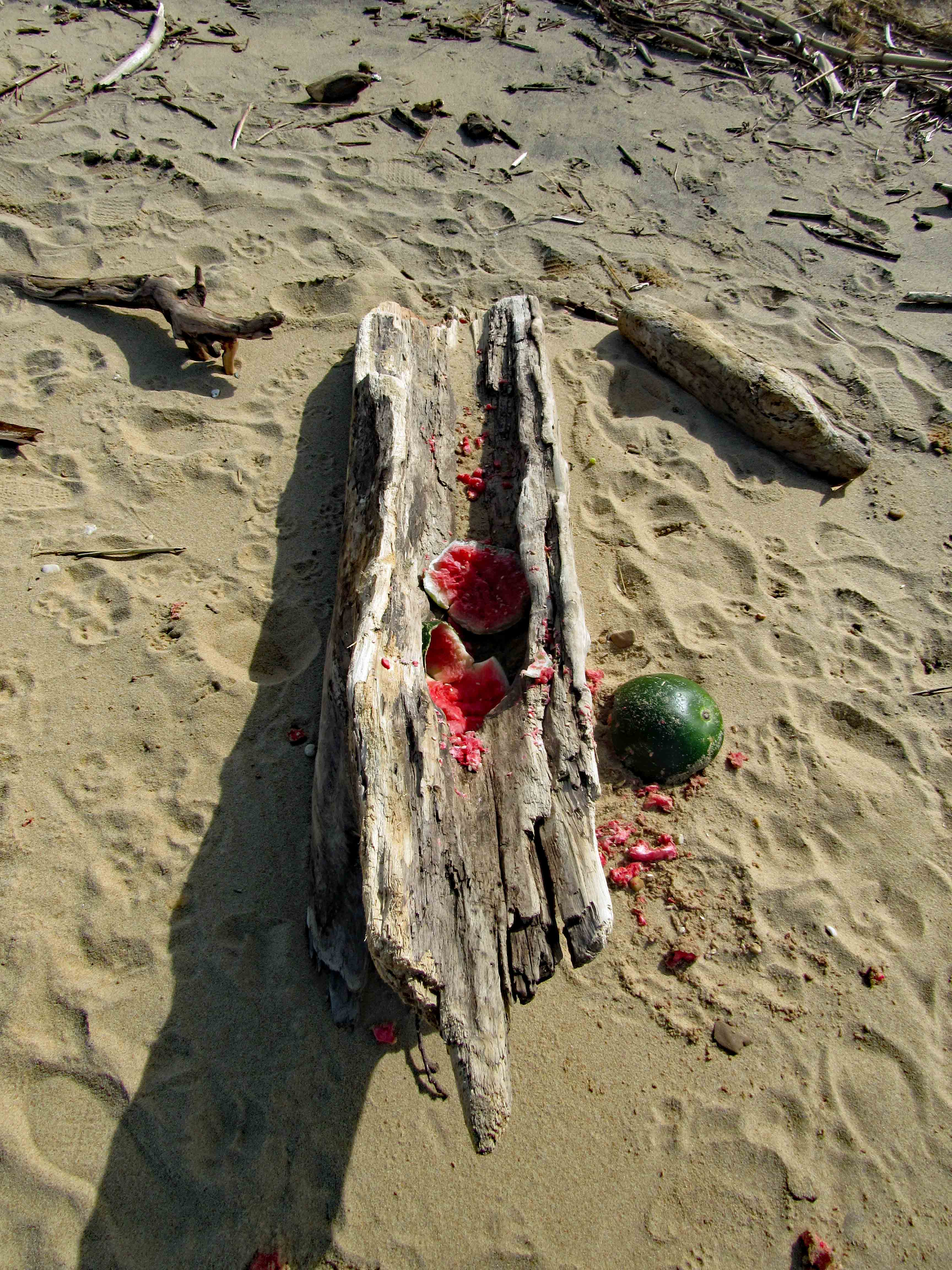
I have my doubts that this was washed up on shore, along with a cantaloupe a few yards away. 

Constantly shifting, in and out of the pond.

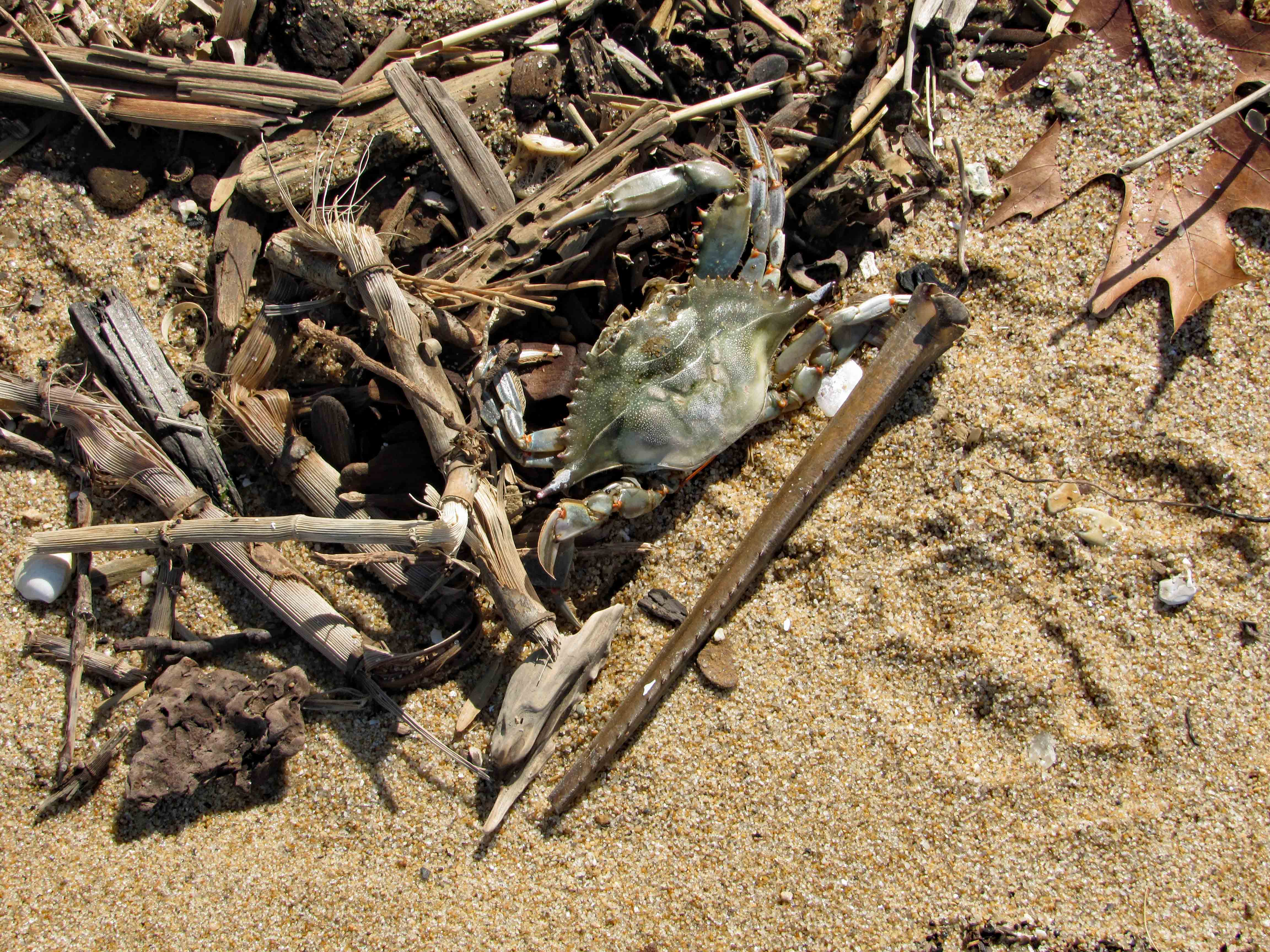
Along with all the debris and driftwood, were some casualties from the storms – like this poor little fellow.

And this guy.

And another.

The breakwater walls seem to have broken.

Gnarly.

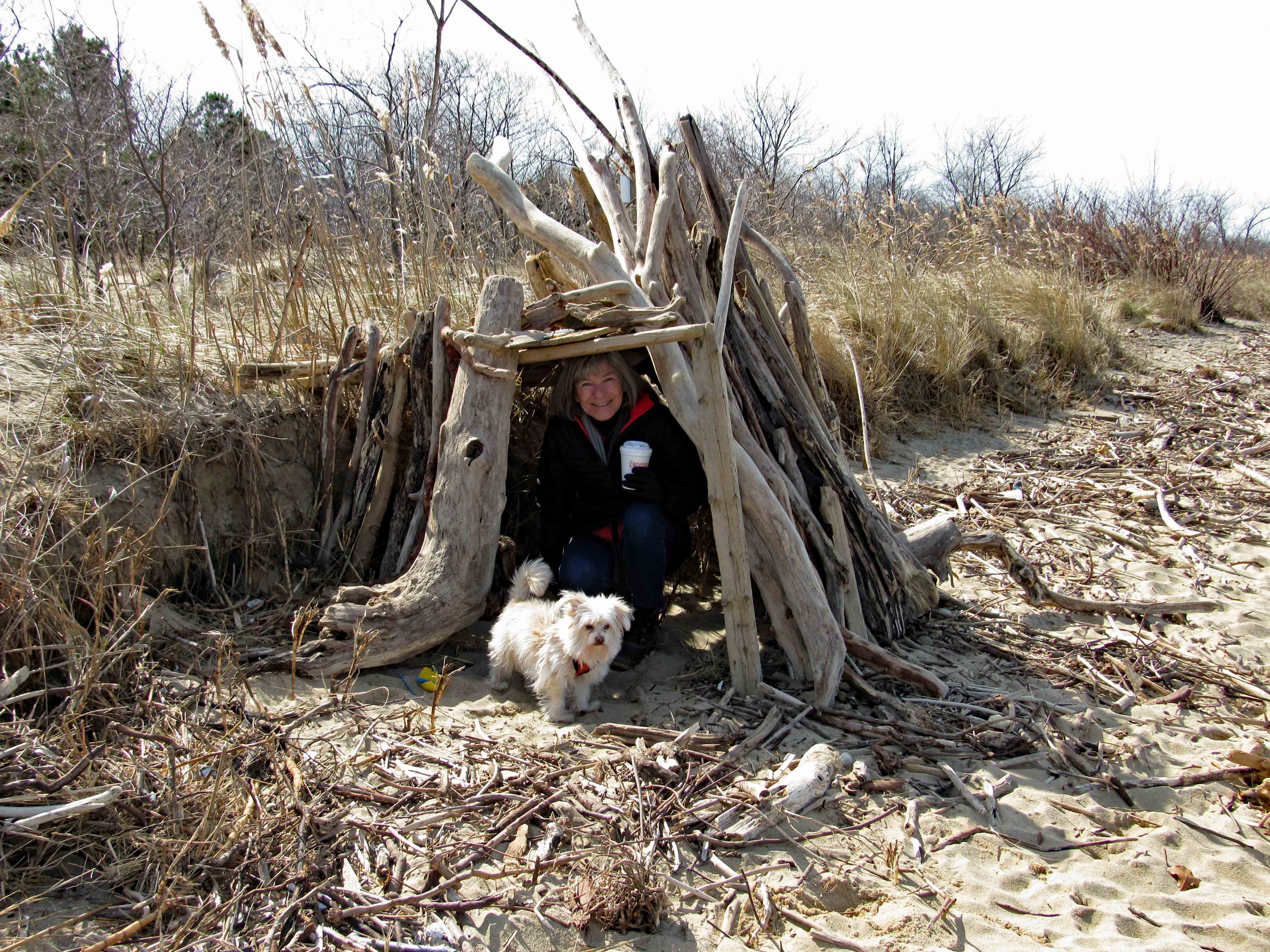
Waiting for its tenants. 

A few areas have eroded away along the beach. Nature just does her thing…

Corvair 95

12 Monday Mar 2018

Posted by Ronald Parks in Hiking, HISTORY

≈ 5 Comments

Tags

car, Corvair, Hiking, van

By no means am I any sort of Car Buff, but while walking through the woods on Saturday, Kathy and I came across this and it piqued my curiosity. 

It kind of looked like some sort of converted van. 

Getting closer I could see that it was a Corvair 95. Never heard of it.

A quick internet search and this is what it is. This version, sitting in the woods, is the 1962-1963 Rampside. It has both a side ramp and a regular truck tailgate.

The tailgate end of this vehicle sits higher than the front end. The engine is in the rear. 

The rampside is visible from this view, on the opposite side.

And here is what a running one looks like. These vehicles cost $2,212 new, but they weren’t well received. Only 2,046 were sold. A place in Minnesota is selling one for $5,500.

Swann Lake – Not the Ballet

23 Friday Feb 2018

Posted by Ronald Parks in Baltimore, engineering, HISTORY, water history

≈ Leave a comment

Tags

Baltimore, Dams, engineering, HISTORY, Jones Falls, Lake Roland, maps, Monuments, POLITICS, Public Works, Research, water history

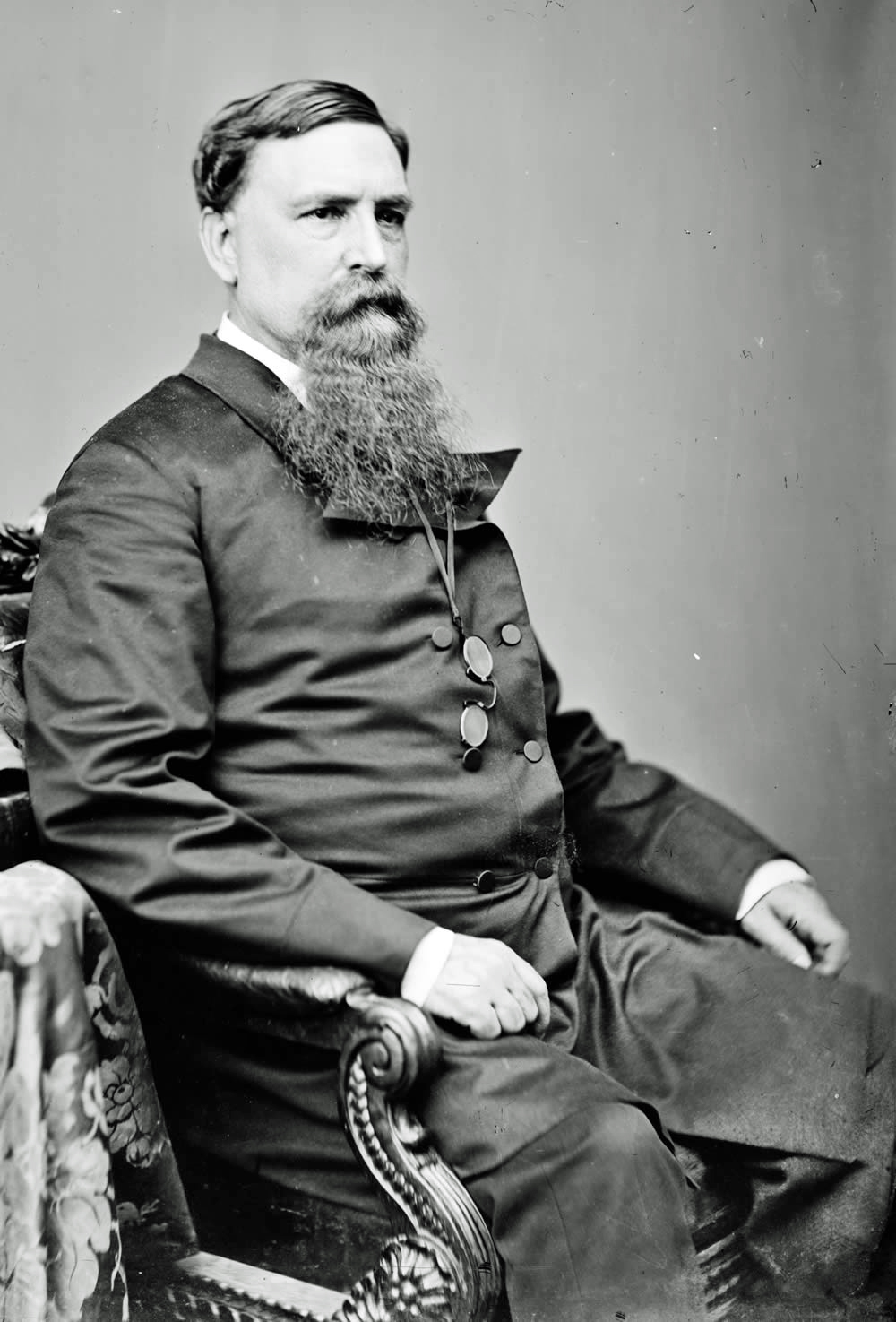
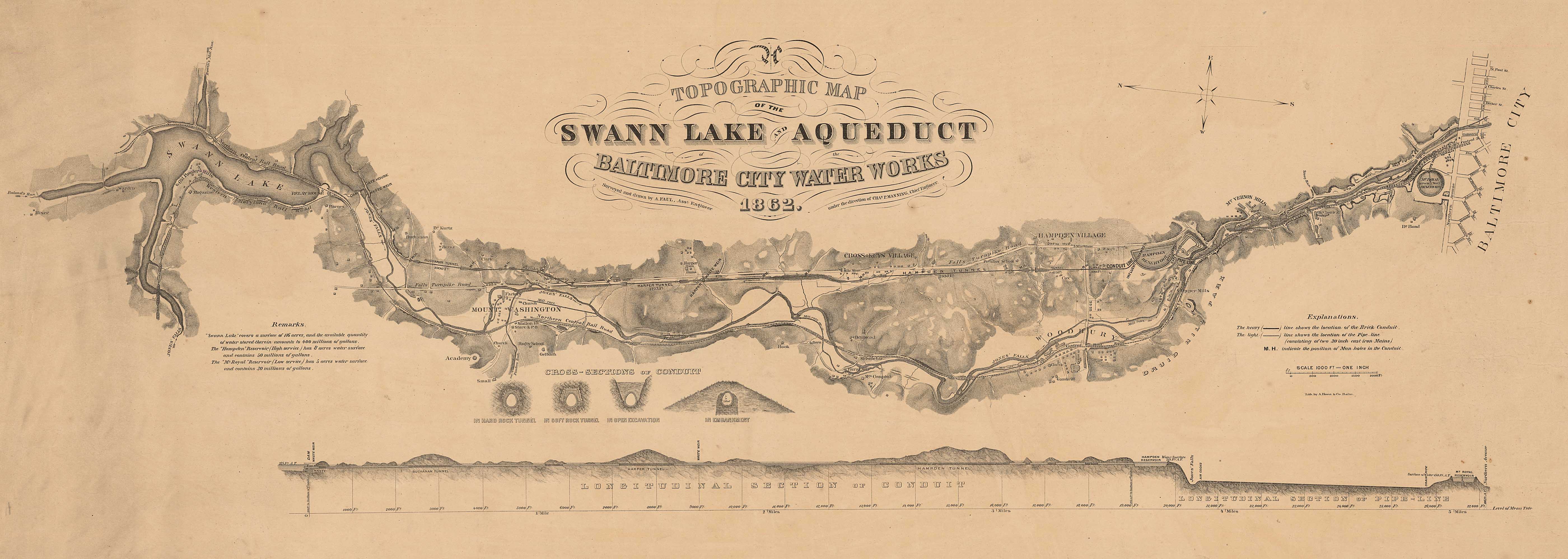
When I first started researching the water history of Baltimore, and I came across a map of Swann Lake, I just assumed that it was called Swann Lake because the Mayor at that time was Thomas Swann, who later went on to be the Governor of Maryland. 

Here is the man himself. In the journal I am presently transcribing, I came across this entry:

October 4, 1869: The Committee on Swann Lake submitted the following report: Having examined the minutes of the Board and the records of the office, with the view of ascertaining in what way and by what authority the Lake, so long called Lake Roland received the name of Swann Lake, would respectfully call the attention to the Board the following – That Mr. Charles Manning, Chief Engineer was asked to name the principal stream that supplies the Lake, by which with great propriety the Lake could be known. Under his direction the name of Lake Roland was placed over the door of the stop house and a map of Lake Roland was presented to the Water Board with the general and final report of the Chief Engineer on the completion of the Works. In this manner the lake became known to all our citizens, by a familiar and more appropriate local name. The Board of Water Commissioners, by resolution, posed at a regular meeting on December 26, 1861, approved and adopted what had been done in the premises…to be called Lake Roland. At some subsequent period the name on the door (Roland) was erased and Swann Lake inserted and a patch was made and placed on the map stating the same. In the opinion of the Committee, these changes and defacement were entirely unauthorized and would have been improper even if ordered by the Water Board. The Board has heretofore declared its opinion as to the impropriety of designating any of the public works by the name of an individual citizen, because of his connection with the City Government and your committee sees no reason why this Lake should be made an exception of. These views have long been entertained but have thought it best to defer presenting them until the present time, when by no possibility can it be supposed that you are in any way influenced by personal or political feeling. Ask that the Lake be referenced from this point forward as Lake Roland. Unanimously resolved.

So, one has to wonder – did a political adversary go and change the name from Roland to Swann over the door? And why would the Water Engineers continuously refer to the lake as Swann Lake? Every entry that I have summarized from the 1862-1869 journal notes “The work at Swann Lake…” or as such. Here is what the work at Swann Lake looked like. Even A. Hoen and Co. called it Swann.

Wikipedia has this to say about Thomas Swann – not too good a commentary!

Many believed once slavery was abolished in Maryland, African Americans would begin a mass emigration to a new state. As white soldiers returned from southern battlefields they came home to find that not only were their slaves gone but soil exhaustion was causing tobacco crops in southern Maryland to fail. With a growing number of disaffected white men, Thomas Swann embarked on a campaign of “Redemption” and “restoring to Maryland a white man’s government”. His strategy was built on the platform of entrenching white power and displacing independent African Americans. During this same time an oyster crisis in New England caused the oyster industry in Maryland’s Chesapeake Bay to surge. Swann’s problem was that the Bay oyster trade was heavily African American. His solution; use government policy to push African Americans in the bay and replace them with, “White Labor, at reasonable rates wherever needed.” Even more egregious he enacted a law that encouraged white fisherman to harass black fisherman when he signed into law the states first ever “Oyster Code.” “And be it acted, that all owners and masters of canoes, boats, or vessels licensed under this article, being White Men, are hereby constituted officers of this state for the purpose of arresting and taking before any judge or Justice of the Peace, any persons who may be engaged in violating any provisions of this article. Furthermore, all such owners and masters are hereby vested with the power to summon pose comitatus to aid in such arrest.” Even more egregious, any property seized during an “Oyster Code” violation was auctioned off, with one quarter of the proceeds going to the white man who initiated the arrest.

Wow and as Confederate Monuments have been removed in Baltimore, I guess no one thought to remove the entrance of Druid Lake at Swan Drive that has his name emblazoned across the top of the arch!

Lake Chapman

22 Thursday Feb 2018

Posted by Ronald Parks in engineering, water history

≈ 2 Comments

Tags

Baltimore, engineering, POLITICS, Public Works, Research, water history

From the 1867 Journal of the Water Board minutes comes the following: December 30, 1867: The Committee on Lake Chapman having recommended a change of name for said lake, it was on motion resolved that the said lake be called “Druid Lake”. And that the Engineer be directed to erase the name Lake Chapman from any and all buildings, structures, charts or drawings, on or in which name now appears and to substitute therefore the same as above, “Druid Lake”.
I wonder who ex. Mayor Chapman pissed off? I could not find anything in the Maryland State Archives blog that would warrant such drastic actions. As a side note – transcribing script gives me a headache. I’m only at page 279 of 462!

Trash and Civic Pride

30 Tuesday Jan 2018

Posted by Ronald Parks in Baltimore, HISTORY

≈ Leave a comment

Tags

Baltimore, HISTORY, POLITICS, Public Works, Trash

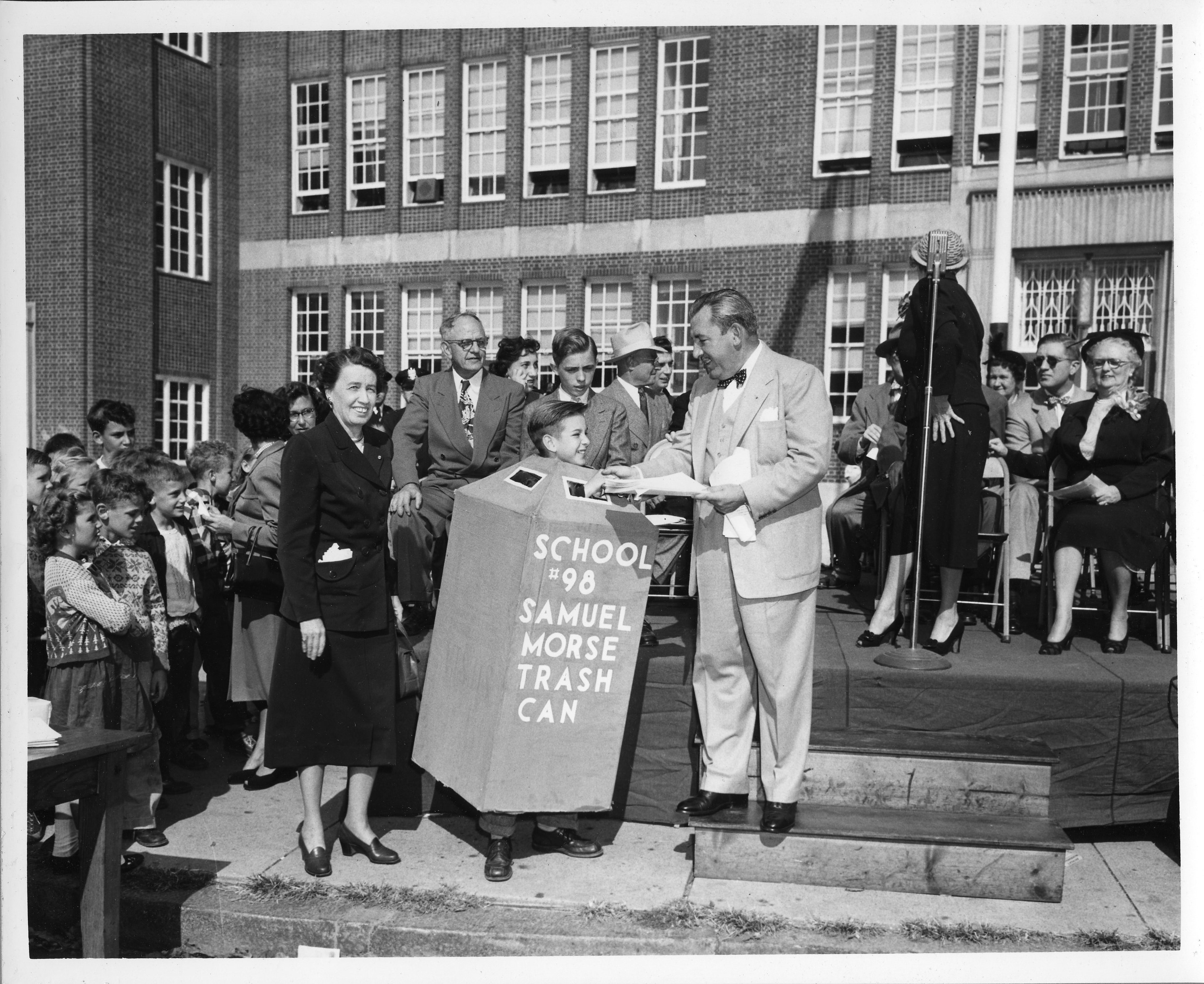
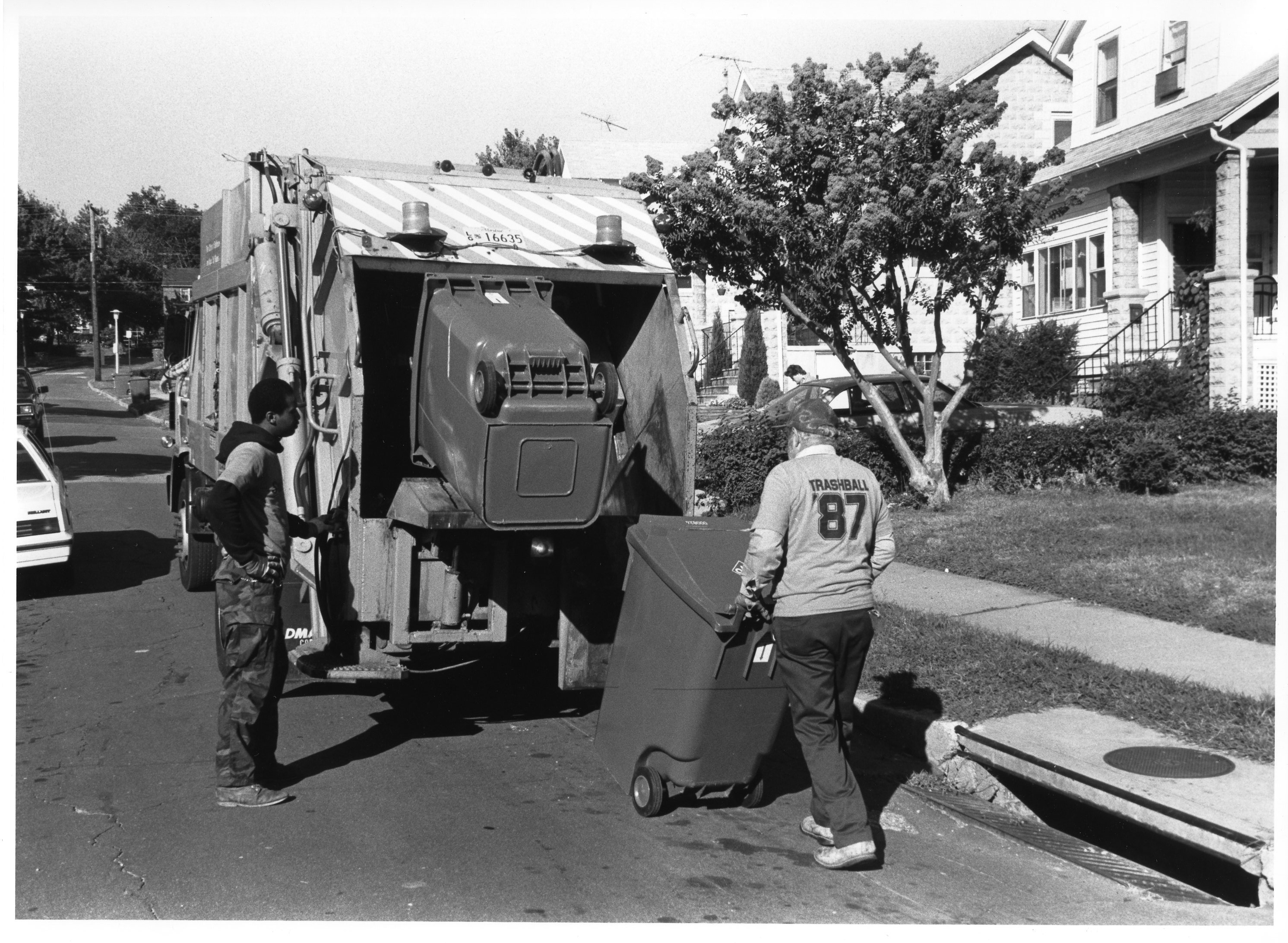
Here we have Mayor Thomas D’Alesandro, Jr. with a kid in a trash can. School #98 Samuel Morse. Civic pride.

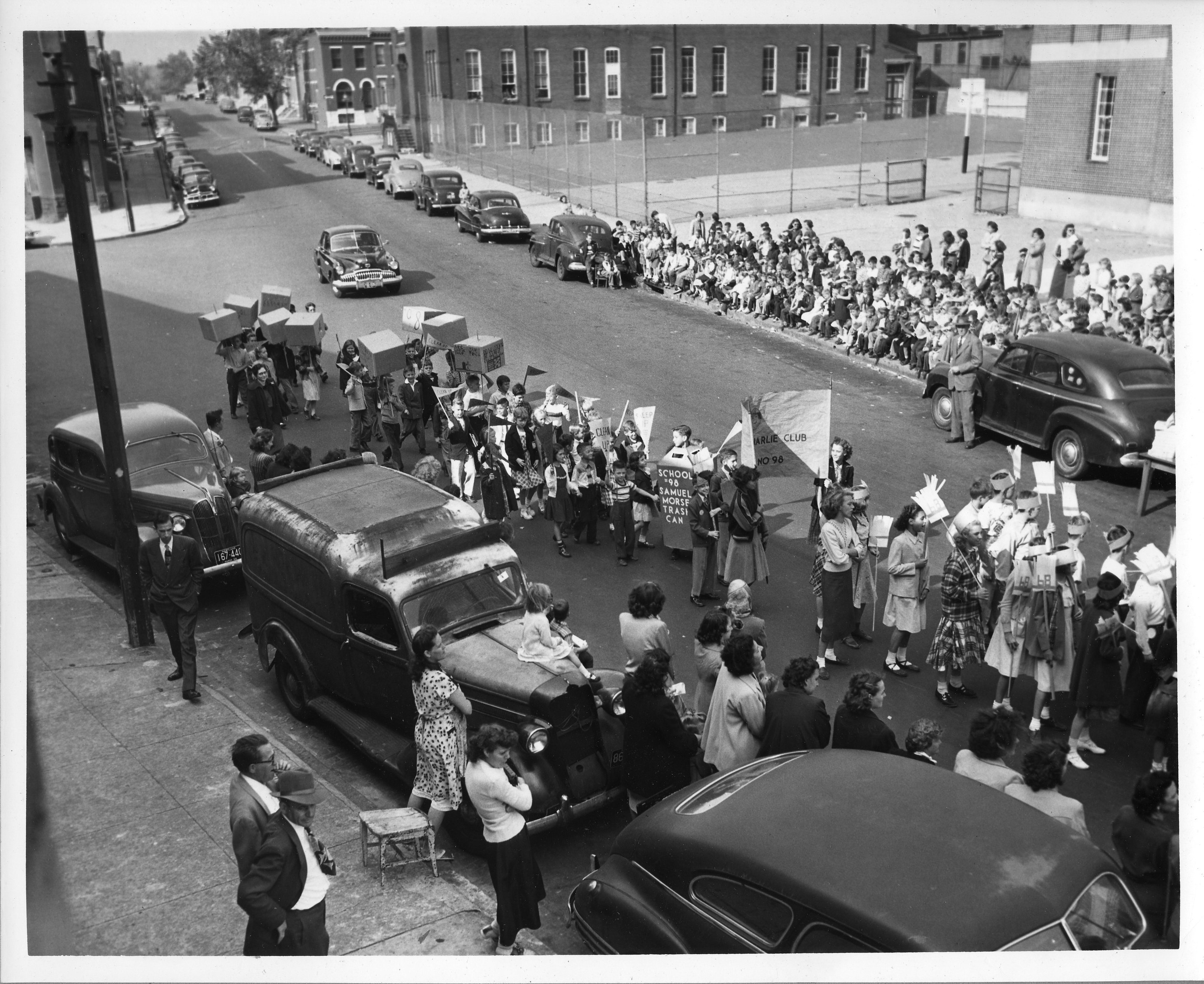
A parade was even held that year – 1951

Jump forward to 1987 and the mayor back then came up with a plan to give everyone new trash cans. Thirty years later, the new mayor did the same thing, at a cost of $10,000,000.00! I wonder what happened to the ones of 1987??

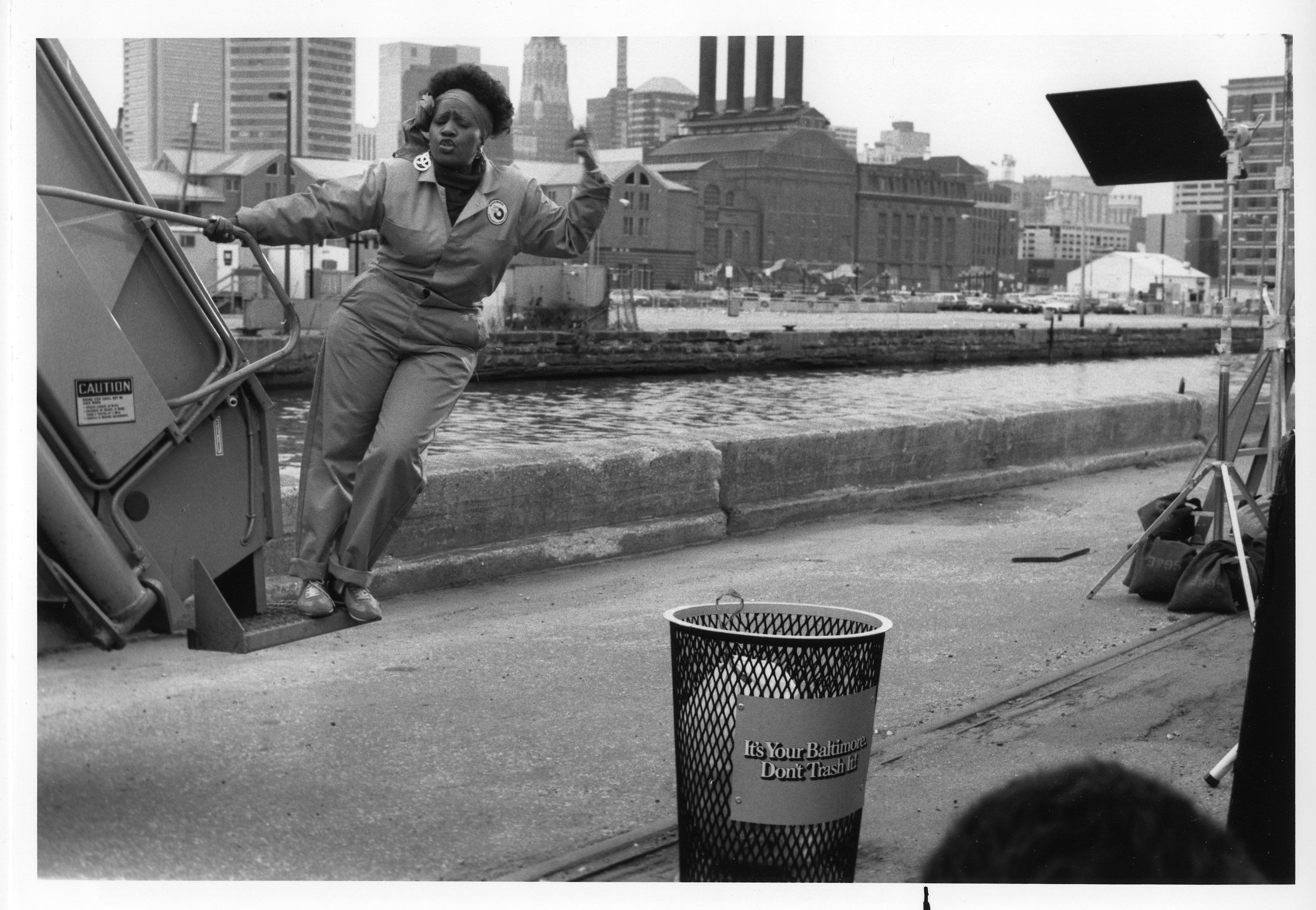
And finally, Ethel Ennis showing her pride by playing TrashBall!


History Hike Part 2

23 Tuesday Jan 2018

Posted by Ronald Parks in Baltimore, Dams, water history

≈ 4 Comments

Tags

Baltimore, Dams, engineering, Gunpowder Falls, Hiking, HISTORY, mills, nature, POLITICS, Public Works, Research, water history

Now the good stuff! In yesterday’s post I shared about our hike along the Little Gunpowder Falls, from Jerusalem Mill to the old iron bridge at Franklinville. On the way we stopped and explored an abandoned mill race and structure that appeared to be for valving or damming up the water flow. Back at my office on Monday I found a report from 1933 concerning the mill and property.

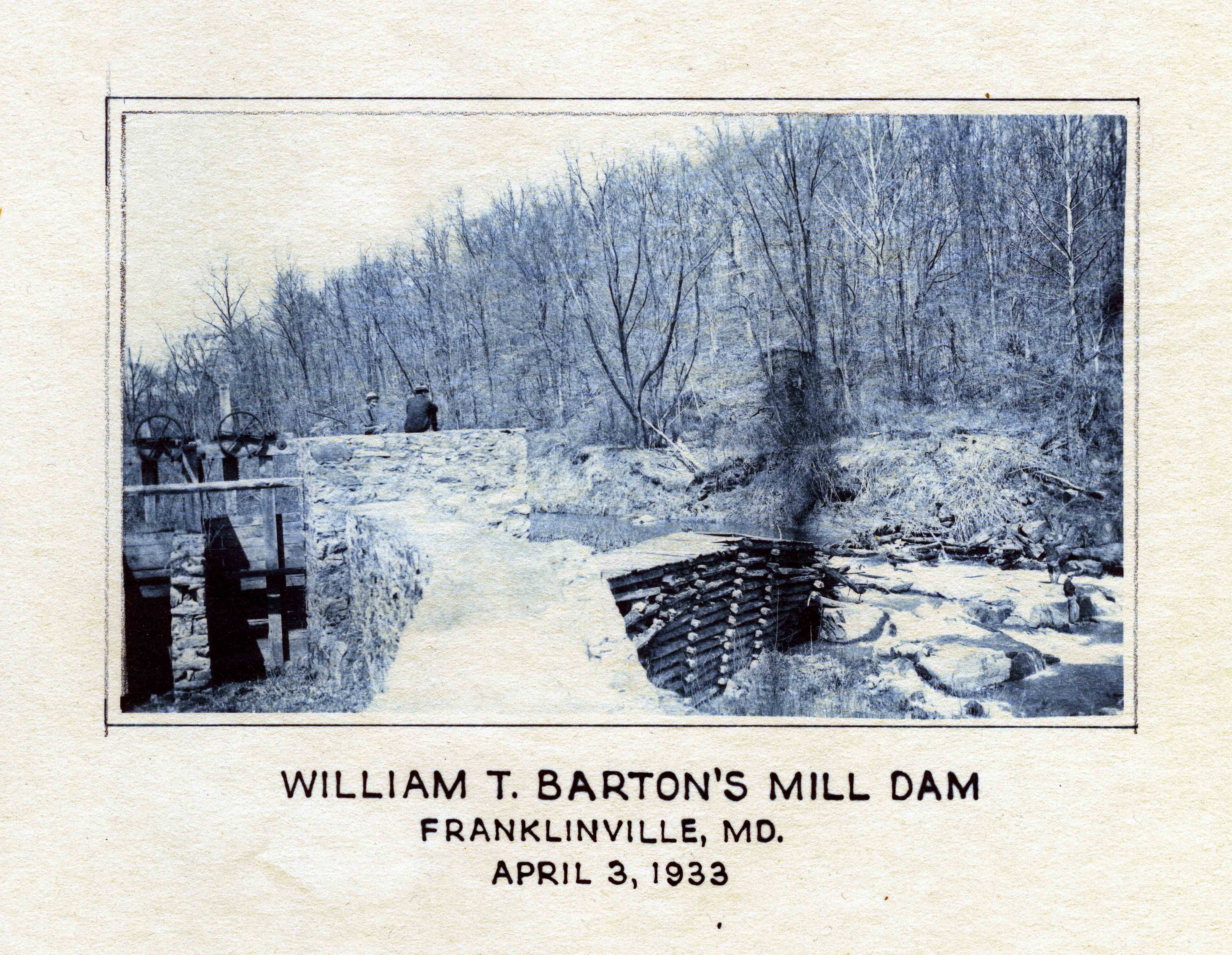
Here is a photograph of the mill that use to be there:

The 1933 report gives this description of the mill – Wm. Barton Mill in Franklinville, Little Gunpowder Falls. Several mill buildings used for the manufacturing of cotton duck. Mill race and dam have been broken thru since about 1926. Mill was built in 1883. All manufacturing equipment has been removed except for turbine. Barton purchased property from Mt. Vernon-Woodberry Mills on August 5, 1930. Information is sketchy on ownership. 1899 sold to Mt. Vernon-Woodberry Mills, yet they sold it twice. Once to Oak Tire and Rubber in 1925 and to Barton, but notes ownership to Marvin Merryman in 1929. No info on size of mill pond since dam was broken through. Supplementary water reservoir of 20,000 gallons in center of square in tenement section to furnish water for automatic sprinkler system in mills. Dam, made of timber, was about 800’ from mill. There was a water wheel at one time, with 140hp capacity.
Buildings at mill included: the main mill, waste house, store house, boiler house, and wheel house. There were also 3, two family two story houses on property. And more, according to tax records at Baltimore county. Records mention a mill adjacent to this one, to the north, known as Jericho mill. no traces of mill could be found.
Along with the report is this plat which shows the layout of the buildings:


And this plat:


As stated before, we climbed down into the mill race where we saw holes in the structure. I told Kathy I believed them to be supports to hold valves or gates.

In the report was this photo. The center part of this structure on the left is missing, along with the dam itself on the right.

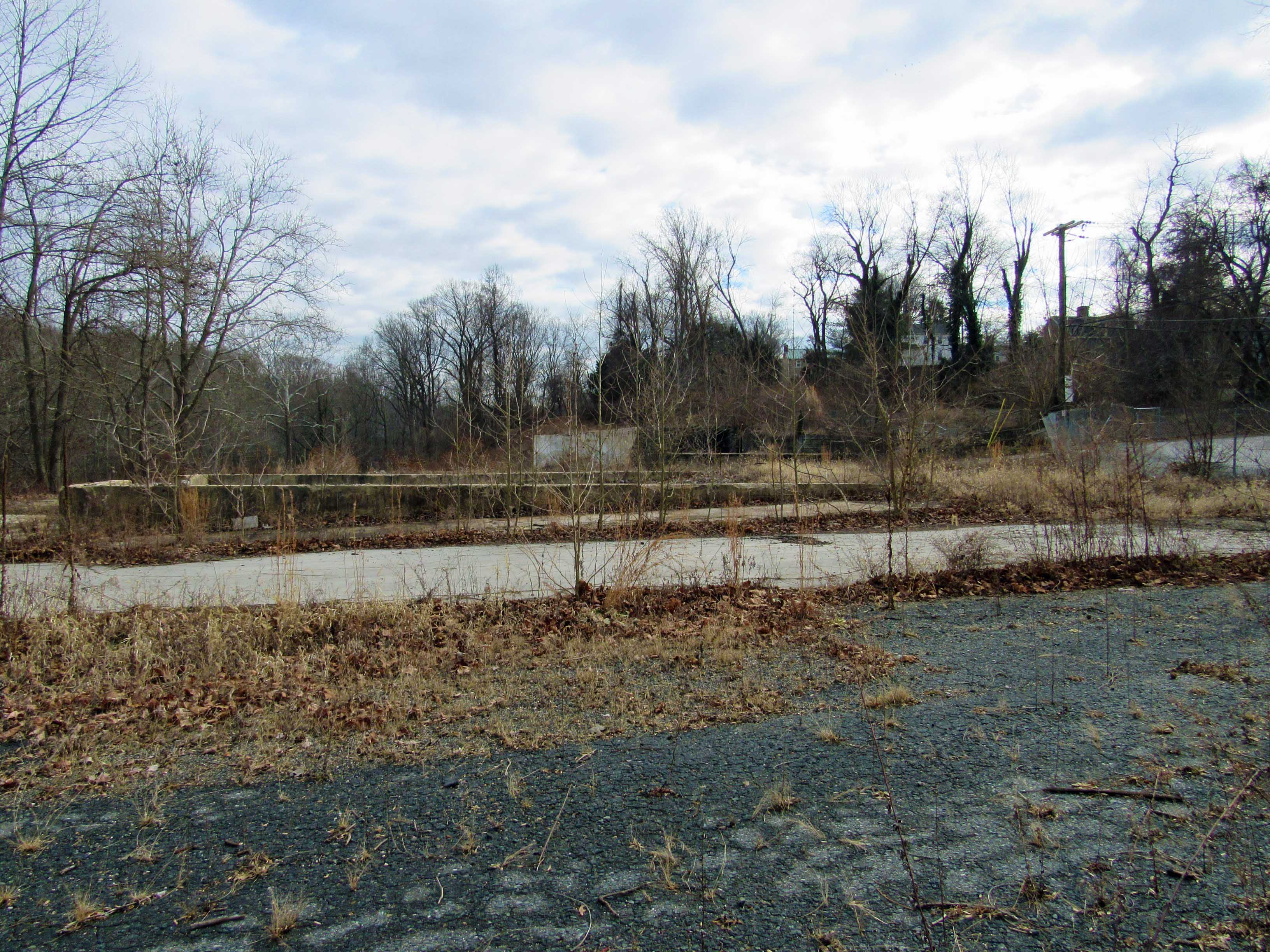
Below is a photograph of the area today, where the mill use to be. A sign on the fence says it is managed by Carnegie Express Construction Managers, Builders and Developers:

What does this have to do with Baltimore’s Water Supply History?

Typhoid cases, which had decreased by the mid-1920s, would re-emerge by the early 1930s along with a long period of drought. In 1932, the City Government hires consultants to review the status of its water supply. These consultants would form a board of engineers known as The Advisory Engineers on Water Supply. The engineers were Messrs. John H. Gregory, Gustav J. Requardt and Abel Wolman9. On December 19, 1934, the Advisory Engineers released their report:
1) Immediate construction of a new Gunpowder Falls Montebello Tunnel.
2) Immediately following the completion of the new Gunpowder Falls – Montebello Tunnel, the existing Loch Raven – Montebello Tunnel should be strengthened.
3) Conduct surveys, land purchases, sub-surface explorations and preparation of plans and specifications for the development of an additional water supply should be undertaken at once. (Areas of development looked at by the Board were the Patapsco River; the Little Gunpowder Falls, Winters Run and Deer Creek, and the Susquehanna River).

They were going to dam up the Little Gunpowder Falls and all the mills and property along the Falls would need to be bought (or taken). It was decided to go with Item #1 above.


History Hike Part 1

22 Monday Jan 2018

Posted by Ronald Parks in Hiking, nature

≈ 2 Comments

Tags

bridges, Dams, Gunpowder Falls, Hiking, mills, nature, photography

Between the work on our houses and going to Salisbury, yesterday was our first opportunity to take a hike. A little over-cast but a very nice day. The map shows we walked about 3-1/2 miles on the Little Gunpowder Trail, starting at Jerusalem Mill.

We headed thru the field to first look at the progress of the old stone structure. Not much done.

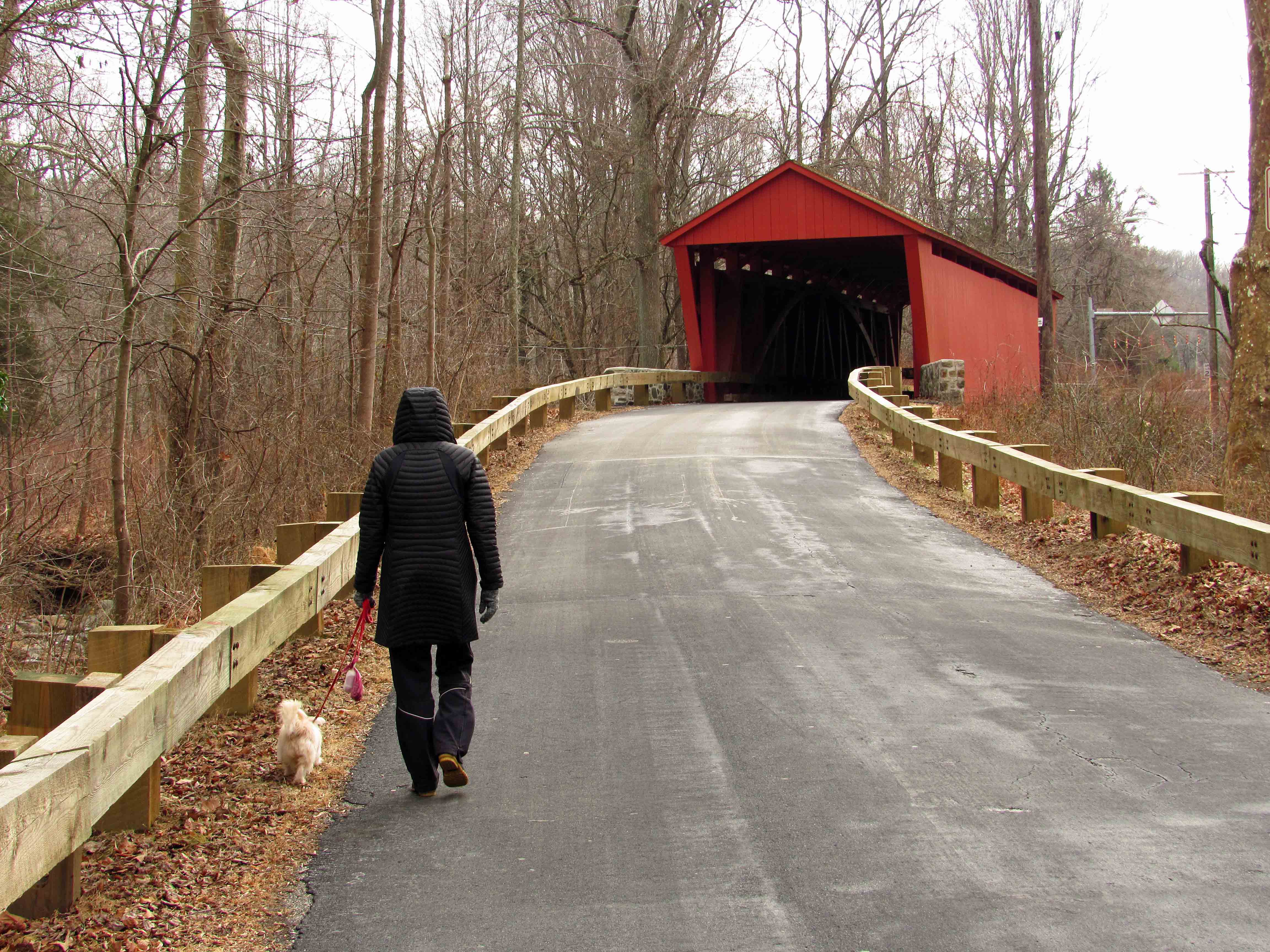
From there onto the Jericho Covered Bridge.

Interior of bridge.

Since this was a short walk, we decided to follow the road for a bit instead of taking the other trail back. Here is a roadside attraction.

Overlooking the stream. 

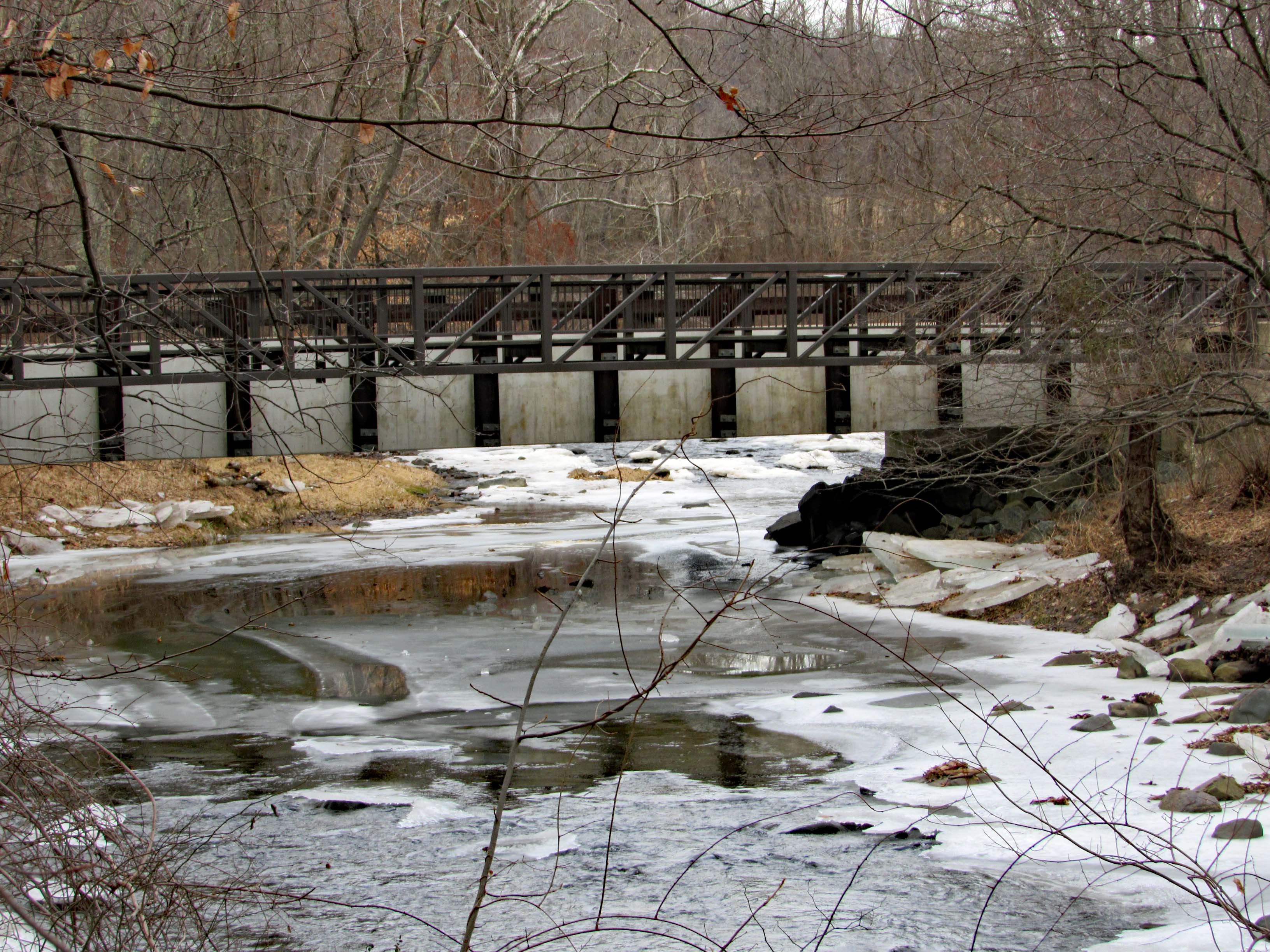
A nice ice floe with some blue ice.

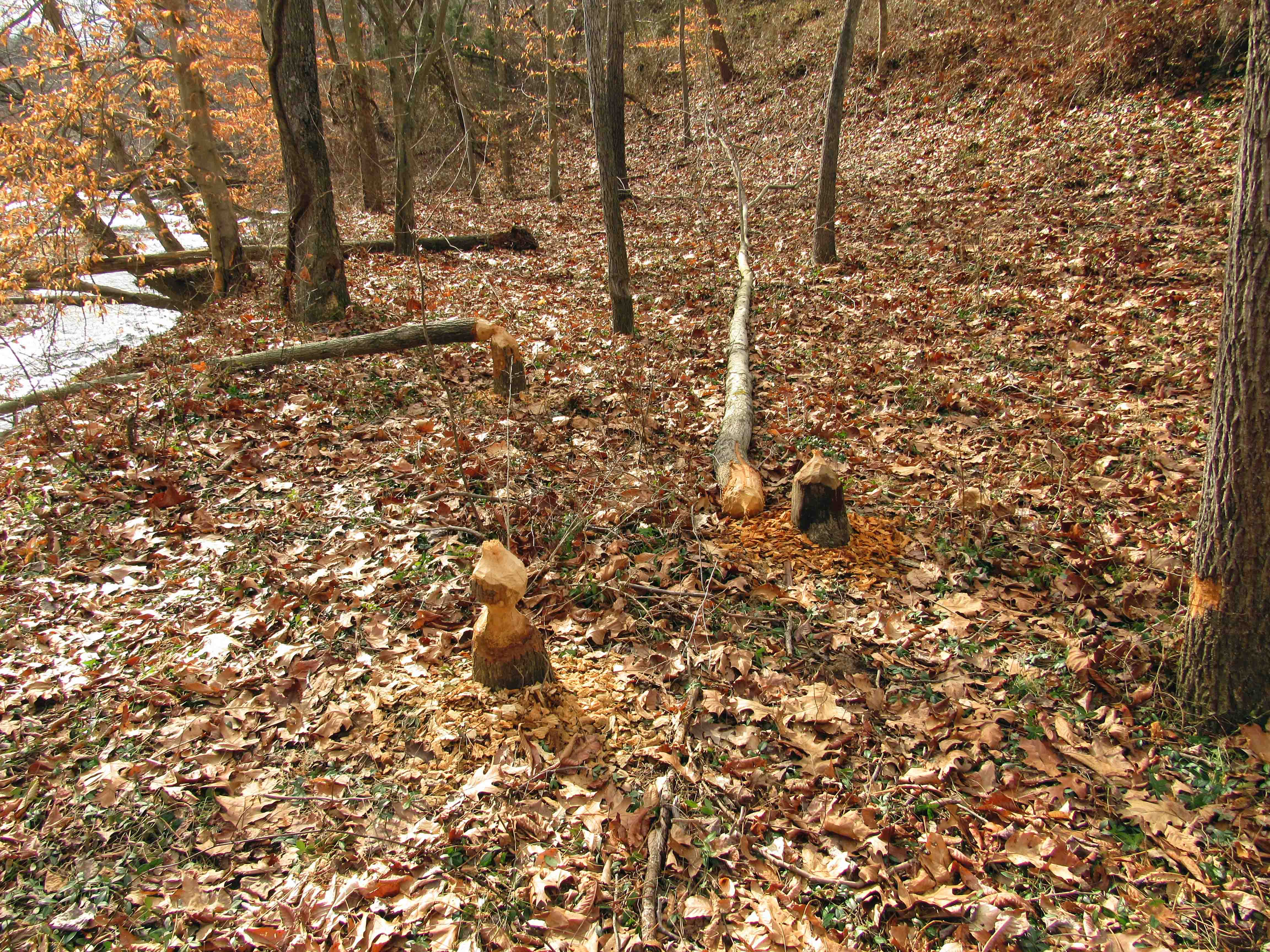
Beavers getting their fill. First time I have seen a double gnawing on a tree?

Another view of the ice floe.

A small stream feeding into the Falls.

And what do we have here?

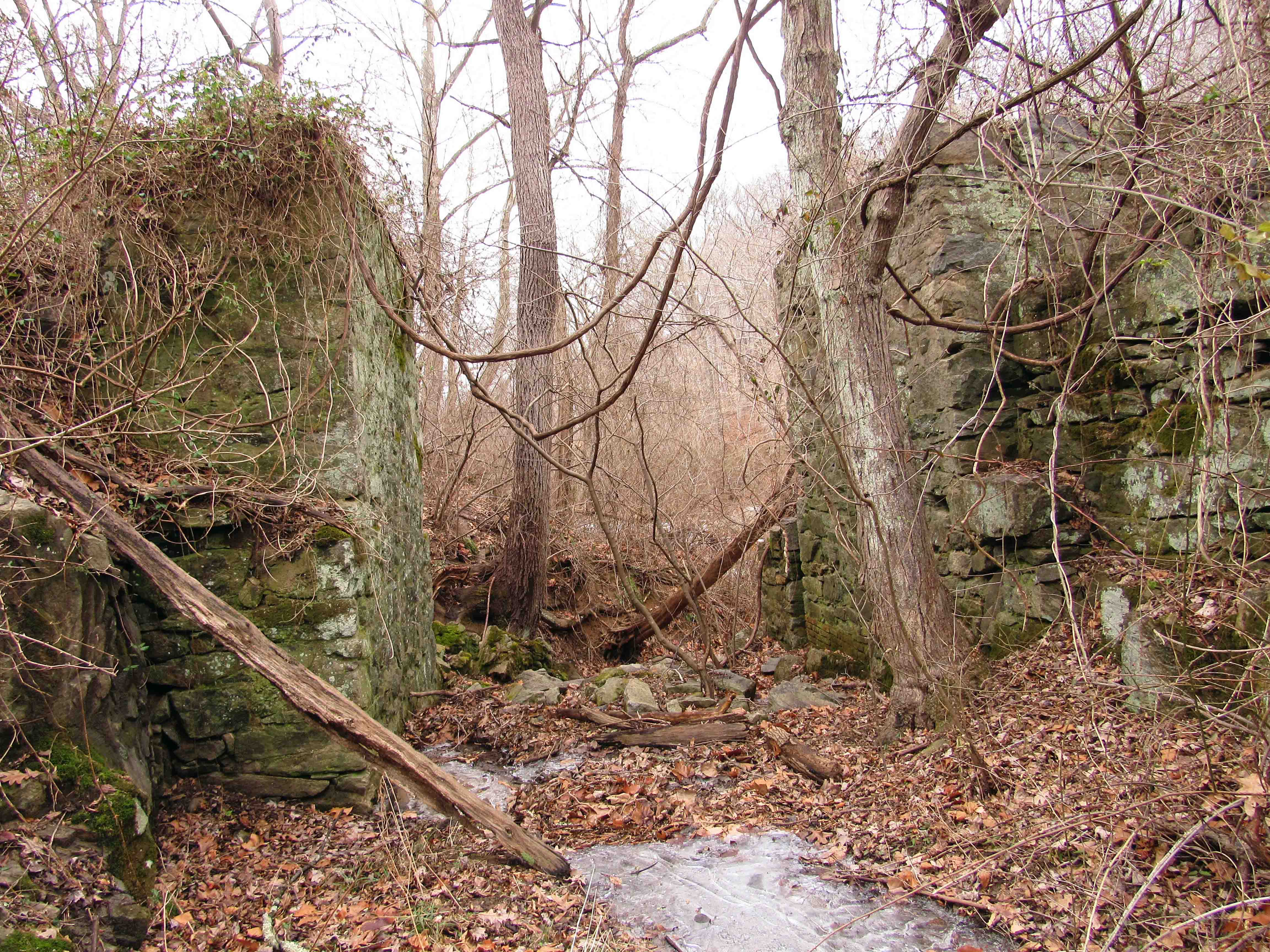
An old mill race. Kathy could see that I was excited to see this, so she prodded me on for us to go down there and take a look. 

So we did. Molly wasn’t too enthused about this. Ice hanging off the rocks.

The mill race valve structure (More later on the mill)

Molly was pretty much done with walking on the ice, so I picked her up and still managed to get some photos while Kathy was taking my pic.

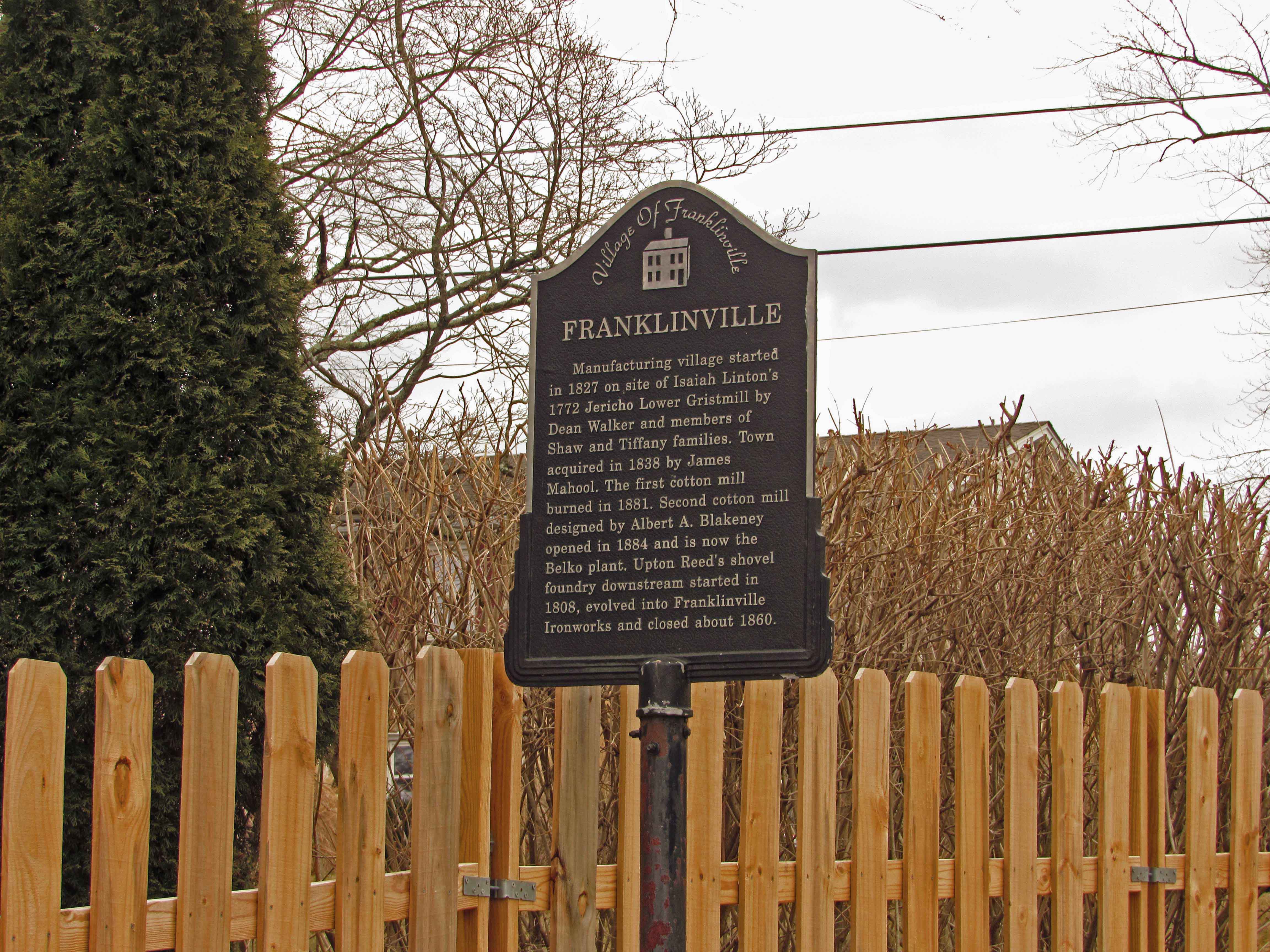
Out of the mill and headed farther south. Sign about the town of Franklinville.

Nice place to be.

Passing thru Franklinville and onto the old iron bridge.

From the bridge. Looking north.

Then looking south. Kathy took a great photo of this. Hoping she shares soon!

Time to head back. Saw this guy on the way.

A leaf left its mark in the asphalt, with the help of a lot of salt.

This is a long narrow road. Most drivers were very cautious approaching us. Nice fence.

The covered bridge from the west side.

Molly back on the ice, floating around.

If you are still long enough, you can hear the ice crack.

How much longer can this tree hold on?

Jerusalem Mill road. Bridge over stream.

Later I will write about the history portion of our hike. Some interesting stuff!!


One Thing Leads to Another

12 Friday Jan 2018

Posted by Ronald Parks in Baltimore, HISTORY, Sewage History

≈ 4 Comments

Tags

Baltimore, engineering, glass plate negatives, HISTORY, Jones Falls, Public Works, Research, Sewage History

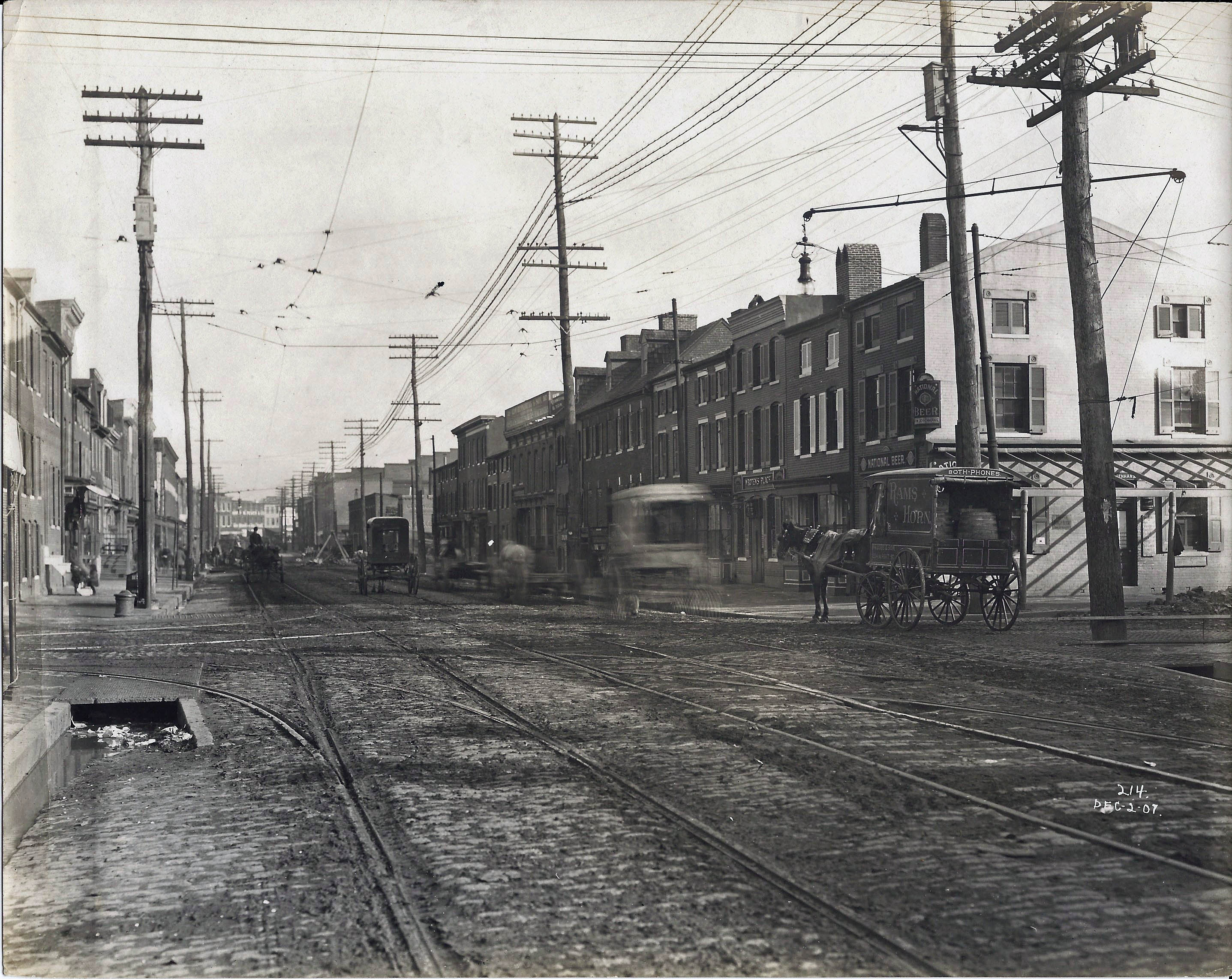
Sometimes the requests I receive for historical information have nothing to do with Water and Sewage. A friend from the Pratt Library and then one from the Baltimore City Archives both sent me request for information on a 1990 article in the Maryland Historical Society Magazine. The article concerned rye whiskey made in Maryland. Accompanying the article was this photograph.

The caption underneath states:  “At Wolfe and Aliceanna streets, about 1910 (Actual 1907), a Phillip Lobe Co. vehicle speeds barrels of Ram’s Horn whiskey to saloons. Photograph courtesy Baltimore Public Works Museum.” The person seeking the information wrote me this: I am a relative of Phillip Lobe and am writing an article about his business for a national bottle collector’s magazine. I would love to use this photo in my article as well as getting a nice, clean version of the photo if possible.
Could you help me with that pursuit?
Sincerely,
Susan Adler Davis
Since the photo came from the DPW Museum, of which I have been documenting, I was able to find a much clearer photograph. On the side of the wagon to the right, Rams Horn, it has written; Lobe and Son W. Pratt Street. The caption in my notes states: SWC 2. Wolf and Aliceanna Sts. showing gutter plates and openings.

While searching for the above, I came across some other photographs that I forgot about. And this is how my mind wanders, from one thing to another!

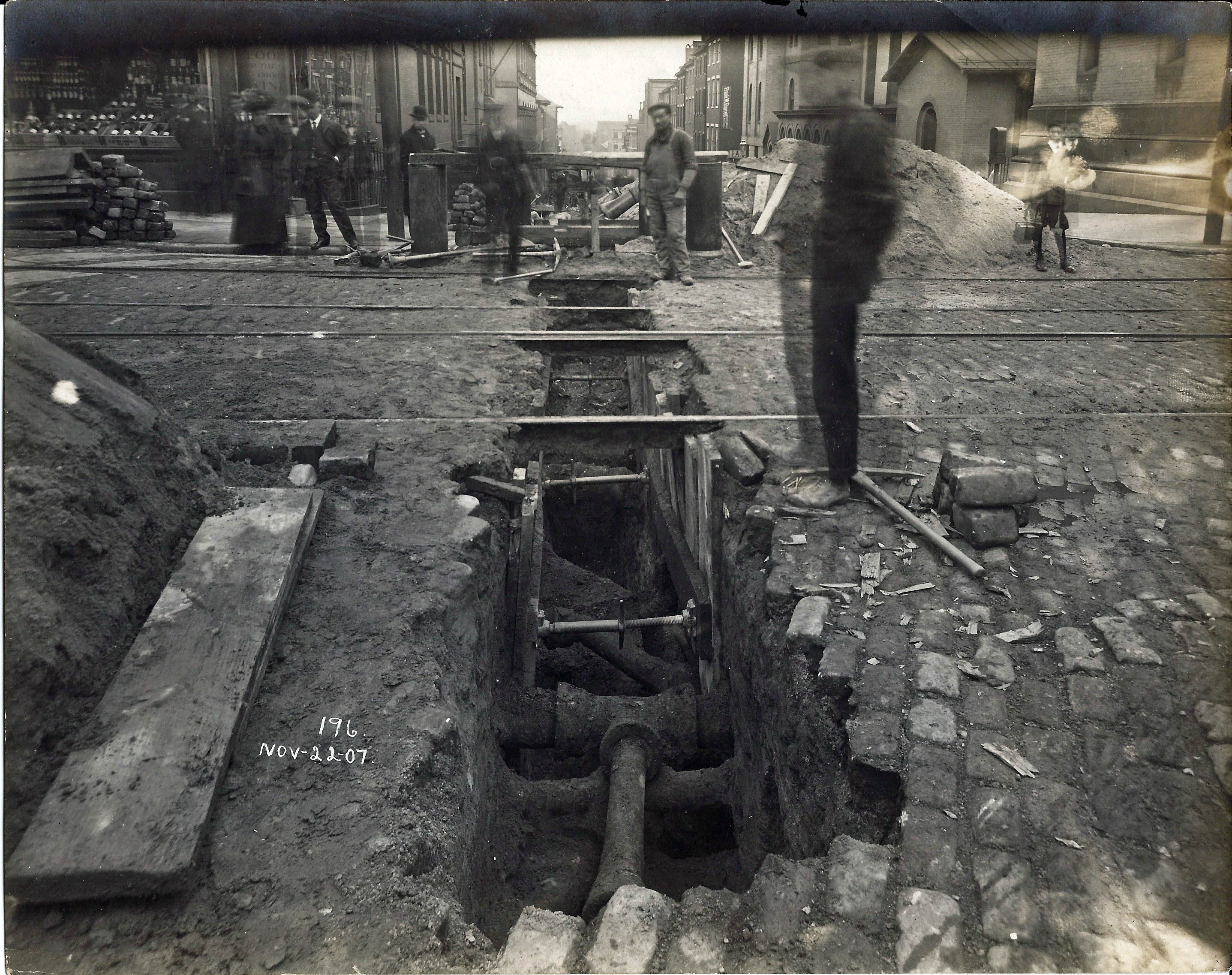
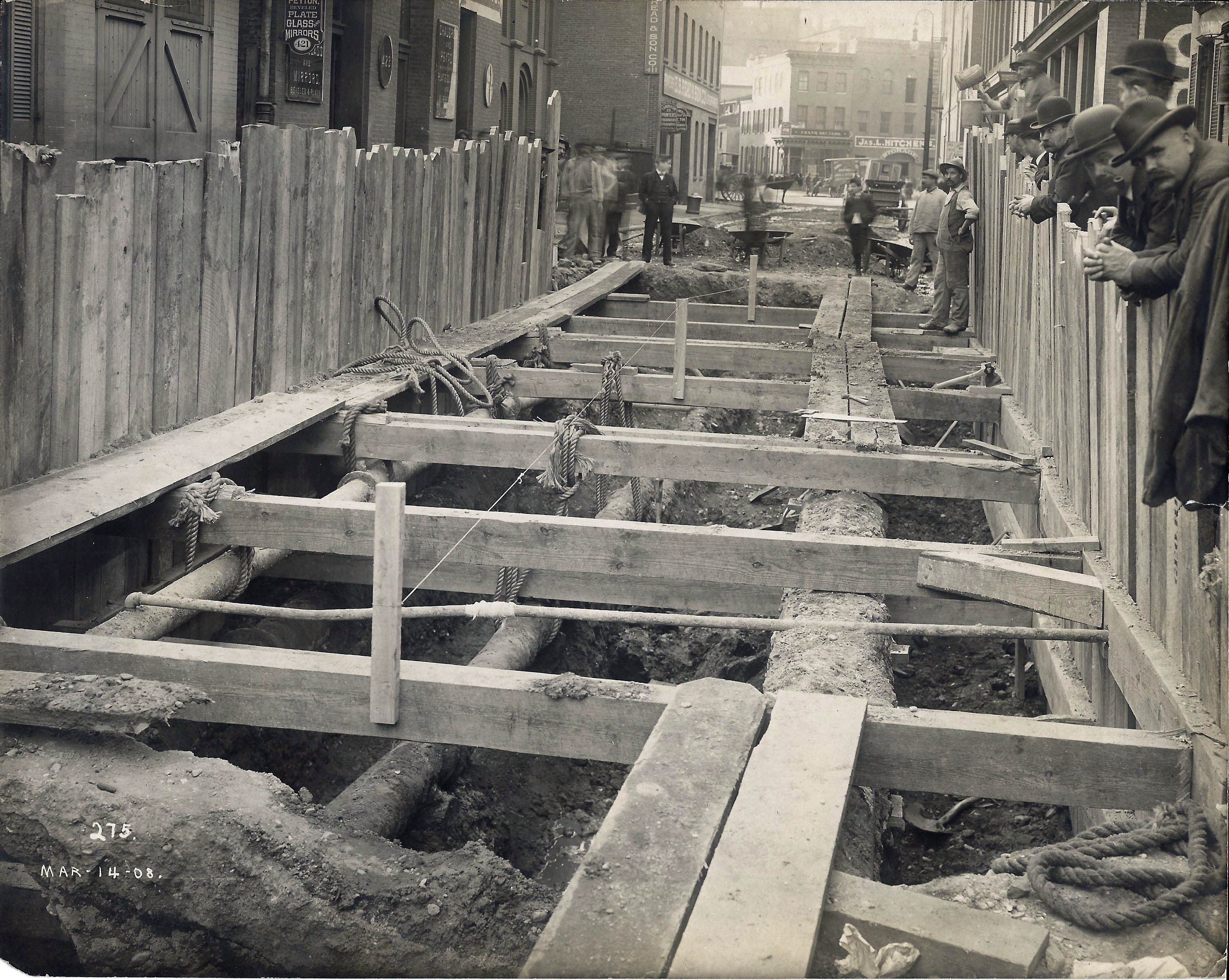
From the same time period, you can see the obstacles that the water department faced in the installation of mains and drains. Caption in notes for the above: SWC 3. Charles and Saratoga Sts. Obstructions in trench. (Storm Water Contract #3)

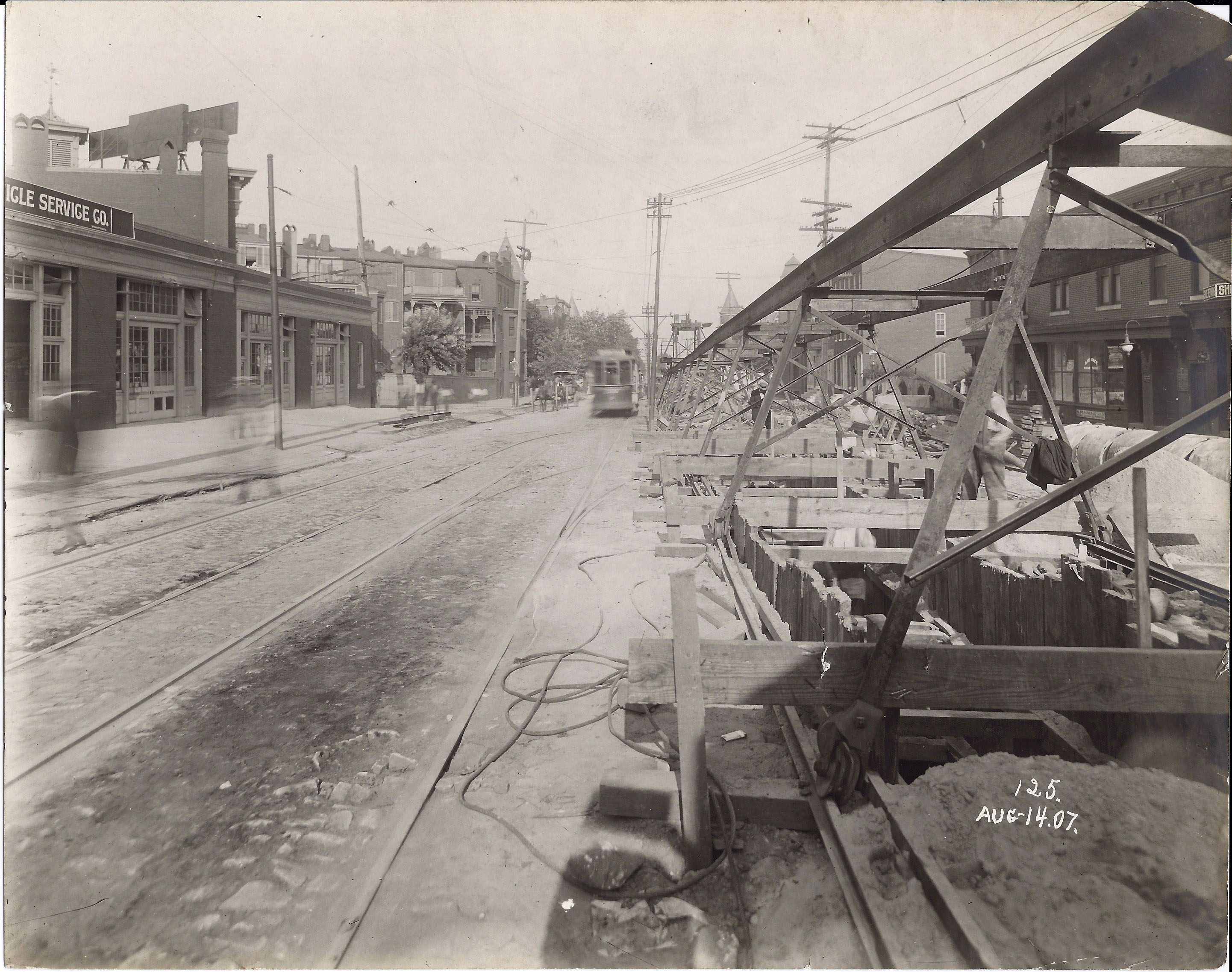
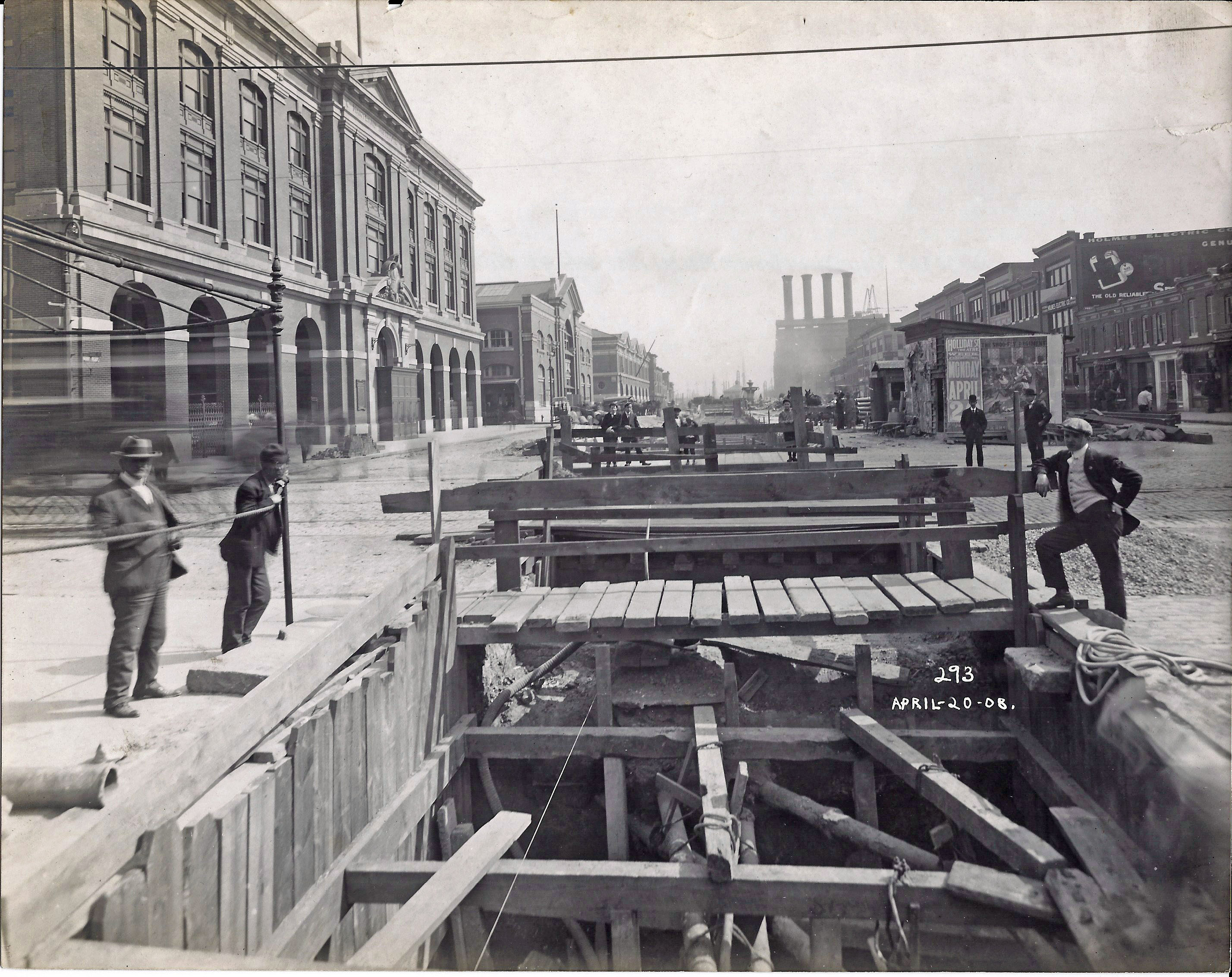
Another concern while installing mains was trolleys zipping by: SWC 1. Showing excavation at North and Madison Aves. 

Of course there was always a crowd watching: SWC 3. Saratoga St above Gay showing obstructing pipes and conduit.

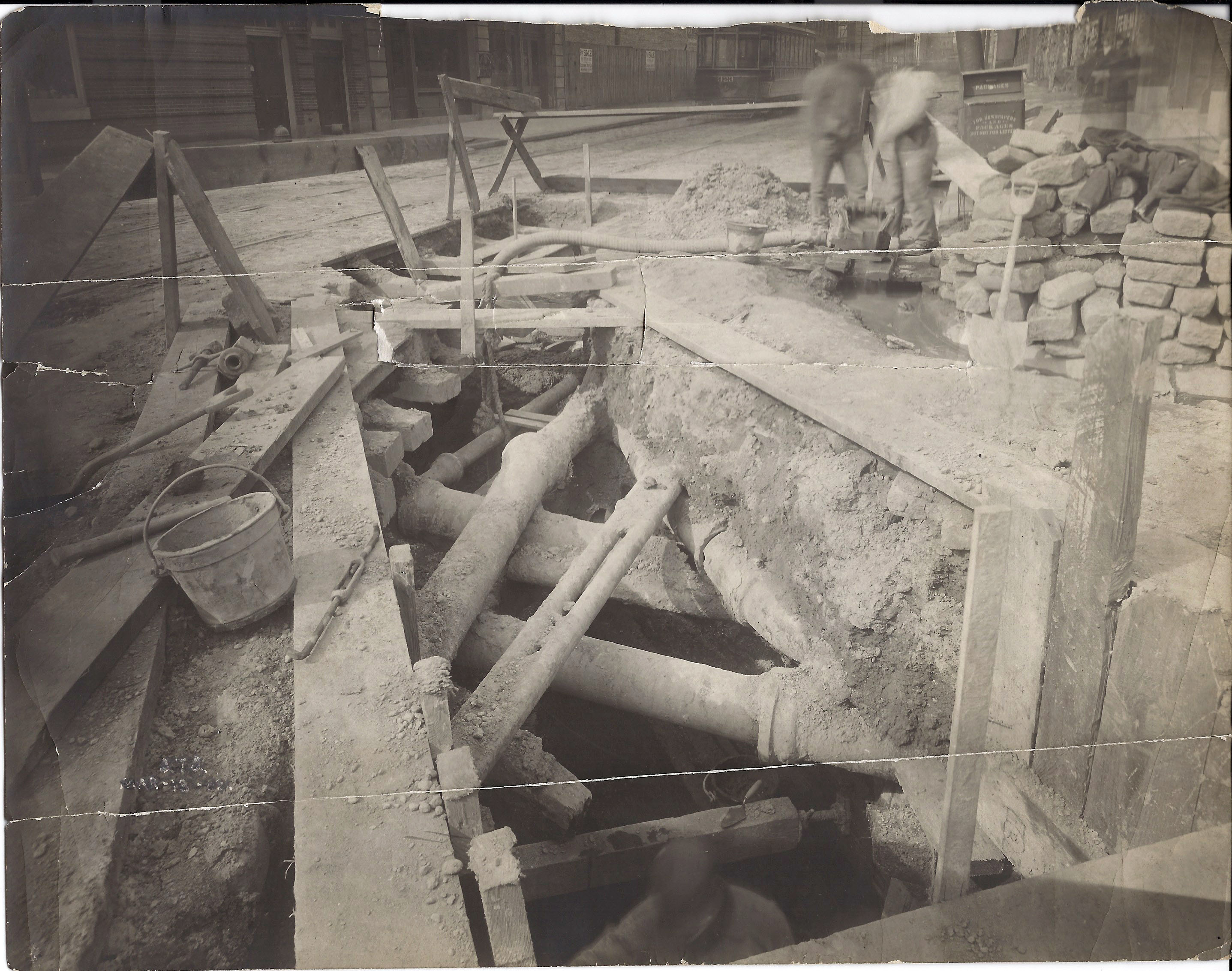
More pipes: SWC 2. South St at Pratt showing nest of pipes encountered in SW trench.

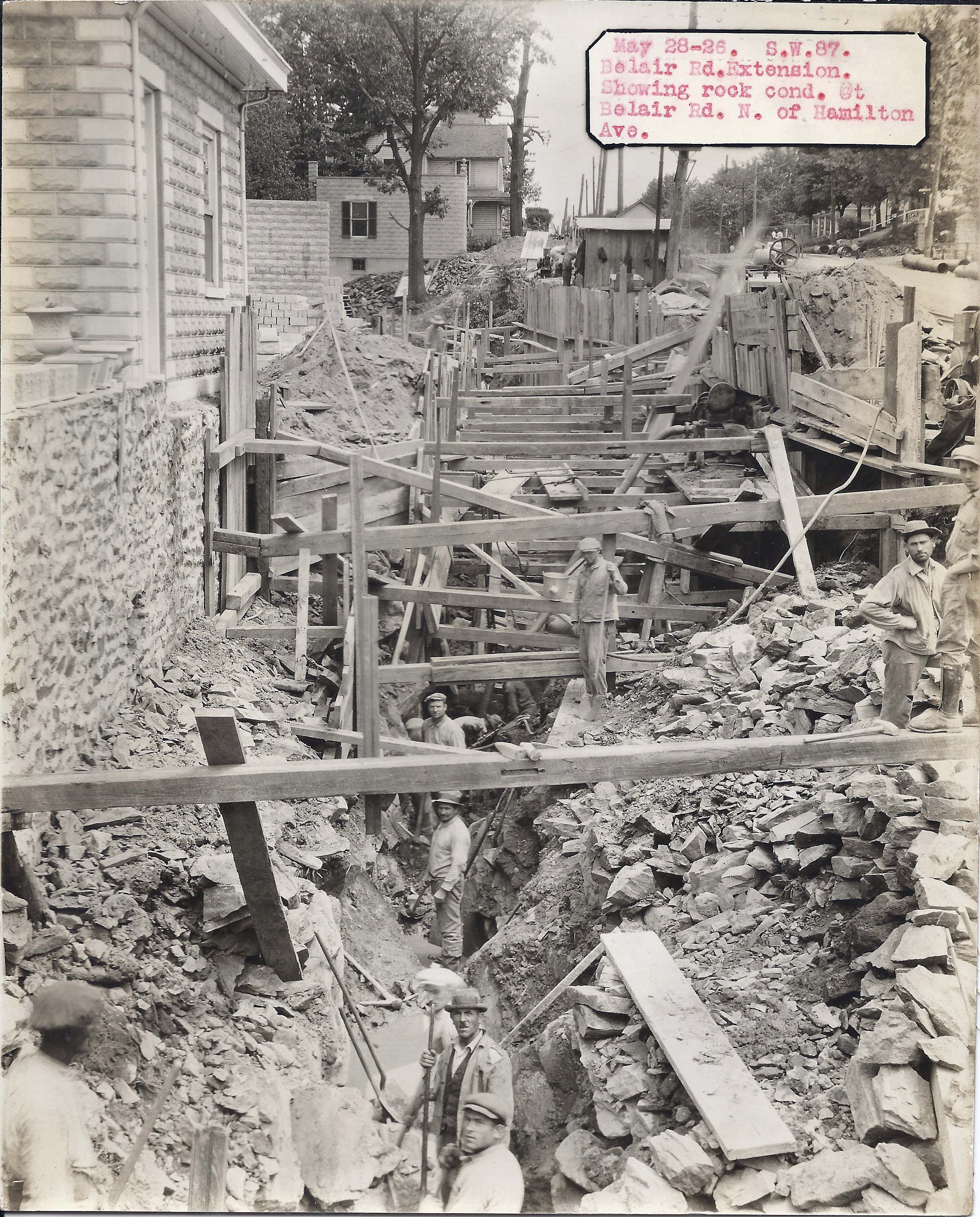
There was always the possibility of adjacent homes crashing down on the workers: SW87. Belair Rd extension, N of Hamilton, showing rock condition.

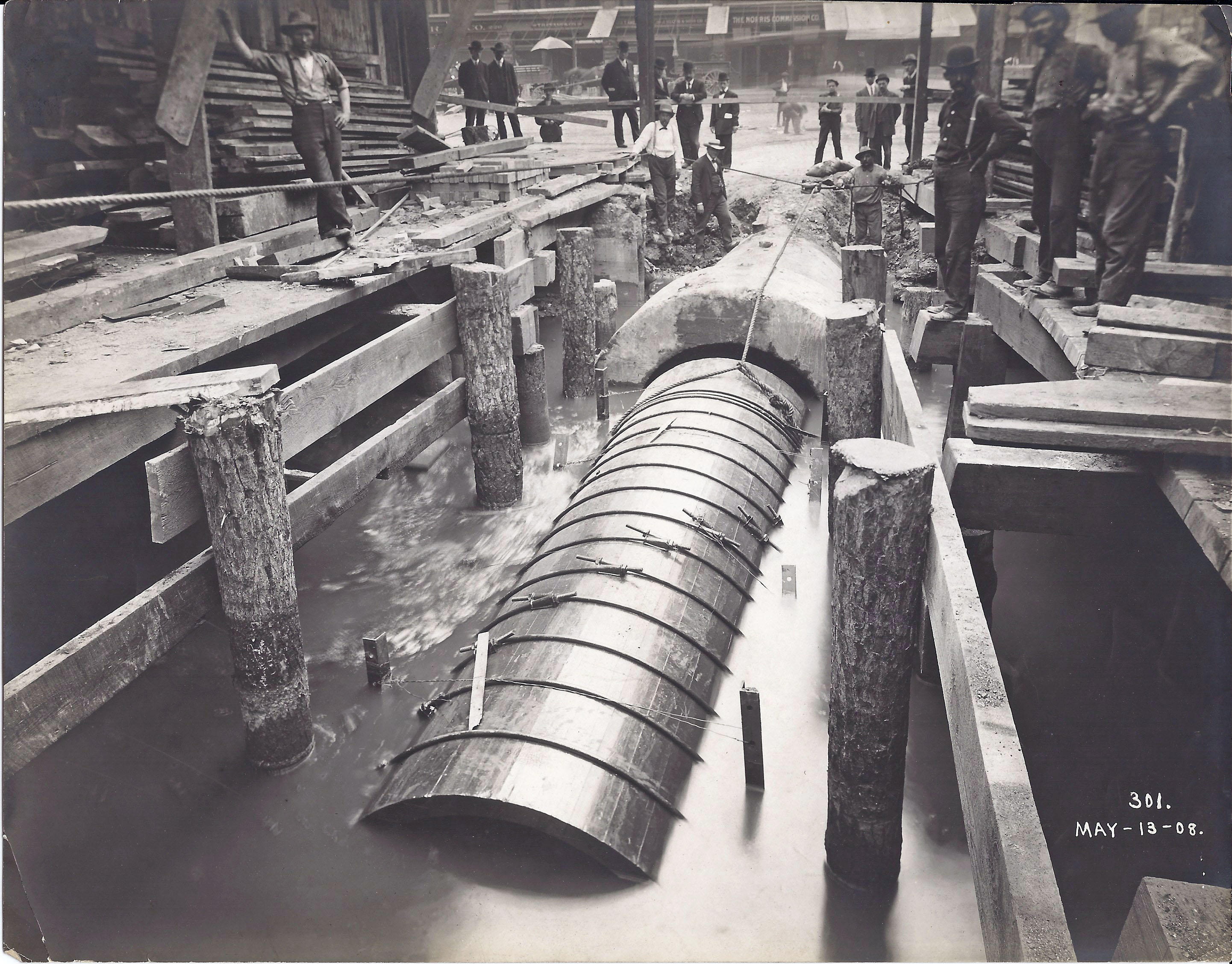
And you also had the placing of wood pipe connections to concrete ones: SWC 2. 62” wooden stave pipe at outlet of Light St drain. (Other marking: Showing barrel construction of outlet).

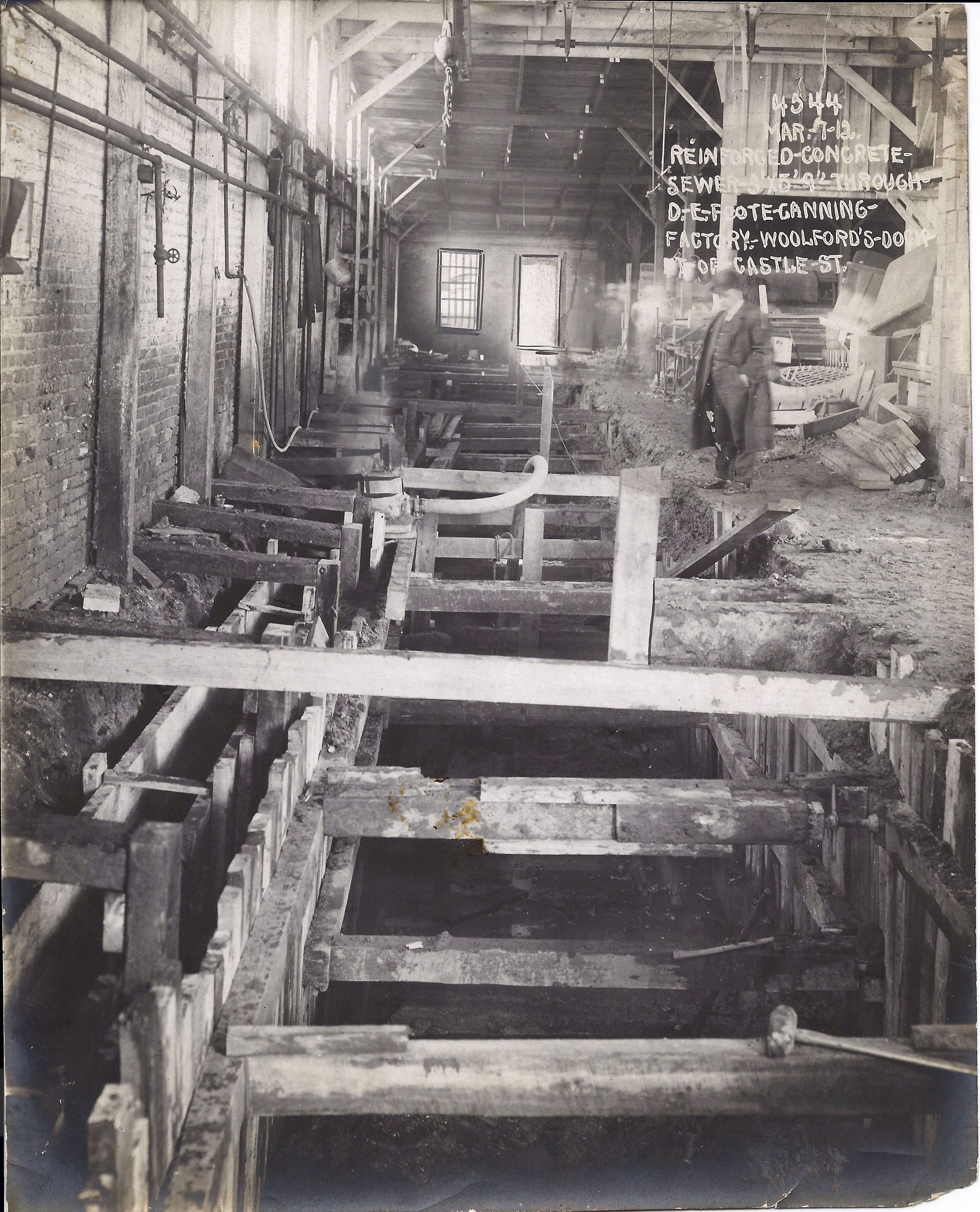
But one of the bigger problems was when you had to go through someone’s house or business: Reinforced concrete sewers through D.E. Foote Canning Factory, Woolford’s Dock, foot of Castle St.

More pipes to work around: SWC 3. Double 50”x69” storm water drain in Market Place at Baltimore, looking towards outlet.

So my mind wanders more times than not, but it is always fun and a pleasure to research these sort of things! I look forward to reading Ms Davis’ article.

Ice

07 Sunday Jan 2018

Posted by Ronald Parks in National Parks, nature, Photography

≈ Leave a comment

Tags

boats, Chesapeake Bay, fishing, nature, photography

Trip this weekend to Salisbury. Nice ice.

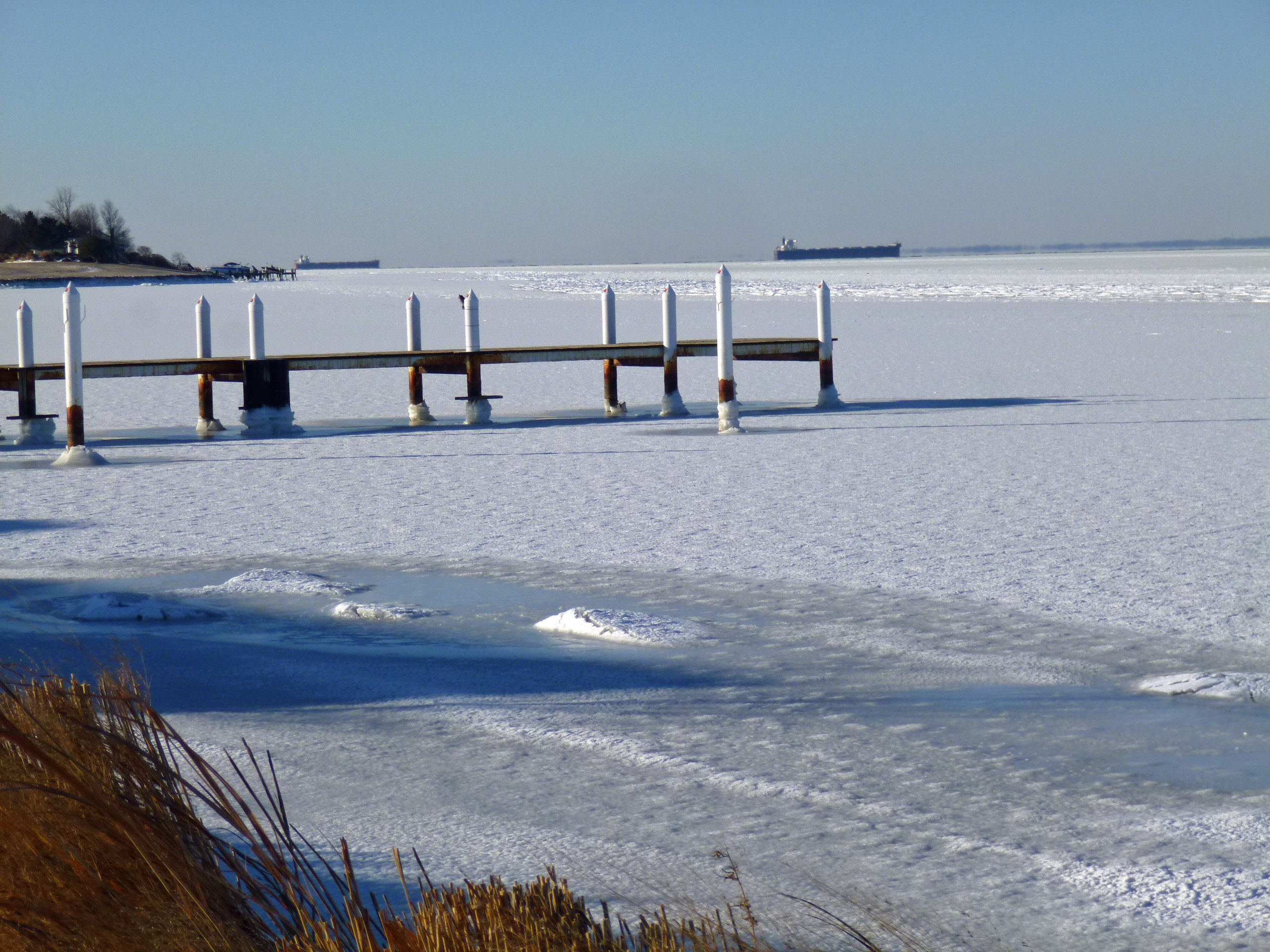
Crossed the Bay Bridge heading east and Kathy says that we should stop on the shore and take a photo of the bridge. Go to Hemingway’s parking lot, I get out and say “Aren’t you coming?” No, too cold! And it was very cold with the breeze coming off of the icy bay.

Looking towards the container ships.

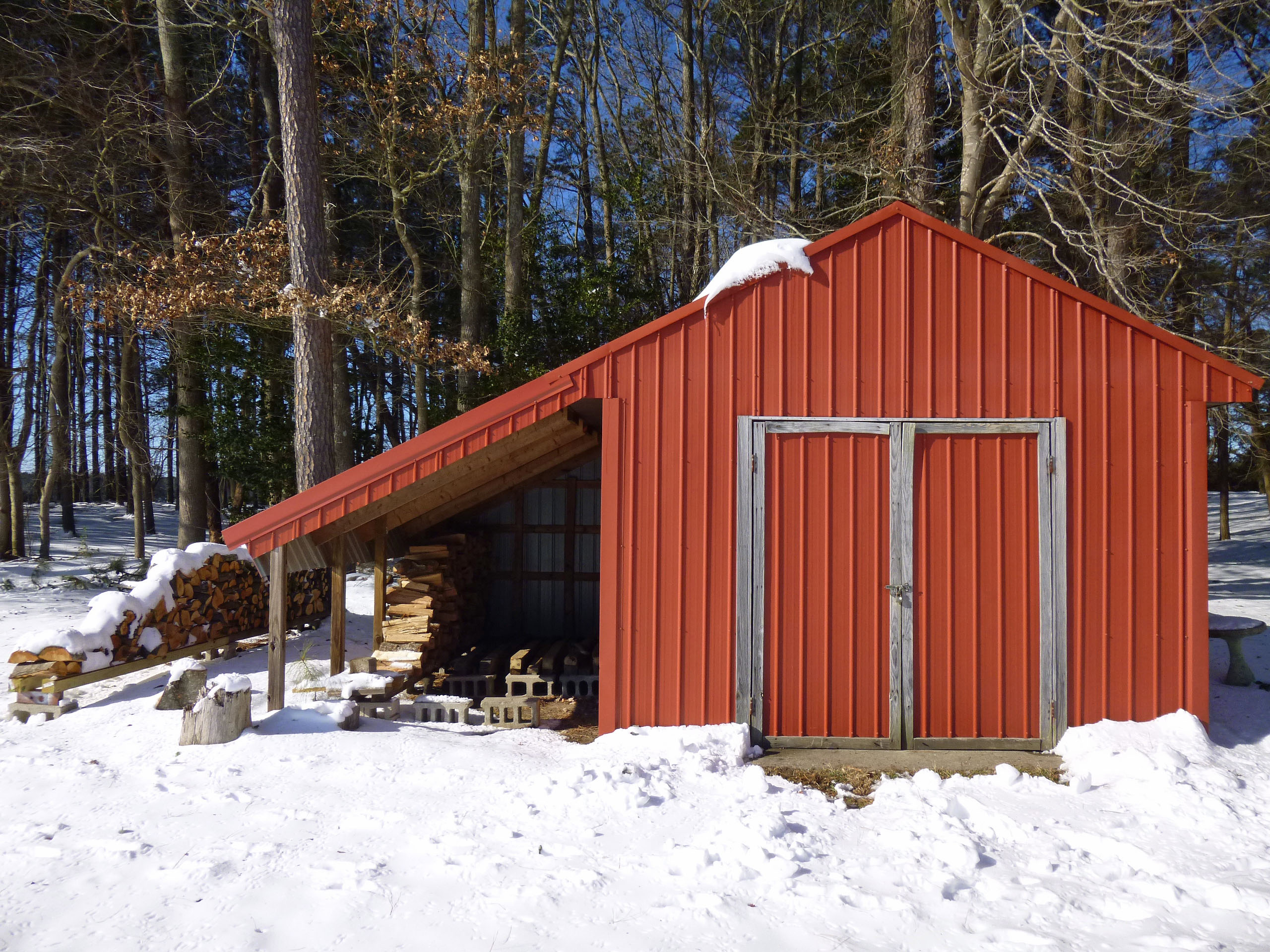
Most roads were pretty clear. A couple drifts on 50 between Easton and Cambridge. Then we made it. The Chokey or the woodshed?

The footbridge over the frozen pond.

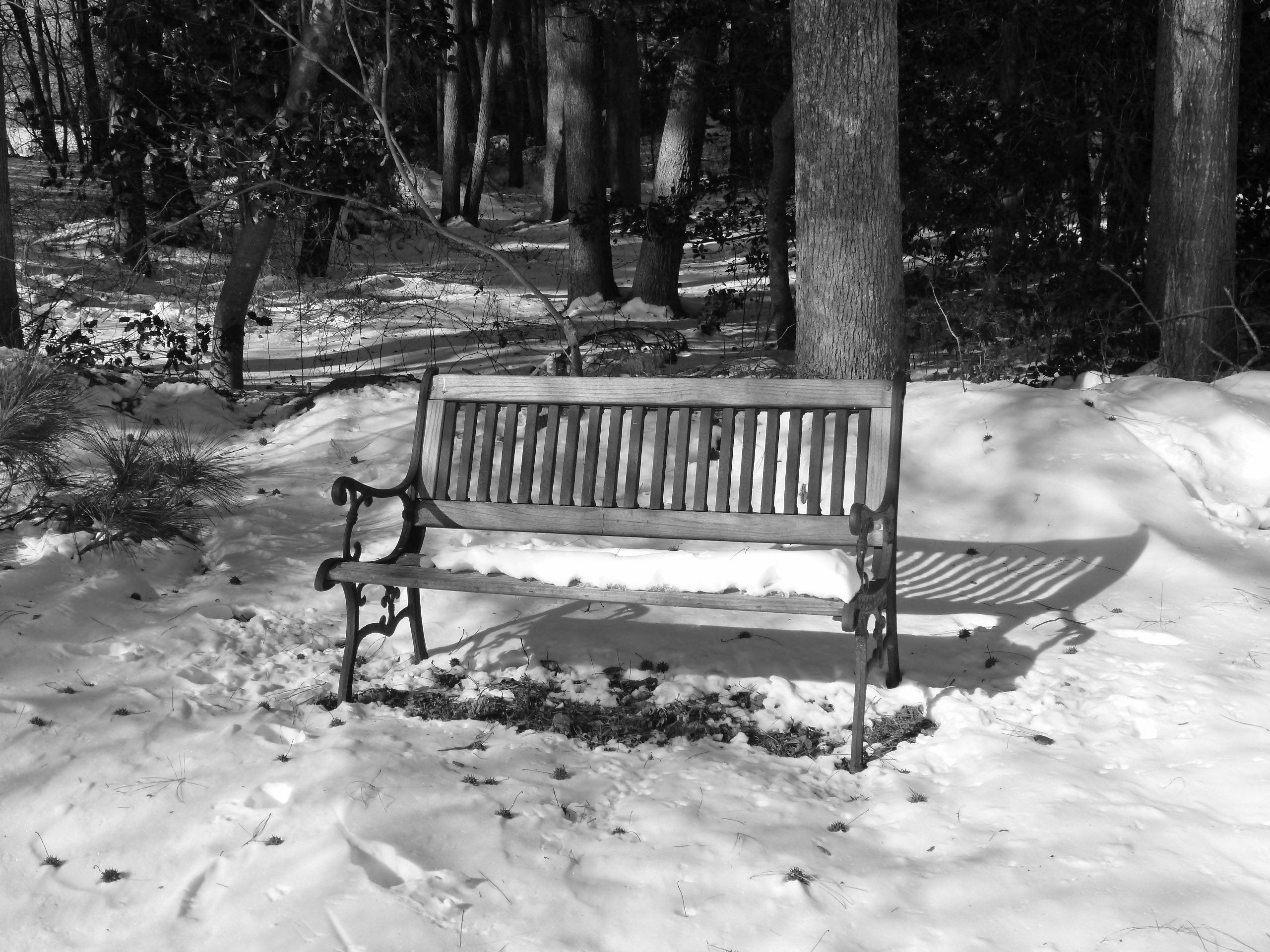
A favorite meditation bench.

Molly only lasted out here, in her new coat, for just a couple minutes.

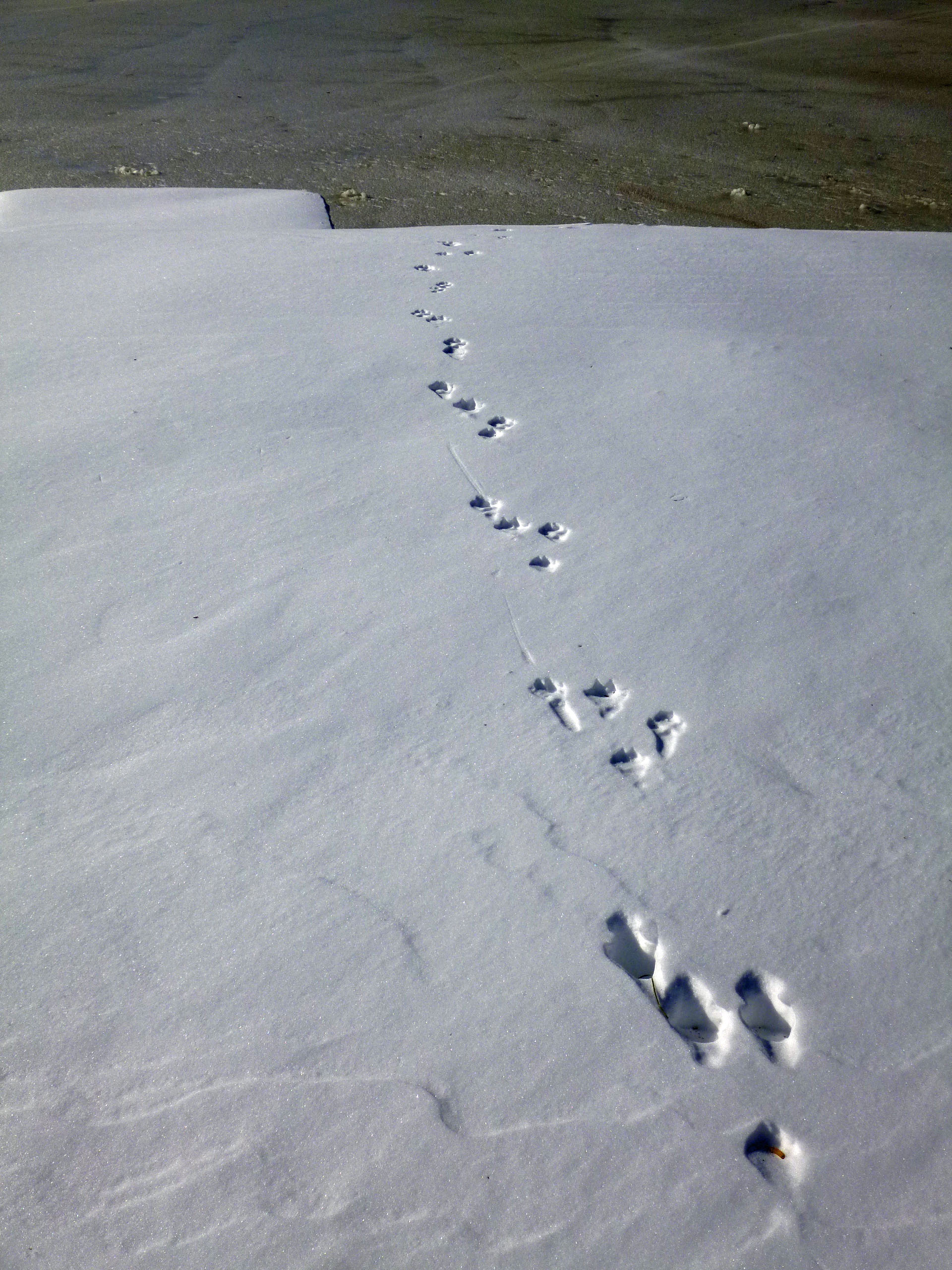
Unknown footprints into the pond.

On the way home we drove towards Blackwater Refuge. I say drove towards because we got kind of lost. We did end up at a part of the refuge we had never been to. The roads here were pretty clear also.


Black water – black sand…

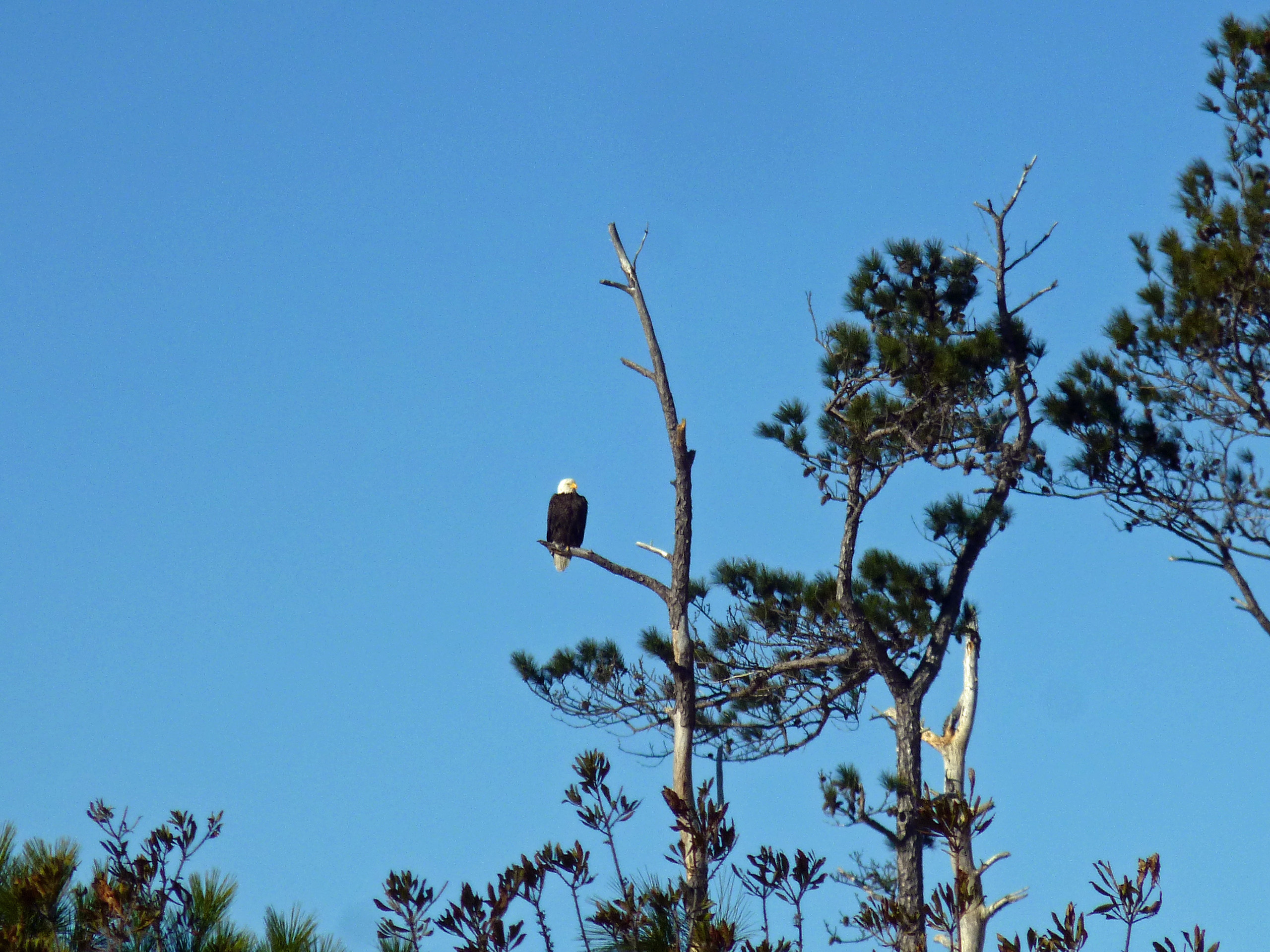
We saw a few eagles and a couple herons.

And instead of turning towards the park, where the visitor center is, we ended up at Hearns Cove and Wingate Creek.

Boats frozen in place.

Dock in B/W

Nice little post office and name.


← Older posts
Newer posts →

Blogroll

  • Flouride Action Network
  • lulu
  • My Book
  • WordPress.com
  • WordPress.org

Recent Posts

  • Bermuda 2023
  • ICELAND April 2023
  • George Chalmers of Fochabers
  • In Search of The Skipjack Ada Mae
  • Trap Pond Kayak

Blog at WordPress.com.

  • Subscribe Subscribed
    • Water and Me
    • Join 231 other subscribers
    • Already have a WordPress.com account? Log in now.
    • Water and Me
    • Subscribe Subscribed
    • Sign up
    • Log in
    • Report this content
    • View site in Reader
    • Manage subscriptions
    • Collapse this bar
 

Loading Comments...